name="description" content="Terroir-expressing natural wine minimum intervention">

Tuesday, 26 April 2011

A Month in the Life of a (completely abnormal) Natural Winemaker

(Warning: this is a long one!) (and after reading it, you'll see why I haven't posted for a month!)

I was thinking of calling this post somrthing like "Crisis Management", or "I Need a Holiday", or "How Not to Run a Startup Wine Business", or even "Strategic Planning? Never Heard of That!", but in the end I thought I'd just keep it simple and to the point!

I'm really writing this for myself, so I can clarify in my mind what I've done over the last month, what I'm doing now (and why!) and what I have to do in the near future - because I've been running around like crazy doing stuff and I haven't had a single moment to sit down and think!

OK, running in the background is the pruning. We should really have started pruning back in January, but for some reason or another (which I won't bore you with here) we didn't start till March; that's a bit late, but not too late, depending on your climate and latitude (and number of vines you have to prune).

   pending: photo of sprouted unpruned vine  (My photos are in my laptop which has a 'critical hard disk error' so they'll have to wait till I get it fixed)

The optimum pruning window is after the leaves fall off the vines, and the sap retreats back down into the trunk and roots, and the vine goes dormant for the winter, and before the sap starts flowing up again when the temperature rises in the spring. We figured that we could prune the 2 vineyards (2 hectares in total) in 8 man-days, ie 4 days each me and Juan. No problemo! But then 'events' caught up with us.

The first event was the Natural Wine Fair in Barcelona (on 27th March), which of course meant no pruning that weekend, and also another day for the bottling, corking, labelling and shipping the wine.

    Me and my Table at the Natural Wine Fair, Barcelona

The Fair itself was great of course, and apart from everything I wrote about it in a previous post, I also made two really interesting contacts:

1. The first one was a possible investor who's interested in investing in Vinos Ambiz! We've reach the point now when we have to expand and increase our production in order to become a small viable business, as opposed to the part-time setup we've been running for the past 8 years. basically, it all boils down to finance: to buy/rent more vineyards, to rent a larger winery, to invest in some machinery and tanks, and to cover running costs. This is all rather difficult and time-consuming, and we're still looking at different options: a straight loan (bank or cooperative), private investors, or both. Anyway, this is all on the back-burner for the time being, because it's very complex and important, and my brain's not big enough to deal with it right now along with all everything else!

2. The second interesting contact was Ryan Opaz, and a brief chat at the Fair led me to writing a guest post about natural wines on the Catavino website. Ryan is a bit skeptical of natural wines at the moment, but the important and admirable thing is that he's genuinely curious and open-minded and willing to find out about it. It was no bother at all to write that post, as the force was with me, inspiration was flowing, and I dashed it off in about 1 hour! I'm really pleased with it. It was in fact the first 'serious' post I've ever written, ie a post about something other than my usual vineyard and bodega activities that I usually write about on my blog.

...and talking about writing posts, ... about 2 months ago Fiona Beckett (a natural wine blogger from London) asked me to write a post on sulphites for her blog, but I've been struggling horribly with it ever since then - it just won't come out!

Anyway, after Barcelona, back to Madrid and reality, and a bit more pruning during the week, hoping to get stuck in seriously at the weekend. But guess what? Another event! I'd completely forgotten that a few months previously we'd signed up for another Fair - Eco-Festi-Ball - a European Folk Dancing Festival, with organic products on the side. fotos. So another week end gone - no pruning!

Outside shot of the European Folk Dancing Festival
  
Again, the festival was great. Lots of weird and wonderful people from all over Europe came to it, and I discovered a whole new world of European folk dancing. Amazing but true! Actually, I have to confess that that I had no idea that it was a dance festival - I though it was just an organic product farmer's market type thing! In fact, the other producers there (olive oil, bread, fruit and veg, quinoa, etc) were all complaining about the lack of interest and custom, and some didn't even bother turning up on the second day. It was OK for wine though, and I even sold a few cases to the official festival restaurant. Wine and dancing go together well it seems!

The highlight of the day for us was when our table suddenly collapsed, spilling about 60 bottles of wine and 90 wineglasses onto the floor. The crash was so tremendous that the music stopped and there was total silence in the hall for a few seconds. An existential moment! It turned out that only 3 bottles broke, though to compensate, all except 3 glasses broke!

     Collapsed Table

For the second day of the festival, Juan and I split forces - he did the festival while I welcomed a 'Grupo de Consumo' (a group of people who get together to buy organic products directly from the producers). They were from Galapagar, a town near Madrid, and they came en masse to visit the vineyard, to see the bodega and to get to know their winemaker. So in the morning, I put them to work in the vineyard (pre-pruning) and answered all their questions about organic grape-growing; then we went to the bodega for lunch, wine-tasting and answering more question about organic/natural winemaking.

Galapagar 'Grupo de Consumo' in the vineyard

Galapagar 'Grupo de Consumo' in the Winery
A few days later my 'partner' (in love, not in business!) got appendicitis all of a sudden and had to have an emergency operation, and is in fact still in hospital as I write (she's recovering well, and is bored and complaining about her diet of consomé!)

Next, there was an unexpected invitation to a winemakers' dinner - 3 organic winemakers came up to Madrid from Andalucía, so there was no way I could refuse to go to that, was there? They were: Barranco Oscuro (Lorenzo), Cauzón (Ramón), Marenas (Jose Miguel), and Almate (Alfredo) from Valladolid and a wine distributor (Luisa of Vinosautenticos). And the next evening, I went to their presentation and tasting at the Viñeta de Montecarmelo, for some post-winetasting beers that night.

    insert photos dinner and tasting

Then what? (yes, there’s more!) Next, my importer from the USA (JosePastorSelections) called up and confirmed that he wants a mixed pallet of wine, but that he needs it fast, so that he can have the wines for his annual presentation in May.

So, ...

- Do I have enough bottles? Luckily, yes! Not only had we ordered a pallet of new bottles a few months ago, but I've also accumulated over 1000 used bottles that my local customers return to me.

- Do I have corks? No! urgent calls and emails to my supplier (Salmantina de Corchos) begging him to please send them fast. (They arrived last Thursday).

- Do I have labels? No! Urgent calls and emails to my designer/printer (Hola Por Que), but she's on holiday, so we're meeting this week.

- Do I have AVIN numbers and those QY code thingies for the back-labels? No! Urgent email to André Ribeirihno (of Adegga) - he works really fast and he's created them and sent them to me already, so all I need to do is cut 'n' paste them onto the back-labels.

- Do have boxes? No! urgent emails to my supplier (Cartonajes Hurtado) who say they'll send them asap next week sometime

- Do I have a special, plastic, homologated, US Customs approved pallet? Amazingly, yes! We picked one up last year by chance from a neighbouring winery who didn't need it. Lucky we did, otherwise it would have been really difficult and time-consuming to get hold of one.

So that's what I'm doing now and what I'll be doing over the next week or so: bottling, corking, labelling, boxing and building the pallet.

But, that's still not all! Last Saturday I was asked to do an interview on video for a slow-food, slow-life (slow-viticulture) campaign, and which I also couldn't refuse to do! I had no time to prepare anything so I just turned up not knowing what to expect. It was really interesting. A couple were spending 40 days in a bed, a bit like John Lennon and Yoko Ono, and every day they invite someone to come and chat to them on their bed. They invite all sorts of people, from different walks of life, but somehow relayed to the concept of "slow". You can see my session on slow viticulture and slow wine here. (Ah, it's in Spanish only)

And I think that's about it. All of the above is of course in addition to the usual daily routine of taking the kids to school, and holding down a day-job as a translator!

Oh, I almost forgot: a few weeks ago yet another wine blogger (Chris Penwarden aka @Singapoured) from Singapour interviewed me by email for a post he wanted to do for Earth Day. It was no bother at all to do as I did it all by email in my 'spare time'! Here's the link to his post.

Maybe one day, if I can find the time, after I've sent off the pallet of wine to the States, and after I've written Fiona's post, I'll have a quick nervous breakdown or just go catatonic for a while - but only until the next task or event, which is no doubt approaching fast even as I write! :)

Post post-writing thought: writing this post really has helped me to put things into perspective! Basically, what's happened is that without realizing it I've done a lot of promotion and sales related activities, and almost no vineyard and bodega activities. We've always based Vinos Ambiz on three (3) equally important pillars: growing quality grapes, making quality wine and promoting and selling those wines. The last pillar is often overlooked or under-valued by many bodegas, but to me it's very important - because there's no point filling up a bodega or a warehouse with wine, is there? So, I reckon that enough promotion activities for a while. It's time to get back into the vineyard and slow down!


Final horrifying thought: I've just realized that I haven't even seen our new vineyard in Villarejo this year, let alone gone to prune it! In the end Juan pruned it all himself!

Tuesday, 29 March 2011

Natural Wine Fair, Barcelona 2011

On Sunday 27th March I was in the Convent de Sant Agustí, as one of the 20-odd producers of natural wines, that had come from mainly Catalonia and France, but also a few from other parts of Spain (including me) and Italy (one).

The Natural Wine Fair

What to say? Was it a success? Did a lot of people turn up? Was it useful to me? Did I make a lot of contacts? Did I have a good time? Did I have sore feet? Did I pour a lot of wine? Did I sell a lot of wine? Was the dinner good? Did I take a lot of photos and videos?

Sticking on my labels

Well, the answer “yes” to all of the above except for ‘Did I sell a lot of wine?’!!! (only about 20 bottles more or less!) and ‘Did I take a lot of photos and videos? (not as many as I would have liked!)

No people yet

I’d say it was a huge success and that hundreds and hundreds of people came. I don’t have exact data from Benoît Vallée, the organizer (L’Anima del Vi), but my own personal anecdotal evidence suggests that it’s true. Right from the moment that people started arriving (at 10:30 – 11:00) I wasn’t able to sit down once or leave my table until about 9:00 in the evening.

Ready for action

I did manage to get to the bathroom once at 5:00, but my neighbouring winemaker (Alfredo Maestro) wasn’t so lucky – he told me he had to wait till 9:00 before being able to take a leak! More anecdotal evidence of the event’s success: sore feet from standing up for 12 hours straight, pouring wine and sore throat from chatting.

Getting busier

There was of course no way for us to go for lunch. But Benoît had a perfect solution: apart from the 20-odd winemakers, there was also a tapas/raciones table run by Bar Cortijo, and they brought us food at regular intervals throughout the day. My major sale of the day was in fact to them – they bought a case of my ‘Orange Airén’ as they thought that it paired perfectly with their sushi dishes. (Forgot to take photos of that!).

3 Airéns - same vineyard, same grapes, same day harvest
Left: Orange (skin contact); Centre: Normal; Right: Carbonic Maceration

Was it useful to me? I don’t know! The usefulness certainly wasn’t reflected in sales of bottles! Maybe future sales? Who knows? I think I promoted and advertised my wines a lot. I gave away about 100 fliers and about 50 business cards. And I only gave them to people who specifically asked for them – I didn’t offer them first.

Reds: Petit Verdot, Sirah, Tempranillo, Garnacha

It was really interesting that such a wide variety of people came. Some were seasoned wine-drinkers who knew their stuff, and asked lots of really difficult and interesting questions. Others were newbies to the wine-world and must have come to the fair to see, taste and learn.

Iconic T-shirt "I don't contain (added) sulphites"

In theory, the event was supposed to end at 5 or 6 in the evening, but at 8:00 it was still packed with people. In the end it was the sunset that drove them out; there were no lights in the cloister of the (ex)convent so it was only possible to see using torches and lighters.

Thanks to more brilliant planning by Benoît, the restaurant where we were to have dinner was just across the street so we didn’t have worry about transport. Just walk out of the convent, cross the road and go into the restaurant.

The Winemakers Dinner

The first ones of us to arrive sat down outside at the pavement tables and immediately ordered beer! It’s not the first time that this has happened. I think that after 12 hrs of tasting wine, and in anticipation of even more wine over dinner, one just has to ‘recalibrate one’s palate’ with a glass of beer or two!

Winemakers drinking beer

Luckily (for the other customers at the restaurant) we were in a separate room! I have to say that we were extremely loud and boisterous, and the staff seemed to be a bit wary if not actually worried about us! Firstly, we all arrived carrying bottles (and cases) of our own wines, which we put on the table and chairs and floor, and unceremoniously opened ourselves before even sitting down. It was like we’d been released from prison! I think each one of us was desperate to taste each others’ wines, because we’d been within sight of each other all day, but unable to leave our tables even for a few minutes.

At table

When we were eventually herded inside, no-one was the least bit interested in the food, and the waiters were unable to get us to order. (I didn’t even get to see a menu, let alone order something specific). In the end, Benoît ordered 30 entrecotes + potatoes as the main course, and 30 assorted starters, to be shared and passed around.

Then things started to liven up a bit! First there was a short speech from Laureano Serres, winemaker and president of the PVN (Natural Winemaker Association), in Catalán, and understood by maybe 5 or 6 of those present, but he received a huge round of applause and unanimous approval of whatever it was he said!

(Link to dinner speech: http://www.youtube.com/watch?v=hDdtswX9Q9M )

People even started smoking at the table - this is now forbidden due to a new law in Spain passed on 2nd January – but spirits were too high by this point for us to remember. But I'm exagerating - we also went outside to indulge in our dirty habit, to get a breath of fresh air and to do some smirting.

Here are some of the wines:

The most well-known was probably this one, by Thierry Puzelat (who was one of the naughty smokers!):

pending: foto Puzelat "in Cot we Trust"
pending: foto Laureano Serres "Brutal"
pending foto Clos du Tue-Boeuf Touraine Le Buisson Pouilleux
pending fotoEls Bassots - Jordi Escodà
pending fotoVinya SanFeliu
pending fotoMacon Cruzille Manganite
pending foto Dinavolo (Italia)
pending foto Alfredo maestro

Monday, 21 March 2011

More Pruning – Days 3 and 4

I’m still recovering from an intense two days of pruning (last Saturday 19th and Sunday 20th).

Collateral damage

Apart from the blisters on my hands, the following are the muscles in my body are sore today: fingers, thumbs, forearms, elbows, biceps, shoulders, buttocks, thighs, calves and toes!!!! But especially the fingers! I guess that’s what happens when you only do certain movements once a year!

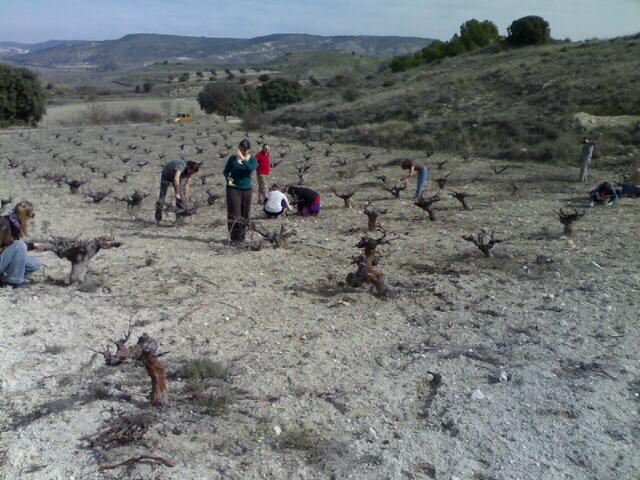
On Saturday, there were 10 of us altogether. Earlier in the week I'd sent an SOS email to my mailing list of usual customers, and asked anyone who could, to come out to the vineyard and give us a hand.

Helpers in Action (1)

We finally solved our dilemma of what to do with helpers who don’t know how to prune. On the one hand, if we were to carefully explain the theory and demonstrate the practice of pruning to them, then we wouldn’t actually get any pruning done!!! And on the other hand, if we were to let them loose in the vineyard with a pair of pruning shears in hand, … well, you can imagine the disaster.

Helpers in Action (2)

What we did was in fact to let them loose with a pair of pruning shears in hand, but with instructions to prune all the canes down to a length of about 10 cm, or leaving at least two buttons. At the same time, two helpers would accompany me and Juan, and we would teach them and explain the technique as we pruned. After a while the ‘apprentices’ would rotate and another two pre-pruners would become ‘apprentices’.

Helpers in Action (3)

This pre-pruning helped us a lot: we could prune faster as there were no long canes getting in our way, and all the helpers got to learn how to prune.

A major disaster and serious error in planning occurred that day: for the first time in 8 years, ie ever since we started growing grapes and making wine, I forgot to bring a bottle of wine from the vineyard. When we stop for a mid-morning break and for lunch, it’s great to drink and taste the actual physical result of our labours (and try to guess which vines it came from!). It’s the most ‘local’ you can get, drinking a wine made from vines that you’re standing beside! Oh well, we had to do without that little pleasure.

The Next Day

On Sunday, it was just me and Juan and his dog.

We noticed a strange thing while pruning – there seemed to be a lot of canes growing from the underside of the ‘arms’ of the vines. Usually, they grow more or less from any position, and a few also sprout from strange places, like from underneath. Like these two, for example:

Canes growing from underneath

More canes growing from underneath

Then we came up with a theory. We figured that it’s related to the late overnight freeze we had last year during the night of 7th-8th May. A lot of young tips were frozen off and so the vine had to sprout new shoots to compensate for the losses; so maybe there were no well-positioned places left and the vine had to use any latent buds it had available, even if they were located in sub-optimal positions. Any thoughts, anyone?

Half-pruned vineyard in Carabaña

By the end of the day, we’d pruned (over Sat and Sun) about half of the Carabaña vineyard, ie 0.5 hectares. That leaves us with 0.5 ha to finish in Carabaña and a whole 1.0 ha in the other vineyard in Villarejo.

On the Sunday, I remembered to bring the wine:

Local Wine: the end result of all our labours


                           A pre-pruned vine 
                                                                                     A pruned vine

And lastly, it looks like we have yet another new neighbour, or neighbours. We found the left-overs of a picnic on top of a few vines:

Almonds!

Friday, 18 March 2011

Second Day of Pruning

I did some more pruning yesterday (Thurs 17th March). We’re still running very late this year. We’ve only managed to do about 0.25 hectares out of a total of 2 hectares.

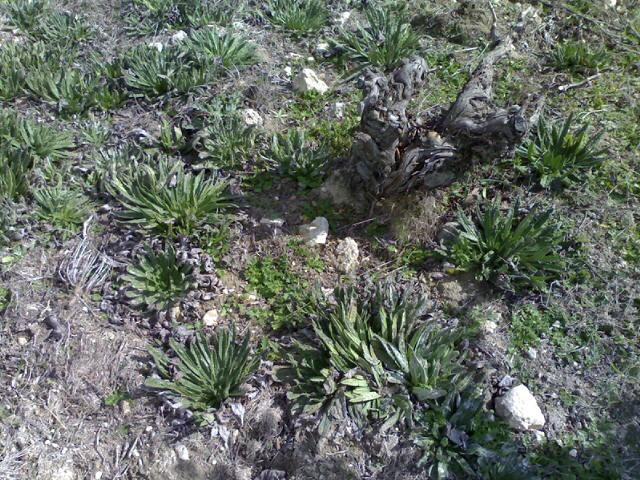
I think that spring is also running late in this part of Spain (Madrid Region and La Mancha). I’d really have to check my notes, but I get the feeling that the vegetation hasn’t really started ‘springing’ yet. The only signs of spring so far are 1) the almond trees, which have been blooming for weeks, but almond trees are notoriously early bloomers and 2) those radial weeds called cardos marianos in Spanish (ie Mariano’s thistles!).

This is good news because, if I'm right, then the vines will be running late too and so we'll have a bit more time to finish the pruning before the buds sprout.

Almond tree in flower, with vines in background

Making a virtue out of vice, it's also the case that if you prune later, the vines will sprout later and so will be more protected against the risk of a late spring freeze. Like what happend to us last year on the night of May 7th - 8th, as a result of which we lost about 25% of our yield!

That's an example of a thing I've noticed over the years: no matter what task/activity you do (or don't do!) it will have both positive and negative consequences. In most cases, of course, if you do the 'right' thing, the positive will outweigh the negative. But still, it's an interesting concept.

Pruned vine surrounded by 'Mariano's thistles'

Top-down view of a cardo mariano

After pruning, I also gathered up all the canes and took them to the edge of the vineyard. Later this year, at some point, we’ll chop them up into small pieces and scatter them all around the vineyard. They will eventually decompose and improve the fertility and structure of the soil.

Piles of canes at the edge of the vineyard

I think this practice is also ‘sustainable’ in the sense that we’re not constantly removing material from the vineyard year after year (grapes, canes) without giving some of that material back. We also add organic manure (from an organic sheep and goat farm up in the mountains of Madrid).

More piles of canes

Lastly, it looks like we have a new ‘neighbour’ living in the vineyard. This hole/burrow was right between the two piles of canes shown above. I have no idea what animal could have made it. Seems a bit big for a rabbit.

Our new neighbour's front door

Monday, 14 March 2011

Racking (some good news and some bad)

Did a bit of racking this weekend:

Firstly, we moved the Sirah and the Petit Verdot from one stainless steel tank to another.

Petit Verdot (near tanks) and Sirah (back tanks)

Closeup of the Petit Verdot tank

The Petit Verdot was smelling a bit of farts and hydrogen! So the airing it got did it a lot of good – it was smelling a lot better after the racking.

We did it by hand: filling a container from the tap at the bottom of the tank, and then pouring the container directly into the new tank from the open top.

Pouring in the wine


Pouring out the wine

The Sirah was smelt a bit ‘closed’ or of being enclosed, but no farts.

Capazo 1

Capazo 2

Gundge at the bottom of the tank

Looking down into the tank

We also racked the Garnacha 2010 for the first time this year, so there was a lot of lees and gunge at the bottom of the tank.

We’re very happy with the way these three wines are turning out.

On the spur of the moment we decided to rack some of the Garnacha to an old oak barrel (+5 years old) as another experiment, just to see how it will evolve.

Burning sulphur

So first we rinsed out the barrel and then we burnt a piece of sulphur inside it.

In it goes

The burning piece of sulphur is in a little cage, so that the bits that melt dont fall down to the bottom of the barrel.

To move the garnacha into the barrel we had to use the pump (because the barrel room is about 30 m away from from where Garnacha was). I really don’t like pumps! They make far too much noise. I don’t know if this noise affects the wine or not, but it certainly affects me!!!

The Garnacha flowing into the barrel

Another thing about pumps (and this one in particular) is that they are far too powerful and move the wine far too fast.

Garnacha flowing onto the floor

Not as bad as it looks - we only lost a few liters before switching the pump off! After cleaning up the mess, I got to write on the barrel with a piece of chalk!

Writing on the barrel

Lastly, and we racked 2000 l of Tempranillo. A bit of bad news here: when we went to open the pneumatic cover, we discovered that it was already open! We forgot to seal it last time we opened it a few month ago. This means that the wine has been in contact with the air (oxygen) all this time.

Not a disaster, but not optimal, and of course really annoying, as we had the use of a beautiful stainless steel with a hermetic seal which we haven’t made use of through our own silly error! Anyway, the wine is fine. We poured about 100 l down the drain, though – the top 25 cm , nearest the surface in contact with the air. Another lesson learnt!

The pump and the tank of Tempranillo

Friday, 11 March 2011

Confessions of a Natural Winemaker

I confess! I did it! I put some SULPHUR in a lot of wine a few months ago. It was either that, or lose the wine.

Bag of Potassium Bisulphite

But it gets worse! It was the first time that we’d ever added a dose sulphites to our wine so we weren’t quite sure how to calculate the quantity to add, and it’s quite complex if you’re not a mathematician or a chemist.

Anyway the upshot of the matter is that we added way too much. We just got back the results of analysis we sent off to a lab, and it turns out that we’ve ended up with 240 mg/l in there!!! I think that’s over the legal limit for even conventional industrial wine, let alone organic or natural wine!!!.

I think we miscalculated by a factor of 10, because what we wanted to do was to add only 20 mg/l, not >200 mg/l.

The product in question was Potassium Meta-Bisulphite.

Some thoughts in theory

I’ve always said that I’ve nothing against the rational, sensible use of sulphur, but I am against its ABUSE, ie adding it at any and all stages of the winemaking process to cover up the bad quality of the grapes or over-manipulation in the winery. In general, I see no need to use sulphites at all, if you:

1) use good quality grapes

2) keep your winery clean

3) don’t over-manipulate the wine

As they say: “There’s always a first time”, and this was the first time in 8 years for us. I hope it will be the last.

Some thoughts in practice

So what are we going to do with this lot of wine now? Well, ‘luckily’ it was a lot that we were planning to use for a ‘coupage’, and we’re still going to do that. We’ll have do some calculations (and get a mathematician or chemist to check them for us) to ensure that the final sulphite level in the blend is low, and we’ll put that level on the back-label when we eventually bottle the wine.

The lot in question was the Graciano, which I posted about back in October: “Stuck Fermentation” and Status of Experiments.

We’re thinking of making a Crianza that is 10% Graciano and 90% Tempranillo. Such a blend should have a sulphite level of 24 mg/l, no? (ie, 240 x 10%) Plus whatever ‘natural’ level of sulphur the Tempranillo has in it. We haven’t added any sulphites to the Tempranillo, but there’s always a little (between 0 and 20 mg/l) present as a result/byproduct of fermentation.

I have lots more thoughts on Sulphites, but I won’t publish them here and now! I’m saving them up and writing a draft text, which I’ll eventually upload to a section in my future webpage (which I’ve been trying to create for about 2 or 3 years now!!!)

Tuesday, 1 March 2011

First Day of Pruning

Last Saturday 26th Feb we finally got started with the pruning. We’re running VERY late this year, as we usually start round about the end of January. We’re still in good time though. We ‘only’ have 2 hectares (5 acres) or 3000 vines to do, which is about 10 full days’ work for 1 person ( or 5 days for 2 people!)

We kicked off on a festive and educational note, so we didn’t actually get much pruning done! About 15 people came to help, to learn how to prune (*) and to see the vineyard, the winery and ‘meet the winemaker’!

All these people are part of a ‘Grupo de Consumo’, a group of people who get together to buy organic products directly from the producers. And among the products they buy, is my wine!

Juan explains how to prune


Lola covers her ears, as Juan gets ready to cut!

Panoramic view of the vineyard

David

Alvaro
Eva and Raquel

Ana

Myself

Scissors

We managed to prune about 100 vines in the course of the morning.

Then it was time for lunch, which we did at the bodega (winery). We make a giant paella, which – surprisingly - turned out perfect. It’s very difficult to cook a giant paella evenly, and usually there are patches where the rice is under-cooked and other parches where it’s burnt!

(pending: foto of giant paella)

Jorge and Dani

At the table

Orange wine

Down the hatch

(*) Here are some of the ‘technical criteria’ we follow, and tried to teach:

- Each vine is different, so the number of ‘thumbs’ to leave depends on its vigour, size and shape
- We leave only one ‘thumb’ at the end of each ‘arm’(sometimes two if the vine is very large or vigorous)
- We leave the ‘thumbs’ that point outwards from the centre, and prune any that point inwards or crosswise
- We prune away all shoots that are growing directly from the trunk or arms
 
Creative Commons License
This work is licensed under a Creative Commons Attribution-Share Alike 3.0 Unported License.