name="description" content="Terroir-expressing natural wine minimum intervention">

Monday, 27 February 2017

Live Wine Milan 2017 - a natural wine fair

The other day (17th and 18th Feb) I was at Live Wine in Milan, one of the many natural wine fairs held in Italy these days. There were at least five others that I could have chosen from, for example Villa Favorita, Cerea, Fornovo, Sorgente del Vino or some others.

In France also there are at least 5 or 6 good natural wine fairs to choose from, though I probably won't go to any in France this year. In contrast, in Spain there are only 2: Vins Nus held in Barcelona and organized by the Spanish natural winegrowers association PVN (Productores de Vinos Naturales = Producers of Natural Wines); and the other one is called H2O and is organized privately by Laureano Serres and/or Joan Ramon Escoda, both natural wine producers from Catalonia.

Another difference between the Spanish natural wine scene and the French/Italian one is in the numbers of producers and visitors that show up at the fairs. The Spanish fairs have about 30/40 producers and about 1000 visitors/day, while the smaller Fr/It fairs have about 200 producers and receive about 3000 visitors.

Yet another difference that I noticed was the age range of the visitors. I couldn't help noticing it, as I was standing at my table, pouring wine and talking to them for 10 hours/day! The majority of my visitors were in their 20s/30s (and very few older people), whereas at the Spanish fairs I go to, it's the opposite way around, ie very few young people and an abundance of old coots!

Why is this? Why such a great difference between Spain and France/Italy? All three countries are major historical producers of wine, all producing the same volume of wine each year (about 50 million hl/yr), but that's the only similarity. As far as natural wine is concerned, I'd guess that there must be about 500 producers in France and 500 in Italy; but there are only about 50 in Spain.

An interesting question to ponder, no? I'm afraid I have no idea why there is such a difference. Any theories welcome.
-----------------------

And to finish off, a nice photo, which has nothing to do with the above. This is of my Doré vineyard which I was in the other day, at about 800 m between El Tiemblo and Cebreros, in the Sierra de Gredos. Still unpruned as yet.

Doré vineyard in Sierra de Gredos


Monday, 13 February 2017

Natural Wine. Nobody knows what it is!

Natural Wine

Nobody knows what it is!

Well, actually, quite a lot of people know what it is. It’s just that there’s no legal or official definition. So this can cause a lot of misunderstandings or even arguments.

This lack of a clear definition seems to be a good thing for many mainstream press journalists and writers, as they can just churn out the same old hackneyed topics time after time. I personally haven’t read anything original in the last 4-5 years. Does that mean it’s all been said then? Hey, maybe everything really has been said, and if I were to do a bit of searching on the internet and make a summary of all the ‘takes’, ‘positions’, ‘postures’ and ‘stances’ on all the ‘issues’, ‘sound-bites’,  ‘talking points’ and ‘philosophies’, I could post a really comprehensive and definitive post, and there would be no reason for anyone to bore anyone else with their unoriginal thoughts J.

Ach, if only I had the time to do that!

Sadly (or rather, fortunately, for you all!) I have far too many natural wine related tasks to be getting on with. Apart from writing 2 posts/month (self-inflicted goal), I also have to grow grapes, make wine, and thirdly sell said wine. Those three tasks being the top-level of their particular multi-branched, multi-twigged, multi-leafed tree.

A few months ago I was talking about the definition of natural wine to a visitor to my vineyards, and I believe I may have come up with an original sound-bite. I said “Natural wine is a bit like pornography – it’s difficult to define but you know it when you see it!”  Well, it’s not totally original, because someone really did say that – about pornography. But I’m claiming the prize for saying it first about natural wine J

Anyway, in this post I’d just like to repeat a message to all those writers and bloggers and commentators who insist on saying things like “but it can’t be ‘natural’ because the vines are all planted in rows, and then pruned, and then the grapes are crushed using machinery, etc, etc” you get the idea.

My message is: adjectives in English (in fact most words in most languages) have many different meanings! This is so blatantly obvious that that I’m left kind of speechless (or wordless!). Just open up a dictionary and you’ll see. For example I just typed “online dictionary” into Google and the first one on the list was http://www.dictionary.com/ and after typing in “natural” I got 31 different meanings of the word natural. Thirty-one!  Obviously many of them are pretty similar, but look at definition No.7:

having undergone little or no processing and containing no chemical additives:
natural food; natural ingredients.
Compare organic (def 11).

That’s obviously the meaning that natural winemakers, distributors and retailers are using when we write about natural wines. Whereas the boring pedants who bore us all with their boring utterances are sticking to definition No.1:

existing in or formed by nature (opposed to artificial):
a natural bridge.

The same results come up for any dictionary you care to consult. And it works for just about any word in the English language!

Another message I have is this one: Why don’t they all go and bore the pants off the producers, distributors and retails of natural gas? There are many, many more consumers of natural gas than there are of natural wine, and the gas industry moves vastly greater quantities of money. And as if that weren’t enough reason, according to their meaning No.1, natural gas is much, much more artificial than natural wine, as it requires incredibly expensive and complex technology to produce the stuff! J

Having delivered my messages, I would also like say why I believe that natural wines are ‘better’ in all possible senses of the word than industrial-chemical-commodity-supermarket wines (ie about 90% of the wines produced in the world today):

1.              Natural wines are better for the environment. I don’t think there’s even any debate on this point, is there? Industrial-chemical vineyards pollute the environment (groundwater, soil, lifeforms, everything) even if they abide by the letter of the law.
2.              Natural wines are 100% risk-free in terms of human health (final consumers and workers on the land and in wineries).  No debate there either, surely?
3.              Thirdly, and this point is immensely debatable, natural wines taste better, are more interesting, are expressive of their terroir and grape variety, are more digestible, and generally just more soul-raising and inspiring of joie-de-vivre! Not all natural wines are like that, naturally! There will be some that are crap, but I’d say most of them are like that. Just go to any natural wine fair and try to find a bad wine. This is 2017! Decades have passed since the latest modern natural wine renaissance. The bad one have been weeded out and have disappeared.

Here's a couple of photos:

A worm
Worms are a sign of a healthy, living uncontaminated soil. You don’t see them in the 90% of agro-chemically exploited vineyards. (I say ‘exploited’ and not ‘farmed’ because it’s an insult to farmers to use the same verb to describe what the industry is doing to the land).

My vineyard and the neighbour's vineyard
 Spot the difference. Which vineyard is clean and alive and allows its vines to be healthy and vigorous  and to produce healthy, balanced, complex and delicious grapes? And which one is polluted and dead?

Tuesday, 31 January 2017

Recycling and Sustainability

Hmmm, it’s been quite some time since I wrote about recycling and sustainability! In fact it was over 7 years ago since I last wrote anything about it! See these old posts if you like:


So what have I got to say for myself now? How is the reuse/recycling of bottles at Vinos Ambiz coming along?

Well on the one hand, it’s gotten a lot worse! Back in the old days (ie pre-2010) I used to delabel, wash and reuse 100% of my bottles. That’s because my production was so small – about 1000 bottles per year – that it was no bother to wash a few hundred bottles a session every few months. Also there was no alternative, because being illegal as I was, the bottle companies wouldn’t deliver any new bottles to me!

Then my production expanded, I had much more work to do – more vineyards to tend, more wines to make and look after – and so I didn’t have the time to wash and reuse old bottles. Also, I became a legal winery and so could take delivery of new bottles!

This used to annoy me a lot – that I was no longer reusing bottles. And in fact I used to delabel, wash and reuse tiny token symbolic lots of bottles whenever I accumulated around 20 or so old bottles. Ridiculous really (considering that I was now producing about 10,000 bottles a year!) but at least it kept my mind and memory thinking about the problem every now and then. I didn’t totally forget, even though in practice I was no longer recycling bottles.

Then a few months ago, around October last year, I came across a company that actually collects, delabels, washes, sterilizes, and packages and sells used bottles. I couldn’t believe it! But I contacted them and after getting the information, I ordered 2 pallets (1000 bottles) from them.

There were a few complications at first. The bottles had to be of the right height and width, because I already had several thousand cardboard boxes in the winery which would last me for years. So I had to ensure that they would send me the right model of bottle. The Bordeaux models (straight with pronounced ‘shoulders’ and a ‘neck’) are all pretty similar really, but a few millimetres here or there would mean that they wouldn’t fit into my boxes. I even got them to send me a box of 6 bottles, so that I could physically check that they fitted – not trusting myself to rely on mere measurements!

Anyway, it all worked out in the end, and the pallets duly arrived. I was also a bit worried that they might not be totally clean, but no worries there either. They looked, felt and smelt totally clean and  brand new. And they sent me a certificate ‘proving’ (somehow!) that they were completely free of bacteria or other impurities.

So, I am overjoyed really. Again I can use 100% reused/recycled bottles, like in the old days. Only this time I’ll be using 10,000 bottles/year as opposed to 1,000! I fully intend to order all my bottles form Infinity Reutiliza from now on.

According to their webpage, they collect all the used wine bottles from the local bars and restaurants in the village of Villena, and a few other neighbouring villages. They then de-label them, classify them according to different models, wash them, sterilize them, and then package them up and sell them.

Here are some photos. Though it’s quite difficult to get excited about a bunch of old bottles!

 
Two pallets of new old bottles

Bottling up - only one pallet left
Bottling up and corking


Saturday, 14 January 2017

Clearing up the Clutter (and planning for the future)

This is the new look of my my part of the winery:


Lots of empty space, everything nice ‘n’ tidy, and everything in its place. I’ve spent a good few weeks tidying everything up, throwing out rubbish, and classifying and storing wines and equipment in a more rational and tidy manner. It must be a phase I’m going through, or maybe it’s just obsession and eccentricity, but I’m getting more and more uncomfortable with the chaos and lack of structure in my life (and in my wine business). Which I was OK with for a long time. But it must be time for a sea change I suppose!

This is just Phase 1 of a longer-term project. Because apart from just keeping everything tidy and not having ‘stuff’ lying around at random, I also want to create some specific areas in all this empty space that I’ve liberated. Eventually, I will have:

1.              Tasting areas, where I can organize proper tastings for visitors and clients 

2.              An office area, where I can do paperwork and correspondence

3.              A merchandising area where I can set up my bottles of wine and info sheets, etc

4.              A chill-out area, for lying down, lounging, reading, sleeping, etc


Here’s the tasting area as it is at the moment:


Comfortable tasting area
Those bottles that can be seen on the table are bottles that I’ve opened for tastings in the past, and which I keep there on purpose to prove (beyond any reasonable doubt) that natural wines (ie wines without any added sulphites or other chemicals) can last perfectly well for a long time without deteriorating or turning into vinegar. It’s so boring and annoying to hear and read about how natural wines are so delicate and fragile that they are undrinkable after a few days of being opened. The truth is the total opposite.
These bottles, that you can see on the left were opened on 14th January 2014, (that's 2 years ago - to the day!) and they are still drinkable.

Save the date
ye olde oxydyzed wine samples


Obviously, they have become tremendously oxidized as I keep them there on the table at ambient temperature (which ranges from 8ºC in winter to 25ºC in summer) and closed with just a cork; and which I open and close every time I receive a visitor! They are of course very dark, and obviously unsellable commercially speaking, but the point I’m trying to prove with this ongoing experiment, is that good quality natural wines do NOT automatically turn into vinegar. I’m pretty sure they will eventually, and I’m looking forward to seeing how many more years it will take.

But getting back to the tasting area…  as you can see it’s a very laid back tasting area, with comfortable settees. This will influence the so-called objectivity of the tasters, but for the better, IMO, because I believe that wine is for enjoying and not for analysing or solving as if each bottle of wine were a quadratic equation! By sitting back comfortably on a sofa and tasting the wines in a relaxed and comfortable setting, it will provide a truer picture of what my wines are all about. But as there is no accounting for taste, I will also provide a more uncomfortable tasting environment for the more analytic visitor, ie a high table with hard stools with space to take notes and lay out laptops, etc. I have the luxury of having so much space in my winery, which is sadly underutilized at the moment, that I can easily afford to do this.

No photos available of this uncomfortable tasting area, because as yet I don’t have a table or high stools. But watch this space!

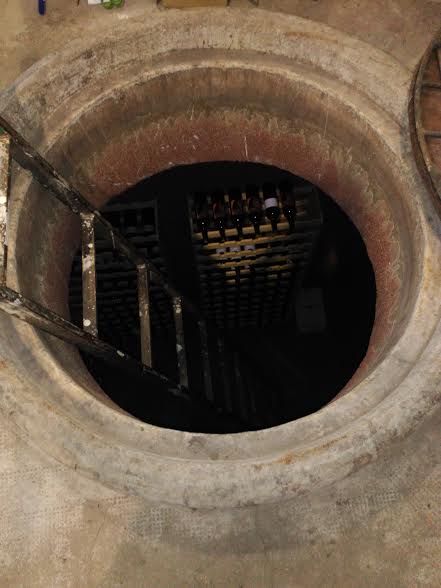
Another area of which I do have photos is this underground concrete ‘cellar’. This used to be a holding tank for wine back in the days before the village co-op went bankrupt. There are 32 such tanks (3 m x 3m by 3 m). Recently I cleaned out two of them, and installed some bottle racks, and laid out all the old, odd, declassified, remainders of old vintages that I can’t sell commercially any more, as the quantities are too small. I’m also thinking of putting in a few seats and a mini table, to do underground tastings!

Cellar entrance

view into cellar
view of rack and wines in cellar

Me building rack with screwdriver
Enough for now.

Thursday, 3 November 2016

Harvests 2016 all done

Another year, and once again all the grapes are in. My last harvest was the Malvar on Monday 10th October.  And not a moment too soon! Because after a long, long, hot, endless summer with zero rainfall, it stated raining heavily and properly all over Spain on Wed 12th! Ha! So I’ll have to find something else to complain about, as viticultural tradition demands J

I did a total of 15 harvests this year, in 15 different plots, for a total of 15 different wines:

1.      Albillo (Charco)
2.      Albillo (Fx)
3.      Garnacha (Charco)
4.      Doré (Fx)
5.      Doré (Pp)
6.      Sauvignon Blanc (Qx)
7.      Tempranillo (TET-A)
8.      Garnacha (Castañar)
9.      Garnacha (Dehesa)
10.   Garnacha (McCarb)
11.   Chelva (Early)
12.   Villanueva
13.   Chelva (Late)
14.   Airén (Carabaña)
15.   Malvar (Villarejo)

That’s 2 red varieties (Garnacha and Tempranillo) and 7 white varieties (Albillo, Doré, Sauv, blanc, Chelva, Villanueva, Airén and Malvar).

I vinify each plot separately even if it’s the same variety, because it’s more interesting that way. It’s amazing how different the wines are, even if the plots are close together and the winemaking techniques are the same. For example, in El Tiemblo (Sierra de Gredos) the Garnacha Castañar plot is only about 1 km away from the Garnacha Dehesa plot as the crow flies, but the grapes and wines are totally different.

The novelty this year is a variety called Villanueva. It’s not uncommon in the area but it’s usually just a few vines interspersed among another predominant white variety. But by chance a local grower, who has an entire vineyard planted to Villanueva, came by the winery one day to offer them to me. ‘Why not?’ I thought. It’s a rather tiny plot, and there was only 150 kg. So I crushed them and pressed them and let the must ferment in small tinaja – in tinaja because it was the only container small enough available at the time!

All the rest I’ve done before, and am following the line of ‘If it ain’t broke, don’t fix it’! That’s to say that for all of the wines listed above, I followed (am following) the same techniques that have worked for me in the past, with regard to decisions on type of container (steel tank, wooden barrel, clay tinaja), maceration times if any, with or without stems, etc.

The only crazy experiment I’ve done this year is to follow a recipe I read in Pliny the Elder’s ‘Natural History, Book 14, Chapter 12. I followed the first recipe of the three he gives. So I guess I’ve made (am making) a beverage called ‘deuteria’ by the ancient Greeks and ‘lora’ by the ancient Romans. This is the stuff that was quaffed by slaves and labourers. The original glou-glou wine?

Following are some assorted photos, from over the summer:

 
View of the Albillo (Charco) vineyard, with the Alberche river in the background.
El Tiemblo, Sierra de Gredos

Bird's eye view of Albillo macerating

Bottling machine

My Garnacha vineyard using no chemicals, next to a naked agro-chemical wasteland vineyard!

Bottling up

At a wine fair

Sheep in the Garnacha vineyard, eating weeds and dropping caca!

Sheep entering

Living soil, for healthy vines

My pet nat exploding on me! Too much pressure!

My Chelva vineyard, surrounded by the houses of El Tiemblo village

In another Garnacha vineyard, steep, in El Tiemblo, Sierra de Gredos

Bottling up!


And to finish off, a note on the word “sapid”

I generally find it impossible to have decent in-depth discussion on FB or other social media sites. And a few weeks ago, I found myself feeling frustrated because I couldn’t say what I wanted to say! I think that FB and other sites are just not the right place for a proper discussion or debate: basically, they all tend to favour spur-of-the moment, shooting-from-the-hip type comments, right there and then, whenever you happen to come across an interesting post that you feel like commenting on. There’s just no time to think before typing! Apart from wine, I also like words, so I was doubly affected!

This had been annoying me for days, so I decided to do something about it. After searching on the internet and after doing a bit of ‘due diligence’, I’ve come to the conclusion that it’s not a very useful word to use in written wine-tasting notes or while speaking live to an audience. The due diligence consisted in asking native-English-speakers, uncontaminated by knowledge of a foreign language, if they knew what ‘sapid’ meant. Not one did! English-speakers who know a Latin language would know ‘sapido’ (It, Sp, Pt) or ‘sapide’ (Fr) where it’s quite a common word for everyday use and just make the connection.

Firstly it’s not a very common word at all in English (see here, this is just one of many word-frequency sites) and so it’s not likely that the readers/audience would understand what it means. This may depend on the level of knowledge/culture of the audience though, so an audience of hardened winelovers may have come across it before. But still!

Secondly, once you discover the meaning of ‘sapid’, you also discover how useless it is, for it means “having flavour” “tasty”. Which covers just about every edible/drinkable substance in existence, except for water!

I suppose that a slight degree of usefulness might be attained if a bit of common sense is applied by the reader/listener, ie by assuming that the writer/speaker really means ‘very’ or ‘extra’ flavourful/tasty. But then why bother with ‘sapid’ at all? Why not just say ‘very/extra tasty/flavourful’ and make life easier for your readers/listeners, who are after all reading/listening to you with a view to learning something about wine! But then again, maybe they would enjoy learning a new word? Or are happy to be introduced to the secret and occult world of wine-tasting? Or would they hate wine forever on account of the arcane vocabulary used?

Well, whatever. Anyway, I feel a lot better, now that I’ve got that off my chest.  J

Monday, 26 September 2016

Albillo Harvest 2016, Sierra de Gredos

Well, that was quick! I can’t believe it’s over already! After only four days of intense work I now have about 2500 litres of Albillo fermenting away nicely.

Day 1: in vineyard, harvesting from 7:15 (crack of dawn!) till about 15:00. Six of us took in about 2000 kg. Lunch, then crushing. All done by about midnight.

Day 2: in another smaller vineyard, again at 7:15. This time the six of us took in another 1000 kg and we were done by 13:00. Lunch, and all crushed by midnight.

Day 3: pressing off the first harvest, after 2 days maceration

Day 4: pressing off the second harvest, after 2 days maceration

Scroll down for photos.

This year I decided not to do any experiments with the Albillo like I’ve been doing over the past few years. I’ve tried lots of options and variations, like different skin maceration times, fermenting in stainless steel, open top barrels, amphorae/tinajas, etc. So based on the feedback I get from people and on my own personal taste and preference, I’ve decided to make my Albillo like this:

-          - Crush and macerate for 2 days in stainless steel
-          - Press off, and put juice back into stainless steel
-         -  One racking only into a large tinaja, to remove the really gross lees
-         -  Bottle up in spring, after the cold of winter has passed
-         -  Age in bottle for at least 1 year

This was in fact the way I made my Albillo 2014 (from which I’m constantly receiving good feedback, AND it’s one of my personal favourites). So that’s that!

Climate/weather

Basically, this year in Gredos there was a very mild dry winter and then it rained a lot in May/June, and then a long hot dry summer. I presume that this affected the ripening of the grapes which was a bit odd; they ripened steadily and normally until about the middle of August when the sugar content was indicating a probable level of alcohol of 13%-13.5%, and then it just stuck there. I’m guessing that the vines shut down their sugar production due to the heat. So eventually I decided to harvest at 13.5% (on 27th Aug) as the grapes were otherwise perfectly ripe, ie golden skin, crunchy pips, stems starting to lignify, some leaves turning brown already, etc.

Well, there you have the meteorological info! I know some winelovers like that sort of data, but I personally find it kind of boring and not even all that relevant. I know that it’s important, but on the other hand, I also know that the interventions of the winemaker are much much MUCH more influential on the final wine. So it leaves me kind of nonplussed when I hear a comment like “yes, the 200X was a very wet/dry year” or some such. Or is this a cold-climate thing? Maybe in the Sierra de Gredos, with its dry continental climate, the yearly weather variations, like the one I just described above, it don’t really make that much difference?

More winemaking info

Sulphites. I haven’t added any sulphites (or any other substance, chemical, additive, nutrient, enzyme, etc) to the must. Why not?
1.              Sanitary reasons. Because there is no need to. I ensure that the grapes are perfectly healthy, ripe and clean; I select in the vineyard and reject unripe, rotten or otherwise undesirable grapes, and don’t take in any leaves, dirt, pebbles, etc (see this page for info on what I do and don't do in the vineyard)
2.              Terroir reasons. Because adding sulphites kills the yeasts and thus removes the complexity provided by all the different varieties of yeasts that are present at this time.
During the first few days, saccharomycescervisae is hardly present at all – the active yeasts are other species, including the ones feared so much by enologists and chemical winemaking engineers! (ie brettamonyces, candida, kloeckera and others). During these first few days, these yeasts provide all sorts of interesting flavours and aromas (including so-called “off-tastes”). But, as the alcohol level increases, these yeasts die off and good old saccharomyces begins to take over, because it’s very tolerant to alcohol. And at the end of the fermentation process it’s 100% dominant. This is what I believe is happening during fermentation. But I could be wrong of course!

Racking. I usually do only one racking to take the wine off the really gross lees, but I prefer to leave the fine lees in there. I believe that this a good thing because:

1.              They contribute to the taste and aroma of the wines
2.              They provide protection for the wines against spoilage over time, which is important as I don’t use chemical preservatives or stabilizers to do that

Filtering, clarifying and fining. I don’t! For the same reasons as above, ie for taste, for protection and for terroir expression. This often results in a cloudy wine which many people don’t like. Oh well, you can’t please all the people all the time, can you? And there’s no accounting for tastes! In any case I’ve found that if you leave the bottle standing vertically for a few days it clarifies itself nicely.
It’s interesting to note that all wines must have been cloudy (or clarified naturally by gravity) ever since winemaking began about 8000 years ago. It was only with the advent of bottling technology and the need to store and to distribute to a mass market, that wines started to get filtered, fined and clarified.
It’s not actually necessarily an intrinsically ‘good thing’ to clarify wine, in terms of quality, taste or terroir expression. It’s done due to the need for the wine to be stable and inert so that it can be transported and stored over long distances and over long periods of time.
Clarified wine is also of course ‘prettier’ to look at than a cloudy wine and so is easy to sell to the mass market. A bit like beautiful, perfectly round, shiny tomatoes (which sadly don’t taste of anything).

Photos and anecdotes


Albillo vineyard in El Tiemblo (Sierra de Gredos). River Alberche in the background

Tree in the shade of which we store the cases of grapes 
Close-up of Albillo grapes
  
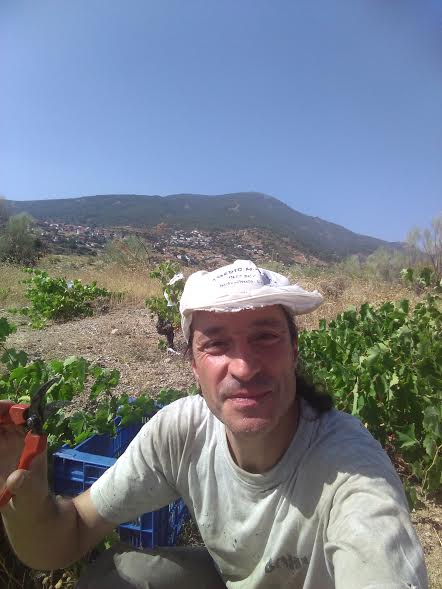
Close-up of me!

Top-down view of Albillo macerating on skins (destemmed)

Albillo juice flowing out of the press

Flamenco moment :)

Albillo juice in full fermentation

Slight overflow of Albillo fermentation foam

All nice and clean again

Rest and relaxation time under pergola structure in the patio of the bodega

Thursday, 28 April 2016

Parker Points and Natural Wine


The other day the Parker Points for the Sierra de Gredos region in Spain were published in the Wine Advocate. About 25 producers had sent in about 120 different wines to be rated, including myself; I sent in only one bottle of Garnacha 2014.

I was satisfied to see that my quality is remaining constant. My Garnacha 2014 was ranked in position 118 out of 118, with 80 Points!  And last year when I sent in three wines they were ranked in positions 150, 149 and 146 out of 150!  So no change there!

Wonderful! I think this is an excellent example of subjectivity in wine tasting. On the one hand my wines get the worst possible ratings from the Wine Advocate, yet on the other hand, they are sold and appreciated in many top restaurants and winestores all over the world. (Just look here for a list of outlets that carry my wines).

Well, I suppose I could use my horrible score for anti-marketing in the 'natural wine niche/ghetto' if I wanted to; I'm sure it would go down a treat, give rise to some chatter on social media, and some people would love it. But happily, and thankfully, I don't even need to bother doing that; I must be doing something right because my sales are doing very nicely these days! (touch wood!)

I think it's a terrible shame that so many producers, especially small ones, waste so much time and energy on chasing Parker Points. It's really a no-brainer for the vast majority of them. They would be much better off seeking their own markets and clients for their own unique and individual wines; instead of forcing their wines to conform to an international standard taste.

It's a no-brainer because there are literally thousands of producers who are all doing the same thing. The competition is brutal, and probably loss-making! Why not find your own niche? Why not be a big or medium sized fish in a small pond? Where you can actually know and speak to the outlet managers and wine-list curators at restaurants and even with some of the final customers? As opposed to being one minnow among thousands, swimming with the pikes and sharks? Where you are just one ‘account’ among many and the relationship is purely commercial. But, hey, I’m just saying! Each winery is obviously free to choose their own path - in terms of viticulture, winemaking and promotion/sales.

Apart from the above commercial considerations there is also the much more interesting ‘subjectivity’ aspect. It’s all part of the incredibly varied colourful and complex wine world which I’m so happy to be part of. My experience of the wine world over the last decade is that there isn’t just one monolithic wine world, but many different wine worlds (or niches or ghettos!) (or extending the previous metaphor, bodies of water). And each has its own cast of characters, rules of the game, criteria and points systems (though not necessarily numerical ones).

The big difference between Parker’s World and the other worlds is that Parkers’ World is hugely more enormous in all senses: there are thousands of wineries, thousands of intermediaries, thousands of outlets, and probably millions of wine consumers who pay close heed to what thousands of writers, journalists, bloggers, wine critics and sommeliers all have to say. The dominance is such that it’s not surprising that everyone forgets about the existence of the other tiny worlds. Maybe my world is tiny in relative terms, but it’s still big and complex enough to be self-sustaining and independent.

Let me clarify my thoughts here. I have nothing against the Wine Advocate or any of its similar publications with their points systems. I believe they have all done a great job over the last three decades or so, widening the wine base, and bringing many people into the wine universe who otherwise would not have bought wine at all.

They have done away with the snobbery and elitism, and they have simplified what was often an unnecessarily complex and arcane private world, which was intimidating and unwelcoming for new consumers.

But like in all good things there is also the other side of the coin which should be borne in mind. One of them is that people (producers, writers, distributors, outlet managers and the final consumers) all tend to think that Parker’s World is the only game in town, and that its rules and points and criteria are the only valid ones.

Example 1: Cloudiness. The rules in Parker’s World say that all wines must be transparent and not have anything floating in wine in the bottle; while the ‘rules’ of the Natural Wine World say that it doesn’t matter whether a wine is cloudy or not. Fair enough, rules are rules and if you want to play in Parker’s World you have to abide by them (otherwise you get 80 Points or less!).

But what a shame to restrict the enjoyment of looking at a glass of wine to a single dimension. Cloudiness can be beautiful to look at too; especially holding your glass up against the sunset.

Example 2: Sediments. Same as above. Though in this case some wineries apologetically explain on the back label that it’s OK to have sediments at the bottom of the bottle because it’s a ‘natural’ process. Ha!

Example 3: Filtering, clarifying and fining. Again the rules of Parker’s World say that all wines have to be clean and sterilized and stable. Why? Why take out all those ‘bits’ that add delicious flavours and complexity to the wine? And which also help to protect and conserve the wine.

There are several consequences of all the above restrictions:

Firstly there is the question of standardization/globalization/homogenization. The great majority of wines sold these days, are all very similar to each other in style, no matter what part of the world they come from or what grape variety they were made with. On the one hand this is great because millions of consumers can now buy good drinkable wine at a good price without fear. But on the other hand, (1) it’s terribly boring and (2) it’s a sad loss of regional diversity.

Secondly there is the question of the restriction or limitation of acceptability of all the characteristics of a wine. All the players in Parker’s World tend to be very intolerant of any characteristic that is out of their narrow range of acceptability.

The most mentioned characteristic in my experience is the volatile acidity content of a wine, ie the ‘vinegariness’. The same applies to other characteristics such as acidity and sweetness. The range of acceptable aromas and flavours is also limited; if a given wine does not conform to certain expected characteristics, then somehow it is deemed not as good as another one. So we have thousands of wineries all striving to attain 100 points, or approach this Platonic ideal of what the wine should conform to! Whatever happened to regional and personal diversity? Uniqueness? Terroir? All gone in the name of standardization and massification.

Oh well! Basically I find these restrictions sad and boring. I mean, what’s wrong with drinking a wine that’s a bit more acidic/sweeter/alcoholic/weaker than usual every so often? Is it not interesting and pleasant? Or is it better to stick to a safe, clean, predictable wine every time? But there’s no accounting for taste. As I said above, I’m happy and honoured to be a part of the tiny natural wine world, providing different and interesting and complex wines to a growing number of winelovers who enjoy them for what they are, without worrying about how many points they scored.


Creative Commons License
This work is licensed under a Creative Commons Attribution-Share Alike 3.0 Unported License.