name="description" content="Terroir-expressing natural wine minimum intervention">
Showing posts with label wild vine. Show all posts

Wednesday, 22 May 2013

Planting New Vines

At last! Hooray! After ten (10) years of thinking about it, and writing about it, and talking about it, I've finally done it!  I've planted about 150 vines in the empty spaces in the Carabaña vineyard, where a vine was missing for one reason or another.

 Newly planted vines, with protective tubing

I decided to plant Tempranillo, because the vineyard is a field blend of Tempranillo and Airén already, but there's not much Tempranillo - only just enough to make one barrel of crianza. I toyed with the idea of planting Malvar, or Torrontés or some other interesting local variety, but in the end I thought that there would be no point, as the quantity of wine I could make with it would be too small. I'll leave that idea for another project for the future.

 More newly planted vines

But the most crucial decision here was not really the choice of variety, but the choice of rootstock. In this case, the most important criterion (more important than resistance to drought, or resistance to disease, or resistance to limestone) was the fact that this is not a new vineyard and that the existing vines (about 50 years old) are very well established; and so their root systems will be very deep and wide and will be competing strongly for the water and nutrients in the spaces where the new baby vines will be struggling to survive and grow. So the rootstock had to be a vigorous and hardy one. The one that was readily available and which was recommended to me was one called "Paulsen 1103", which is not only vigorous, but also tolerant to drought and to limestone soils.

 Looking down into the tube

Well, that's half the job done this year. There's more to do next year! There are also about 100 vines in the vineyard where the grafted variety has died, for whatever reason, but where the rootstock is alive and kicking. These will have to be cut back and grafted.

They are so vigorous that in summer they turn into monsters like this one below:

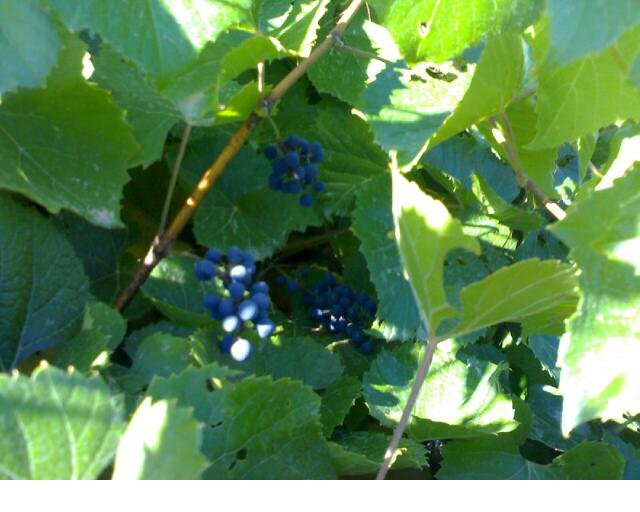
A 'wild' vine, where the rootstock itself has sprouted
Tiny and numerous clusters on a 'wild' rootstock sprouted vine

And there are also about 20-30 vines that are dead and which will have to be pulled out.

I'm so glad I managed to do that task. It gets depressing when you think about doing something for so many years but never get round to doing it :)

Wednesday, 11 April 2012

Pruning and Digging and Snipping Wild Shoots

Hopefully this will be the last pruning post (for this year). Not because I've almost finished the pruning, but because I'm getting fed up writing about pruning and would quite like to write about something else too!!! About vineyard and winery things, that is.

But, I do have some interesting (I hope!) anecdotes from my latest pruning session over the Easter break:

Numbers

I actually counted the vines that we have in the vineyard in Villarejo! It turns out that there are about 820. But I'll have to count them again properly one day and draw a map, because it's not so simple. The rows have 41 vines and there are about 20 rows, BUT it's not a regular rectangle! One of the sides is squinty so it's more like a lopsided parallelogram! Also, the vines are not planted in square grid shape, but in a hexagonal pattern (called 'tresbolillo" in Spanish), so each alternate row may really have 40 or 42 vines!

Anyway, as of Monday 9th April, I still have about 520 vines to go.

Wild Shoots

I'm going at a rate of about 10 vines/hour, which is very, very slow. The reason for this is the wild shoots that are growing around the vines, sometimes directly from the main trunk from under ground level, and sometimes independently rooted just next to the vine.

Ridiculously long, thin and numerous wild shoots

This must have been due to laziness on the part of the person who ran this vineyard before we took it over last year. It would seem that he just snipped these shoots back at ground level, without uprooting them or cutting them back properly from the main trunk. This would solve the problem for a year, but the deeper problem would just get worse and worse. As you can see from this vine above, for example.

Not all the vines are that bad, but I reckon about 75% of all the vines have some wild shoots that have to be dealt with.

State of the Soil

Well, as I'm digging so much in the soil, I've been getting a good look and feel of it! I think it's surprisingly healthy! There are earthworms, and other beasties underground, always a sign of a soil which is alive and healthy I believe. Above ground there's a veritable plague of ladybirds! I've never seen so many. They must be eating up every single aphid in the vineyard! Unfortunately I can't take a decent photo of them with my current mobile.
Other fauna

Butterflies, magpies and another type of singing bird which I can hear but have never seen. Moles, or mice or some kind of tunnel-maker, as can be seen from the holes and little piles of earth here and there. I presume that this is a 'good thing' as this will help aerate the soil.

Flora

The grass has started to grow, and some flowers and plants too. We have mostly little white flowers and little yellow ones and occasional little blue ones:

White flowers

Little blue flower
(pending: forgot fotos of yellow)


Wild Shoot Elimination Sequence

This is how I do it:

1.
This is the way a vine looks (1) when I approach it for the first time. First of all I prune the top, as usual,
otherwise the canes get in the way.

Next step (2) is to clear away the leaves and vegetation (if any) so that I can see what's there, and then to snip the shoots away at ground level:

2.
Step (3) is to dig a trench next to the shoots so as to expose the roots, down to about 20 or 30 cm. Sometimes they go deeper, but I'm hoping that at that depth they won't be able to grow back.


3.
Step (4): Snip! Snip! Snip!

4.
Then, pull the earth back into the trench, and lastly, superficially dig up all the earth and grass in a radius of about 50 cm around the vine, so that it ends up looking like this (5):

5.
Then, repeat Steps 1 to 5, and you get a nice row of vines that look like this:

One row done
I'm doing this so that the vine can have what little water is available. Otherwise the grass and flowers nearest to it would drink it all up. Normally, I don't think that this would be a problem for the vine, as it can access deeper water, but we're in a drought cycle here in central Spain, so I think that every little bit helps.

And the reason for cutting away the wild shoots is so that the vine can focus all its energy and nutrients on the fruit-bearing upper branches - instead of producing and feeding all those unproductive shoots.

The Rain in Spain

Well, even though it rained during the Easter break (enough to spoil everbody's holidays, as tradition demands!), it didn't really rain a lot, at least not to the east of Madrid! And here's the evidence to prove it: the second-last day I went to prune, at some point I took off my jumper, as I was too hot, and laid it on a vine intending to pick it up when ready to leave; but I forgot it, and there it stayed for two days while it was supposedly raining. When I noticed it the next day I went, it was almost dry!!! Only just a tiny bit damp.

My dry jumper after two days in the rain!
A Really Wild Vine

I found this beast (below) the other day, hidden in the grass between the first row proper of the vineyard and the road. I was just about to dig it up, when I thought that it would be nice to leave it alone and see what it does! So I even made its life easier for it, by cutting back the tall grass and flowers near it, and by pruning it a bit.

(dammit, lost the photo, will take again, next time, sorry)

Wednesday, 10 February 2010

Pruning our Sustainable Vineyard

Last Saturday 6th Feb we were pruning again, this time just three of us (no students!) so we managed to do quite a lot (about 200 vines) relatively speaking, but unfortunately we took far too long over lunch, otherwise we could have done maybe 300 vines!

Juan prunes a vine

The two photos below show the same vine, before and after pruning

                      Before                                                After

The next two photos below show the same vine before and after sawing off a dead ‘arm’

                       Before                                                      After


Here we can see a ladybird (US: ladybug), a bit out of focus (sorry, will do better next time). Ladybirds are our friends! They are super-predators and eat all sorts of nasty aphids and bugs that attack the vines/grapes. This is just a small part of the vastly complex biodiversity that we work to create in the vineyard, as opposed to using industrial agro-chemicals that poison the environment and affect peoples’ health.

"I say ladybird, you say ladybug"

More biodiversity! This is a holm oak sapling (one of five) which has sprouted right next to a vine. We are going to transplant them to the edge of the vineyard next day we go.


Holm oak sapling 1 of 5

Below left is a vine that has gone wild, ie the grape variety (either Tempranillo or Airén) that was grafted onto the rootstock either didn’t take or died off at some point. There are about 100 of these wild vines in the vineyard, and we are planning on regrafting them this Spring with a different variety. Any suggestion as to which variety we should select?

                   Wild                                                  Tamed

Above right  is what was left when I’d finished with it! The reason we prune these vines back is not for any ‘production’ reason (the bunches are tiny and the berries are tiny too) – we only do it because they grow enormously long and smother the neighbouring vines (which are about 3 m away!).

Monday, 9 November 2009

Map of vineyard, Tasting notes, and a Coupage


Last Sunday (8 November 2009) I was in the vineyard (Carabaña, Spain) bright and early, as I wanted to make a detailed map, showing the state of each individual vine. I didn't have time to finish but I did manage to map out about 600 vines or so, ie about half the number of vines in the vineyard. On my map I marked:
1. Vines that are OK (with a dot)
2. 'Wild' vines (with an 'S') (Salvaje = wild in Spanish)
3. Dead vines (with an 'M') (Muerto = dead)
4. Spaces where there is no vine (with a 'na') (nada = nothing)

'Wild' vines means that at some point in the past (before we took over the vineyard 6 years ago) the vinifera insert did not take and the rootstock itself sprouted. These need to be pruned way back and grafted again with a vinifera variety.

(pending photo of 'wild' vine)
(sorry, Blogger is having problems with umploading images)

Dead vines need to be uprooted and replanted

(pending photo of dead vine)

Empty spaces with no vine also need to be replanted.

(pending photo of empty spaces)

The time to do this is around March/April when the sap is just starting to flow, but not too much. The top priority is to plant new vines in the empty spaces; second priority is to uproot the dead vines and plant new vines, and third (if there is time and money leftover!) to prune and graft the wild vines.

After that, it was off to the winery to meet Juan for a preliminary tasting by ourselves, before letting the experts loose on our wines. We had eight (8) different wines to taste this year:

1. Young white 2009 (100% Airén) - Lot I
2. Young white 2009 (100% Airén) - Lot II (same as above, but grapes harvested 2 weeks later)
3. Young red 2009 (100% Garnacha/Grenache) Carbonic Maceration
4. Young red 2009 (100% Garnacha/Grenache) Conventional fermentation
5. Young red 2009 (100% Tempranillo) Conventional fermentation
6. Young red 2009 (100% Cabernet Sauvignon) Conventional fermentation
7. Crianza 2008 (100% Tempranillo, 6 months in oak barrel)
8. 'Young' red 2008 (100% Tempranillo)

(pending: our tasting notes)


Coupage (Tempranillo and Garnacha) in action


Spontaneous and appropriate vine around the door (of Vinos Ambiz Organic and Sustainable Winery)
We didn't actually plant the vine on purpose. It must have sprouted sponaneously one year from a stray pip during the crushing. We noticed it at some point and we trained it round the door. The rest of it is posing on a crate at the moment until we get round to training it all over the wall and maybe even make a shady pergola one year.
 
Creative Commons License
This work is licensed under a Creative Commons Attribution-Share Alike 3.0 Unported License.