name="description" content="Terroir-expressing natural wine minimum intervention">

Tuesday, 16 July 2013

Pouring Wine Down the Drain


The other day I poured about 400 liters of wine down the drain. 

Down the drain it goes
Why? Because it had started to turn into vinegar! 

This had never happened to me before, but it just goes to show that there's a first time for everything.

It's interesting that it had to happen right now at this time, as I've been involved in several on-line discussions about natural wines in general, and about wine faults in particular. Especially over at Robert Joseph's blog (here). It makes me think that the universe is out to get me! Or maybe looking out for me!

But first, here's my thoughts on the possible immediate causes of this little personal tragedy:

1.         The ambient conditions. I'm sharing a bodega at the moment and the space available to me is right next to the main door. So I'm thinking that there would be not only be no temperature control, but that the temperatures could actually swing quite a lot from day-to-day and from day-to-night, and also over the course of the year.

2.         Lack of day-to-day attention to the wines. Over the last few months I've not been able to attend to my wines as much as I'd have liked because I've been so busy looking for (and finding, and refurbishing) a new bodega (see these previous posts: here and here ).

3.         The non-use of sulphur. That wine may well have survived if I had used a bit of sulphur in there. Like I’ve said before, I have nothing against the sensible moderate use of sulphur; just its abuse.

But whatever the immediate causes, the more interesting question was: to pour it away or not? Because I've tasted wines that were on sale that had a much higher VA (volatile acidity) and were much closer to being real vinegar that the stuff I just poured down the drain. On the one hand I think I could have quite easily bottled it up and sold it off. But on the other, I think that my constant involvement in debates and discussions on different wine blogs over the last year or so, has had an influence on my beliefs and attitudes towards natural wines and their so-called 'faults'.

I think that the wine I just threw away would have been considered faulty by the conventional wine world, but would have been perfectly acceptable to many in the natural wine world. Like I said, I've tasted plenty that were closer to vinegar than the lot in question.

There’s also the question of my own personal taste. Even though I have a wide range of tolerance for wines that others would consider faulty, I personally don’t like wine with a high VA!!! I find it OK to drink every now and then, but not habitually; and certainly don’t want to produce wines like that. One of my main goals in my winemaking enterprise is to produce “terroir-expressing” wines, as I say in the header of this blog and on my labels and anywhere else I can! And wine with a high, noticeable, tasteable Volatile Acidity level simply does not express terroir, IMHO. Wine that tastes of vinegar, tastes of vinegar no matter what part of the world it comes from.

Ultimately, I’d like to think that I've put my money where my mouth is. On the one hand I was hesitating, thinking of the lost income and the amount of work put into making it to date. But on the other hand, the very thought of having that wine out there on the market just made me cringe with embarrassment! I guess it’s been a great lesson learnt, and not just from a technical winemaking point of view, but from the point of view of the type of winemaker I want to be and the types of wines that I want to produce.

all down the drain


Interlude in Barga

My idyllic interlude in Barga (Tuscany) is over! This is the town where my family is from - my great-grandfather emigrated to Scotland from here in the 1890's, and my parents also in the 1960's. If you're interested, check out this page (and the 'Links' page) for info on the history of Italian emigration to Scotland.


Panoramic view of Barga (photo by GrifoTour.com)


A few days ago I flew back to Madrid to take up where I left off 10 days ago - ie getting the bodega ready for the harvest, which involves more cleaning, scraping, washing, painting, and moving in all my equipment from the old bodega, etc. And at the same time doing all sorts of red tape and bureaucracy tasks!

It was a very relaxing ten days, even though I was actually working quite hard there too! I was cutting grass, chopping down trees, cleaning up the 'poggi' (terraces), trimming hedges, mowing lawns, and generally doing gardening and agricultural labour type tasks around the house! Not everyone's idea of what 'relaxing' is all about, I know! :)

The log-sawing area
Logs stacked up for the winter
But all that hard physical labour was amply compensated by at least 2 aperitivos/day!  The first was at an old bar (called da Casciani) where I had a 'tocchino - ie a local white wine with a splash of Campari
A "tocchino" - local white wine with a touch of Campari

The second one was round the corner at John Moscadini's wineshop (Colordivino), where he has an excellent selection of wines by the glass.

Some wines at Colodivino (Barga)
More wines at Colodivino
I already posted pics of the specific wines on Facebook (here), so I won't bore you with them again! Except for this one!

Bordocheo Bianco

All that hard physical labour was also compensated by nice, simple, as-natural-as-possible lunches and dinners made with many ingredients grown directly in the garden by my parents. especially vegetables like tomatoes, lettuce, radicchio, onions, etc.
 
Tomatoes just starting to ripen
Zucchini and basil
Lettuce and radicchio

Zucchini flowers, battered and fried


I have to say that it was great to forget about the painting and scraping and cleaning at the new bodega for those 10 days. I was starting to get a bit stressed out but now I'm back with renewed energy :)
The timing of this interlude was good too, because we managed to finish off main works (which took us 8 weeks!). Now there's just a whole load of smaller tasks to do, but which will take us at least a month to do.

More compensation of the hard physical labour was lighting the oven and cooking dinner in it :)

Oven firing up
Dinner cooking!


Alas, all good things come to an end, and already I'm back into the routine of painting and cleaning and doing tasks!!!

Saturday, 29 June 2013

New Bodega - Refurbishing Work

Here's a quick update on the refurbishing work that we've been doing at the bodega.

It's been a very intense month or so for me, as we're racing against time to have everything by August, for the Albillo harvest.

The biggest jobs were: 1. Scraping and painting the ceiling, and we had to hire a mobile platform to reach the highest points;
Scraping and painting (1)

Scraping and painting (2)

Scraping and painting (3)

Scraping and painting (4)

2. Scrubbing and cleaning the walls of the concrete tanks.

Cleaning concrete tanks (1)

Cleaning concrete tanks (2)

3. Painting the floor of the area where we're going to make the wine, with special washable paint.

...fotos

We did all this by ourselves with the help of friends and family, otherwise the cost would have been too much for our budgets!

We're also installing a bathroom, tidying up the patio, and refurbishing a bottling room, and an office/lab room.

Future bathroom

Future bottling room

Now we have about a month to do all the remaining "minor" tasks. The most time-consuming is the painting. Even if it's not really essential I think it's important from an aesthetic (and psychological) point of view, ie the place will look a lot better when we take visitors there, and the visual impact makes me feel that the place is really mine!

A few weeks ago we had a visit from the inspectors from the Ministry of Health, and they gave us a provisional acceptance, pending certain works, which we have to do now in order to get a definitive permit:

- install false ceilings in the bathroom and bottling room
- install foot-operated wash-hand basins
- install hot water boiler and ventillation grille in the bathroom
- paper-towel dispenser, locks and cupboard in the bathroom
- anti-insect screens in all the windows of the bodega
- fix gaps in main doors

As if that were not enough, we also have to do some other tasks (even though they're not legally required):

- fix bars on windows
- sell conveyor belts, and other scrap
- make patio nice
- set up tasting-room area

Mobile conveyor belt for sale

Non-mobile conveyor belt for sale
Messy patio (1)

Messy patio (2)

And lastly, we have to fix the lighting and power installations. This is going to be hugely expensive and we're still asking for estimates from electricians and looking for ways of cutting down the cost.

All of the above has meant that I haven't been able to tend my vineyards or my wines in the old bodega, or attend to my blogs, interact on FB and Twitter, etc, or go to tastings or events :(

But I can't complain! After all, this is what I've been wanting to do for the last 10 years :)


Tuesday, 28 May 2013

New Bodega


At last! 

After almost two years of searching I've finally found a bodega that meets all my own criteria, and all the legal and bureaucratic ones too! 

I still can't believe it! But I signed the lease the other day so it must be true!

Signing the contract for the new bodega

I think I’m still in a state of shock or disbelief, in a sort of existential haze, like when you become a parent or buy a new house or get a new job!

But not only that. It's even better! Because the bodega is beyond my wildest dreams! Over the last two years, as time went by, I'd been gradually lowering my expectations, and I'd ended up looking at buildings that were functional but ugly, ie industrial sheds located in horrible areas; and my basic criteria had been reduced to mere functionality, ie a minimum of space, temperature and humidity conditions, and above all licensability, which means legally and officially approved electrical, water, drainage, fire-protection, etc; and I'd forgotten all about aesthetics, visitablity, enjoyment, nice surroundings, etc.

Hence my shock and disbelief. Because the bodega we've found is a historic building right on the main street of a village not too far from Madrid, in the Gredos Mountains, and that actually used to be a cooperative winery until it went bankrupt about 2 years ago.

My New Bodega! - Front view from across the street
Side view

The space is absolutely enormous - it has a capacity of 1.2 Million liters! In the form of concrete tanks ("conos" in Spanish), about 50 of them holding about 20,000 liters each. We'll be like mice in a cathedral, as we're not planning to use any of those tanks this year. We're just going to use our own tiny artisan-sized equipment and make maybe 15,000 liters each, max!

Inside view - ground floor


I've been saying "we" because I'll be sharing the building with fellow winemaker Daniel Ramos (Finca Zerberos) who was in exactly the same position as me, ie looking for a place to call his own and make wine in. In fact it was him who found the building about a month ago. Circumstances threw us together by chance about a year ago at a blind tasting event in Sotillo de la Adrada (see this post from last year); so we got chatting and agreed then to try and find a place together to share the costs.

 
Inside view - upstairs
Now it's a race against time to get the place ready for the harvest, which will be in August for the Albillo grapes! And there's a LOT of work to do, as the building has been empty for two years and is very dirty; and also it doesn't comply with the latest modern legal requirements, as the installations have never been upgraded since 1958 when the co-op was built!

We have to fix the roof, put in a new toilet, paint the ceiling and walls, change the electrical cabinet and wiring, and who knows what else? We’ll find out soon enough when the inspectors from Health & Safety, Social Security, Ministry of Industry, etc come round to check it out!

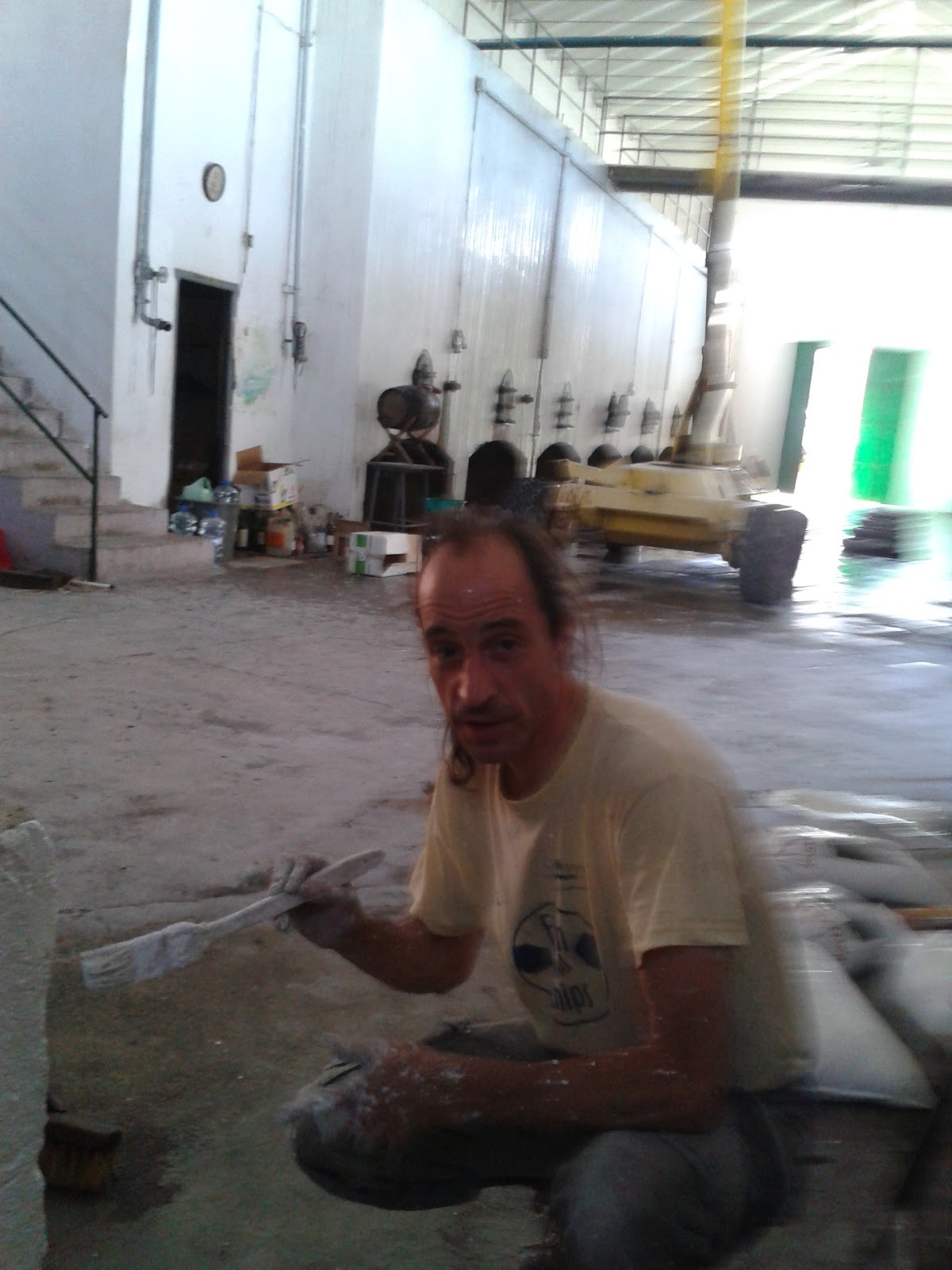
Yours truly doing a bit of painting

To be continued!  :)


Wednesday, 22 May 2013

Planting New Vines

At last! Hooray! After ten (10) years of thinking about it, and writing about it, and talking about it, I've finally done it!  I've planted about 150 vines in the empty spaces in the Carabaña vineyard, where a vine was missing for one reason or another.

 Newly planted vines, with protective tubing

I decided to plant Tempranillo, because the vineyard is a field blend of Tempranillo and Airén already, but there's not much Tempranillo - only just enough to make one barrel of crianza. I toyed with the idea of planting Malvar, or Torrontés or some other interesting local variety, but in the end I thought that there would be no point, as the quantity of wine I could make with it would be too small. I'll leave that idea for another project for the future.

 More newly planted vines

But the most crucial decision here was not really the choice of variety, but the choice of rootstock. In this case, the most important criterion (more important than resistance to drought, or resistance to disease, or resistance to limestone) was the fact that this is not a new vineyard and that the existing vines (about 50 years old) are very well established; and so their root systems will be very deep and wide and will be competing strongly for the water and nutrients in the spaces where the new baby vines will be struggling to survive and grow. So the rootstock had to be a vigorous and hardy one. The one that was readily available and which was recommended to me was one called "Paulsen 1103", which is not only vigorous, but also tolerant to drought and to limestone soils.

 Looking down into the tube

Well, that's half the job done this year. There's more to do next year! There are also about 100 vines in the vineyard where the grafted variety has died, for whatever reason, but where the rootstock is alive and kicking. These will have to be cut back and grafted.

They are so vigorous that in summer they turn into monsters like this one below:

A 'wild' vine, where the rootstock itself has sprouted
Tiny and numerous clusters on a 'wild' rootstock sprouted vine

And there are also about 20-30 vines that are dead and which will have to be pulled out.

I'm so glad I managed to do that task. It gets depressing when you think about doing something for so many years but never get round to doing it :)

Monday, 13 May 2013

Hi-ho! Hi-ho! To Fenavin I Went

Three days at a fair like FENAVIN was too much for me! I had a great time (socially and wine-tasting-wise) but it was excessive "work-wise", ie making contacts with importers and distributors, etc. Basically, because my production is so small, I already have all the importers and distributors I need this year anyway! And being nice to people for 8 hrs/day, 3 days in a row was really trying!!! I'd much rather have been alone in my vineyard!!!

Our stand "Caballo de Troya"
(my barrel is the left- most one with the"I'll be back" sign attached)

There were 14 of us who got together to rent a space in common so as to save on expenses; all of us more or less small-ish artisan-type producers of organic and/or natural wines. Each producer had one barrel.

Technically and logistically, everything worked out just fine, thanks to Jose Miguel Márques (Bodega Marenas) who coordinated between us and the fair organizers, and to Julian Ruiz (Esencia Rural) who kindly provided the barrels that we used to display our wines.

Socially, I devirtualized quite a few friends form Twitter and FB, and also made a few that have still to be virtualized!!!

I had a pocketful of visiting cards, but unfortunately have managed to lose them all; and of course now I can't remember the names of all the people who came to taste my wines! But here are some that I do remember:

Nacho Bueno, Spanish wine-blogger; sponsor of one of my oak casks (see this post), and collaborator in the creation of the 2010 coupage "Los Cinco en Punto"

Ignacio Segovia, organizer of The Winebus, running wine-tourism visits to wineries within a radius of about 2 hours from Madrid. Hopefully, he will organize a visit to me, when I have a winery that is 'visitable' one day!!! :)

Sam Caldwell, owner of SMC Fine Wines, who distributes to restaurants and winebars in La Mancha

A trio of Frenchmen (living in Spain): Carlos Campillo, of Petit Bistrot fame, the only winebar/restaurant in Madrid exclusively serving natural wines. Benoit Valée, importer of French and Spanish natural wines, to his new winebar, L'Anima del Vi in Barcelona, and Jean Jacques (surname?) soon to be starting a wine project in Madrid.

Mar Galvan, a professional wine-taster and writer, (for Verema among other publications), who took this photo of me!
Me and my barrel

Mónica Fernández Bobadilla, export manager at Pago Casa del Blanco, came to visit several times a day, so she could step out of her high heels and relax from the very serious and corporate ambiance at her own winery's stand!

who else?...


I have two interesting anecdotes worth mentioning (both involving food and wine! How surprising!):

Tuesday night

After closing up the shop at 7 o'clock (ie, rinsing out wineglasses, tidying up, etc) I was milling around trying to decide what to do for dinner, when my problem was instantly solved by Samuel Cano (fellow natural wine producer, from La Mancha), who'd booked a table for 10 at a restaurant, and invited me along. So we drove to Daimiel (about 20 mins away from Ciudad Real) and parked right next to the restaurant (which is of course impossible to do in Madrid!). It was a low, white-washed, traditional-looking building right in the centre of town, called El Bodegón. Inside, the decor was really nice (ye olde traditional style, tiles, exposed wooden beams, etc). In fact it used to be a bodega, and they'd kept some of the machinery and features for decoration. Downstairs in the basement, they had kept the 'tinajas' (large clay vats for fementing wine) and cut out a doorway into each one; and inside each vat was a table for two!! How romantic is that?

But we had a round table for 10 upstairs. I was expecting some traditional food from La Mancha, ie solid, consistent, no-nonsense energy-giving food, but was I in for a surprise!  It turns out that the restaurant did 'nouvelle cuisine' or 'fusion' or whatever it's called! So we were served plate after plate (I lost count after the 12th!) of intricate and complex delicacies (tiny portions on large plates!). They were all very tasty and interesting, but it's not really my style. It was in fact the first time that I'd had such a 'dining experience'. I'm really glad to have done it, but I don't think I'd do it again, if other options were available! I think we were given special treatment (as Samuel is a friend of the owner!) and we 'only' paid €55 each. This is a huge amount for me to spend on dinner, but on the way out I saw the menu at the front door and noticed that each one of those tiny plates we had cost an average of €20!!!! And we weren't charged for any wine, because we'd all brought our own!

Wednesday night

Action replay at 7 o'clock, milling around, and this time my problem was solved by Roberto (surname?), winemaker at Suertes del Marques (Tenerife). He was going round collecting bottles of wine and inviting people to a paella for dinner at the house he was staying at. Which was in Alcolea de Calatrava, about 20 mins from Ciudad Real. It was a sort of bungalow, with a large back garden and all the infrastructure needed for a barbeque, ie firewood, charcoal, grill, kitchen, table and chairs, etc!

Two paellas were planned (a vegeatable one and seafood one), but unfortunately a Frenchman was in charge of the cooking, and he burnt the first one!! For the record, it was Sebastien (surname?), who makes natural wine in Alicante! But to the important business of the evening: Roberto had managed to collect 28 different bottles of wine, which we all proceeded to taste blind, to see if we could guess at least the variety and the region. Well, I was in the presence of some awsome and experienced expert tasters (like Juan Ponce, Gregory Perez, Mal Galvan, Alfredo Maestro, and more etc), while I couldn't taste my way out of a paper bag, so I was just tasting and listening and learning.

Round about wine #12, I thought that I knew what the wine was, but I didn't dare to speak up, and lo-and-behold, when the bottle was uncovered, I was right - it was an oak-aged Albillo.

Then at around wine #20+, I was pretty sure that it was a Garnacha. The experts were humming-and-hawing and not committing themselves, so this time I just blurted it out. And it was! :)  That just goes to show, that if you practice enough and remember the wines you taste, you really can learn. I managed to identify that Garnacha, because I take every opportunity I can to taste Garnachas, and have been doing so for about three years! Even so, I couldn't identify the region!

Eventually at about midnight, the paella was ready, and it turned out very nicely!

Paella in the making

Then, more wine and wine conversations till about 4:00 a.m. We talked wine for the entire 8 hours that we were there! Amazing! No talk about football, politics, filmstars, or any of that other stuff that people tend to talk about. Absolutely brilliant.

I have to say that I behaved myself admirably, as I was driving. So I actually spat (most of) the wines we tasted blind, and then I stopped drinking altogether after the paella. Which brings me to the last anecdote: I was driving back to our own bungalow (on the other side of Ciudad Real) with Alfredo Maestro, who had promptly fallen asleep as soon as we set off! And he didn't even wake up when I got stopped by the police, and had to furnish documents and explanations!!! They didn't give me a breathalizer test, but I think I would have passed it if they had. So, home and in bed by 5:00 am. Not bad, considering!

Conclusion

Would I go again to a similar fair? Well, for the wining and dining and networking and conversational experiences, yes. But not to sell wine or 'make contacts'!  And I'd think twice about going to a fair for 3 days in a row!

And talking about wining and dining experiences, I'm going to end this post with a rant against Spaniards and Spain in general - because I've been living here long enough, and paying Spanish taxes for long enough, to have the right to complain!!!!  And what I'm complaining about is the absolutely appalling and shameful quality (and quantity) of the catering services provided at Fenavin. They consisted of a large functional cafeteria, of the type you used to see at airports, railway stations and bus-stations. No table service. Only 2 barmen attending hundreds of customers at the bar. I managed to get a beer after about 15 mins (but only because I saw someone I knew getting served and I got him to sneak my order in!). I didn't bother trying to get anything to eat, but went outside instead. Where the situation wasn't any better. There was a street with 4 or five bar/restaurants serving lunch. But did they buy extra food for the 3 days of the fair? Did they put out extra tables? Did they hire a few more waiters, to attend to literally thousands of extra customers from the fair?  No, they didn't! Go figure what's going through the bar owners' and fair organizer's heads, if anything! Oh well. I wasn't too bothered myself, because I'm used to it, but what must foreign visitors be thinking? What kind of an impression would they be taking home with them?

Thursday, 18 April 2013

Hi-ho, hi-ho, to Fenavin I go

In a few weeks there's a big wine fair here in Spain, called Fenavin , which I believe is the biggest, most serious, and most commercial wine fair held in Spain, and it'll be full of men dressed in suits!

Fenavin Wine Fair
(photo by El Crisol de Ciudad Real)

"What's that got to do with me or with Vinos Ambiz?" I hear you ask, and in fact I'm asking myself the same thing!!!  Well it's too late to back out now (and I've already paid up!) so I'll be going - on Tue 7th, Wed 8th and Thurs 9th May, in Ciudad Real (La Mancha, Spain).

This is the result of a bright idea over lunch one day last year, when a bunch of winemakers decided what
a cool idea it would be to gatecrash a mainstream, commercial winefair!! So one thing led to another and
here we are!  The name of the group we've registered under is "Caballo de Troya" which means Trojan Horse.

There are now 14 of us and we've taken a big empty space where we will offer our wines, each on our own
barrel or table. We've decided to be minimalist, so we haven't hired a stand or anything. This has the advantage of keeping our costs down, and maybe the importers tasting our wines will be able to focus better on them, without being distracted by fancy decorations and hostesses in short skirts! We didn't even want to put down carpet and just use the raw concrete floor, but the organizers informed us that we weren't allowed to do that!

Alfredo Maestro (Bodegas Maestro Tejero) Ribera de Duero
Charlotte Allen (Almaroja) Zamora
Fabio Bartolomei (Vinos Ambiz) Madrid and Gredos
Friedrich Schatz (Bodega Schatz) Ronda
José Miguel Márquez (Marenas) Cordoba
Juan Pascual (Viña Enebro) Murcia
Julian R. Villanueva (Esencia Rural) Toledo
Manuel and Lorenzo Valenzuela (Barranco Oscuro) Granada
Miguel J. Márquez (Dagon) Valencia
Nicolás Marcos (Dominio del Urogallo) Asturias
Rafa López (Sexto Elemento) Valencia
Ramón Saavedra (Cauzón) Granada
Samuel Cano (Patio) CuencaTodd Blomberg (Benito Santos) Galicia

You can find us here:

Pavilion: NOE
Street: 5
Stand: 11


Now I have even more tasks to do! ... bottling up different wines, sticking on labels, printing out info sheets, printing out business cards, looking for somewhere to stay for 2 nights, etc, etc, ...
 
Creative Commons License
This work is licensed under a Creative Commons Attribution-Share Alike 3.0 Unported License.