name="description" content="Terroir-expressing natural wine minimum intervention">
Showing posts with label natural wine. Show all posts

Friday, 8 January 2021

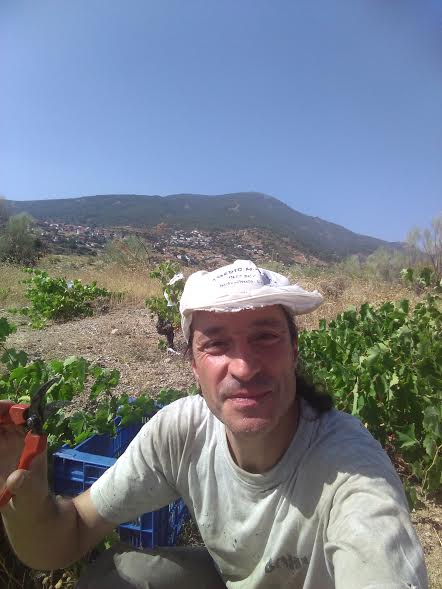
Vineyard Work in Sierra de Gredos

Vineyard Work in Sierra de Gredos


(This is a post which I wrote way back in March 2020 and which I just found in my Drafts folder!)


Another year, another post!

I'm very disappointed that I haven't been able to post more often. I'm either just too lazy, too busy or too tired! But I shall make another effort this year and see if I can do better than once a year!

(Aside: this is the third week of lockdown in Spain due to the Coronavirus pandemic. However, as a grapegrower and winemaker, I am considered as part of the agriculture and food sector, hence "essential services" and so am allowed to travel to go to work.)

So, during the month of February I was focussing on a vineyard to the exclusion of almost everything else. It's a wonderful vineyard, in the middle of a pine forest and surrounded by rock roses and pinetrees, off the beaten track, and so very peaceful and relaxing.

There are many problems with this vineyard, the most serious of which is the lack of rain, and a few  vines died this year. But there's nothing I can do about that.

Panoramic view of the bottom of the vineyard


Another problem is that wild deer have somehow been getting in and eating the shoots/leaves/grapes. So I've been checking the perimeter fence and have been fixing the weak points.

One weak point is between the lowest part of the fence and the ground. The sneaky beasts somehow manage to wriggle their way in through these tiny gaps! So I'm going round the whole perimiter and blocking all the gaps, no matter how small. Using rocks and branches and clippings.

The vineyard is surrounded by pinetrees and rock roses. Rock roses are hardy and invasive. They smell nice and look nice, ...but they're invasive! If you don't keep an eye on them constantly, they'll just take over your vineyard!

In the foreground: Rock roses that I've cut back making the fence visible
In the background: Rock roses growing through the fence

Another problem with the deer is that not only can they sneak in under the fence, but they can also leap over it! So, when I finish blocking the gaps, I'll go round the perimeter again, but this time looking for any low points. I will then raise the height using poles (tied to the existing posts) and string or wire, and possibly some old CD's.

I found the poles in the forest beside the vineyard:

Pine forest seen through the fence

Pine forest seen from the pine forest

I didn't actually have to chop any trees down! There were lots of fallen trees and branches lying around already. I just had to saw them into lenghths and drag them up to the vineyard:


Then I tied them with wire to the existing low posts, and strung up some bright tape:


Apart from all of that, I also gave the vines some manure this year. This involved, first of all, digging up around each vine. This is a really fun activity and I recommend you come out to El Tiemblo, in the Sierra de Gredos, and lend a hand next year in another vineyard :)

After digging up arround the vines, we shovelled in some manure, using wheelbarrows and shovels:


Shovelling shit!

Shovelled shit!


Apart from digging a hole/trench beside each vine for the manure, we've also hoed up a circle of grass around the vine, to help retain any rainwater that may fall this spring. This vineyard is very steep, so any rain that falls tends to run off as opposed to being absorbed by the earth, due to the grass.

This vineyard is Garnacha, about 50 years old, and I use it to make a classic red wine, aged in barrel. I used to get about 4 or 5 barrels (1500 bottles) but last year only 1 barrel (300 bottles) due to the drought.

I call it "El Castañar" because the vineyard is on the way to the famous El Castañar de El Tiemblo, chestnut forest of El Tiemblo, which is about 5 km further up the road.

And lastly, I had to clear up a slight mess caused by a pine tree falling into the vineyard and destroyimg a small part of the fence:


All that was in February.

In March I was mainly bottling up (including some pet nats), but I'll write about that in another post soon. Hopefully!

I hope you are all bearing up well during the lockdown and confinement. If you need more wine these days, I'd be very happy to ship some to you, or have my distributor ship it, depending on where you live!


Thursday, 30 March 2017

A Weekend in London, at RAW 2017


It was a very strange RAW weekend in London for me this year! 

Usually when I go to RAW, I come a few days before and arrange meetings, tastings, events, etc to make the most of my time, and to make the expense more worthwhile. But this year, due to 'circumstances', I wasn’t able to do that. The reason being that I had no wine available in London to use at said events; because my importers Otros Vinos had sold it all and the last shipment that I had sent over quite recently had been seized by HM Customs and Excise, and there wasn’t time to send over another shipment!

Of course there was lots of wine sitting at the RAW venue which I had shipped over specially for RAW, but due to HM C&E Regulations, I wasn’t allowed to remove the wine from the venue until after the fair – even though I’d already paid duty on the wine. Go figure! But anyway, such is life.

The upshot of the matter was that I had some extra days in London – with nothing to do!!  Apart from to relax and enjoy, that is. But I seem to have forgotten how to do that! I always seem to be active, running around, doing tasks, ticking items off my to-do lists, etc J

There were many events being held in the days before, during and after RAW in restaurants and winebars which I could have gone to (see this RAW page), but my mind and body seemed to be telling me to just stop it, let go and do nothing till Sunday 12th (the first day of the Fair). So I did. I went for a walk, bright and early, in Battersea Park, had a coffee by the lake (and started writing this post!).
Battersea Park Lake Cafe Anglo-Saxon Table
But I was soon interrupted - by the call of duty. There was champagne to be drunk! It so happened that Caroline Henry was signing copies of her new book “Terroir Champagne”:

Cover of the book
It was being held at a nice winebar and restaurant called Cellar, at 1 Voltaire St in Clapham. Within walking distance of Battersea Park, so off I walked!

Cellar, at 1 Voltaire St, Clapham
It’s a really interesting book, especially if you don’t know much about champagne, like me! There’s a brief history of the Champagne region and an explanation of why so many grapegrowers there use chemicals and why it’s so difficult to stop using them. Then there’s photos, interviews and info on about 60 champagne makers who are either organic, natural, biodynamic or generally respectful of the environment.

Moi avec le book et le T-shirt
So I ended up staying there all day, tippling champagne and chatting to all the people who came along to buy a signed copy of the book and to have some food and champagne; which for the occasion was in fact Fruit de Ma Passion, by Vincent Charlot.

I met quite a few interesting people over the course of the day and evening, though of course I forgot to take notes and photos!

One person that I met was Cain Todd, a philosopher! Who’s also written a book – called The Philosophy of Wine. We’ve agreed to barter a copy of his book for some bottles of my wine! J


Another person that I met was Rosanna McPhee, a foodie blogger:
Rosanna McPhee, right (with Caroline Henry, left)
And so it went, until it was time to go for dinner!

The first day of RAW was awful! I felt really bad and hungover. Not surprising really, as I drank far too much Champagne the day before! And more wine at night! But still, I managed to do what I had to do, ie pour my wines and talk about them for 8 hours non-stop. And it was a busy, busy, busy for those 8 hours. It was so busy that it was really difficult to escape from my table to go for a pee or to nip outside to smoke a quick cigarette, or even to get something to eat! J

But it helped that all the wines I drank were natural. So they didn’t contain any noxious chemicals which is what makes hangovers really bad. The only horrible hangover effects I got were from the alcohol itself! Which can be dealt with, by the passage of time and lots of water!

Me and my wine bitch!
The second day was much better, from a physical point of view, ie I went to bed at 10 o’clock the night before and slept like a log till next morning! The fair was just as busy as the first day; I finished all my own business cards AND my UK importer’s too! Day two was also easier easier because I had a helper at my table, so I was able to sneak off more often!

And so it went, another year at RAW. Am now back to the normal surreality of a small independent winemaker, ie pruning vines, fixing fences, bottling up, sending samples, preparing orders, going to tastings when I can, ... 

Cheers!

PS, My next post, which I'm working on already, will be Part 2 of my previous post "Sierra de Gredos as a Wine Region", which I think focussed far too much on the negative side of the coin. The next post will focus on all the good stuff that's happening there.


Thursday, 3 November 2016

Harvests 2016 all done

Another year, and once again all the grapes are in. My last harvest was the Malvar on Monday 10th October.  And not a moment too soon! Because after a long, long, hot, endless summer with zero rainfall, it stated raining heavily and properly all over Spain on Wed 12th! Ha! So I’ll have to find something else to complain about, as viticultural tradition demands J

I did a total of 15 harvests this year, in 15 different plots, for a total of 15 different wines:

1.      Albillo (Charco)
2.      Albillo (Fx)
3.      Garnacha (Charco)
4.      Doré (Fx)
5.      Doré (Pp)
6.      Sauvignon Blanc (Qx)
7.      Tempranillo (TET-A)
8.      Garnacha (Castañar)
9.      Garnacha (Dehesa)
10.   Garnacha (McCarb)
11.   Chelva (Early)
12.   Villanueva
13.   Chelva (Late)
14.   Airén (Carabaña)
15.   Malvar (Villarejo)

That’s 2 red varieties (Garnacha and Tempranillo) and 7 white varieties (Albillo, Doré, Sauv, blanc, Chelva, Villanueva, Airén and Malvar).

I vinify each plot separately even if it’s the same variety, because it’s more interesting that way. It’s amazing how different the wines are, even if the plots are close together and the winemaking techniques are the same. For example, in El Tiemblo (Sierra de Gredos) the Garnacha Castañar plot is only about 1 km away from the Garnacha Dehesa plot as the crow flies, but the grapes and wines are totally different.

The novelty this year is a variety called Villanueva. It’s not uncommon in the area but it’s usually just a few vines interspersed among another predominant white variety. But by chance a local grower, who has an entire vineyard planted to Villanueva, came by the winery one day to offer them to me. ‘Why not?’ I thought. It’s a rather tiny plot, and there was only 150 kg. So I crushed them and pressed them and let the must ferment in small tinaja – in tinaja because it was the only container small enough available at the time!

All the rest I’ve done before, and am following the line of ‘If it ain’t broke, don’t fix it’! That’s to say that for all of the wines listed above, I followed (am following) the same techniques that have worked for me in the past, with regard to decisions on type of container (steel tank, wooden barrel, clay tinaja), maceration times if any, with or without stems, etc.

The only crazy experiment I’ve done this year is to follow a recipe I read in Pliny the Elder’s ‘Natural History, Book 14, Chapter 12. I followed the first recipe of the three he gives. So I guess I’ve made (am making) a beverage called ‘deuteria’ by the ancient Greeks and ‘lora’ by the ancient Romans. This is the stuff that was quaffed by slaves and labourers. The original glou-glou wine?

Following are some assorted photos, from over the summer:

 
View of the Albillo (Charco) vineyard, with the Alberche river in the background.
El Tiemblo, Sierra de Gredos

Bird's eye view of Albillo macerating

Bottling machine

My Garnacha vineyard using no chemicals, next to a naked agro-chemical wasteland vineyard!

Bottling up

At a wine fair

Sheep in the Garnacha vineyard, eating weeds and dropping caca!

Sheep entering

Living soil, for healthy vines

My pet nat exploding on me! Too much pressure!

My Chelva vineyard, surrounded by the houses of El Tiemblo village

In another Garnacha vineyard, steep, in El Tiemblo, Sierra de Gredos

Bottling up!


And to finish off, a note on the word “sapid”

I generally find it impossible to have decent in-depth discussion on FB or other social media sites. And a few weeks ago, I found myself feeling frustrated because I couldn’t say what I wanted to say! I think that FB and other sites are just not the right place for a proper discussion or debate: basically, they all tend to favour spur-of-the moment, shooting-from-the-hip type comments, right there and then, whenever you happen to come across an interesting post that you feel like commenting on. There’s just no time to think before typing! Apart from wine, I also like words, so I was doubly affected!

This had been annoying me for days, so I decided to do something about it. After searching on the internet and after doing a bit of ‘due diligence’, I’ve come to the conclusion that it’s not a very useful word to use in written wine-tasting notes or while speaking live to an audience. The due diligence consisted in asking native-English-speakers, uncontaminated by knowledge of a foreign language, if they knew what ‘sapid’ meant. Not one did! English-speakers who know a Latin language would know ‘sapido’ (It, Sp, Pt) or ‘sapide’ (Fr) where it’s quite a common word for everyday use and just make the connection.

Firstly it’s not a very common word at all in English (see here, this is just one of many word-frequency sites) and so it’s not likely that the readers/audience would understand what it means. This may depend on the level of knowledge/culture of the audience though, so an audience of hardened winelovers may have come across it before. But still!

Secondly, once you discover the meaning of ‘sapid’, you also discover how useless it is, for it means “having flavour” “tasty”. Which covers just about every edible/drinkable substance in existence, except for water!

I suppose that a slight degree of usefulness might be attained if a bit of common sense is applied by the reader/listener, ie by assuming that the writer/speaker really means ‘very’ or ‘extra’ flavourful/tasty. But then why bother with ‘sapid’ at all? Why not just say ‘very/extra tasty/flavourful’ and make life easier for your readers/listeners, who are after all reading/listening to you with a view to learning something about wine! But then again, maybe they would enjoy learning a new word? Or are happy to be introduced to the secret and occult world of wine-tasting? Or would they hate wine forever on account of the arcane vocabulary used?

Well, whatever. Anyway, I feel a lot better, now that I’ve got that off my chest.  J

Monday, 26 September 2016

Albillo Harvest 2016, Sierra de Gredos

Well, that was quick! I can’t believe it’s over already! After only four days of intense work I now have about 2500 litres of Albillo fermenting away nicely.

Day 1: in vineyard, harvesting from 7:15 (crack of dawn!) till about 15:00. Six of us took in about 2000 kg. Lunch, then crushing. All done by about midnight.

Day 2: in another smaller vineyard, again at 7:15. This time the six of us took in another 1000 kg and we were done by 13:00. Lunch, and all crushed by midnight.

Day 3: pressing off the first harvest, after 2 days maceration

Day 4: pressing off the second harvest, after 2 days maceration

Scroll down for photos.

This year I decided not to do any experiments with the Albillo like I’ve been doing over the past few years. I’ve tried lots of options and variations, like different skin maceration times, fermenting in stainless steel, open top barrels, amphorae/tinajas, etc. So based on the feedback I get from people and on my own personal taste and preference, I’ve decided to make my Albillo like this:

-          - Crush and macerate for 2 days in stainless steel
-          - Press off, and put juice back into stainless steel
-         -  One racking only into a large tinaja, to remove the really gross lees
-         -  Bottle up in spring, after the cold of winter has passed
-         -  Age in bottle for at least 1 year

This was in fact the way I made my Albillo 2014 (from which I’m constantly receiving good feedback, AND it’s one of my personal favourites). So that’s that!

Climate/weather

Basically, this year in Gredos there was a very mild dry winter and then it rained a lot in May/June, and then a long hot dry summer. I presume that this affected the ripening of the grapes which was a bit odd; they ripened steadily and normally until about the middle of August when the sugar content was indicating a probable level of alcohol of 13%-13.5%, and then it just stuck there. I’m guessing that the vines shut down their sugar production due to the heat. So eventually I decided to harvest at 13.5% (on 27th Aug) as the grapes were otherwise perfectly ripe, ie golden skin, crunchy pips, stems starting to lignify, some leaves turning brown already, etc.

Well, there you have the meteorological info! I know some winelovers like that sort of data, but I personally find it kind of boring and not even all that relevant. I know that it’s important, but on the other hand, I also know that the interventions of the winemaker are much much MUCH more influential on the final wine. So it leaves me kind of nonplussed when I hear a comment like “yes, the 200X was a very wet/dry year” or some such. Or is this a cold-climate thing? Maybe in the Sierra de Gredos, with its dry continental climate, the yearly weather variations, like the one I just described above, it don’t really make that much difference?

More winemaking info

Sulphites. I haven’t added any sulphites (or any other substance, chemical, additive, nutrient, enzyme, etc) to the must. Why not?
1.              Sanitary reasons. Because there is no need to. I ensure that the grapes are perfectly healthy, ripe and clean; I select in the vineyard and reject unripe, rotten or otherwise undesirable grapes, and don’t take in any leaves, dirt, pebbles, etc (see this page for info on what I do and don't do in the vineyard)
2.              Terroir reasons. Because adding sulphites kills the yeasts and thus removes the complexity provided by all the different varieties of yeasts that are present at this time.
During the first few days, saccharomycescervisae is hardly present at all – the active yeasts are other species, including the ones feared so much by enologists and chemical winemaking engineers! (ie brettamonyces, candida, kloeckera and others). During these first few days, these yeasts provide all sorts of interesting flavours and aromas (including so-called “off-tastes”). But, as the alcohol level increases, these yeasts die off and good old saccharomyces begins to take over, because it’s very tolerant to alcohol. And at the end of the fermentation process it’s 100% dominant. This is what I believe is happening during fermentation. But I could be wrong of course!

Racking. I usually do only one racking to take the wine off the really gross lees, but I prefer to leave the fine lees in there. I believe that this a good thing because:

1.              They contribute to the taste and aroma of the wines
2.              They provide protection for the wines against spoilage over time, which is important as I don’t use chemical preservatives or stabilizers to do that

Filtering, clarifying and fining. I don’t! For the same reasons as above, ie for taste, for protection and for terroir expression. This often results in a cloudy wine which many people don’t like. Oh well, you can’t please all the people all the time, can you? And there’s no accounting for tastes! In any case I’ve found that if you leave the bottle standing vertically for a few days it clarifies itself nicely.
It’s interesting to note that all wines must have been cloudy (or clarified naturally by gravity) ever since winemaking began about 8000 years ago. It was only with the advent of bottling technology and the need to store and to distribute to a mass market, that wines started to get filtered, fined and clarified.
It’s not actually necessarily an intrinsically ‘good thing’ to clarify wine, in terms of quality, taste or terroir expression. It’s done due to the need for the wine to be stable and inert so that it can be transported and stored over long distances and over long periods of time.
Clarified wine is also of course ‘prettier’ to look at than a cloudy wine and so is easy to sell to the mass market. A bit like beautiful, perfectly round, shiny tomatoes (which sadly don’t taste of anything).

Photos and anecdotes


Albillo vineyard in El Tiemblo (Sierra de Gredos). River Alberche in the background

Tree in the shade of which we store the cases of grapes 
Close-up of Albillo grapes
  
Close-up of me!

Top-down view of Albillo macerating on skins (destemmed)

Albillo juice flowing out of the press

Flamenco moment :)

Albillo juice in full fermentation

Slight overflow of Albillo fermentation foam

All nice and clean again

Rest and relaxation time under pergola structure in the patio of the bodega

Thursday, 28 April 2016

Parker Points and Natural Wine


The other day the Parker Points for the Sierra de Gredos region in Spain were published in the Wine Advocate. About 25 producers had sent in about 120 different wines to be rated, including myself; I sent in only one bottle of Garnacha 2014.

I was satisfied to see that my quality is remaining constant. My Garnacha 2014 was ranked in position 118 out of 118, with 80 Points!  And last year when I sent in three wines they were ranked in positions 150, 149 and 146 out of 150!  So no change there!

Wonderful! I think this is an excellent example of subjectivity in wine tasting. On the one hand my wines get the worst possible ratings from the Wine Advocate, yet on the other hand, they are sold and appreciated in many top restaurants and winestores all over the world. (Just look here for a list of outlets that carry my wines).

Well, I suppose I could use my horrible score for anti-marketing in the 'natural wine niche/ghetto' if I wanted to; I'm sure it would go down a treat, give rise to some chatter on social media, and some people would love it. But happily, and thankfully, I don't even need to bother doing that; I must be doing something right because my sales are doing very nicely these days! (touch wood!)

I think it's a terrible shame that so many producers, especially small ones, waste so much time and energy on chasing Parker Points. It's really a no-brainer for the vast majority of them. They would be much better off seeking their own markets and clients for their own unique and individual wines; instead of forcing their wines to conform to an international standard taste.

It's a no-brainer because there are literally thousands of producers who are all doing the same thing. The competition is brutal, and probably loss-making! Why not find your own niche? Why not be a big or medium sized fish in a small pond? Where you can actually know and speak to the outlet managers and wine-list curators at restaurants and even with some of the final customers? As opposed to being one minnow among thousands, swimming with the pikes and sharks? Where you are just one ‘account’ among many and the relationship is purely commercial. But, hey, I’m just saying! Each winery is obviously free to choose their own path - in terms of viticulture, winemaking and promotion/sales.

Apart from the above commercial considerations there is also the much more interesting ‘subjectivity’ aspect. It’s all part of the incredibly varied colourful and complex wine world which I’m so happy to be part of. My experience of the wine world over the last decade is that there isn’t just one monolithic wine world, but many different wine worlds (or niches or ghettos!) (or extending the previous metaphor, bodies of water). And each has its own cast of characters, rules of the game, criteria and points systems (though not necessarily numerical ones).

The big difference between Parker’s World and the other worlds is that Parkers’ World is hugely more enormous in all senses: there are thousands of wineries, thousands of intermediaries, thousands of outlets, and probably millions of wine consumers who pay close heed to what thousands of writers, journalists, bloggers, wine critics and sommeliers all have to say. The dominance is such that it’s not surprising that everyone forgets about the existence of the other tiny worlds. Maybe my world is tiny in relative terms, but it’s still big and complex enough to be self-sustaining and independent.

Let me clarify my thoughts here. I have nothing against the Wine Advocate or any of its similar publications with their points systems. I believe they have all done a great job over the last three decades or so, widening the wine base, and bringing many people into the wine universe who otherwise would not have bought wine at all.

They have done away with the snobbery and elitism, and they have simplified what was often an unnecessarily complex and arcane private world, which was intimidating and unwelcoming for new consumers.

But like in all good things there is also the other side of the coin which should be borne in mind. One of them is that people (producers, writers, distributors, outlet managers and the final consumers) all tend to think that Parker’s World is the only game in town, and that its rules and points and criteria are the only valid ones.

Example 1: Cloudiness. The rules in Parker’s World say that all wines must be transparent and not have anything floating in wine in the bottle; while the ‘rules’ of the Natural Wine World say that it doesn’t matter whether a wine is cloudy or not. Fair enough, rules are rules and if you want to play in Parker’s World you have to abide by them (otherwise you get 80 Points or less!).

But what a shame to restrict the enjoyment of looking at a glass of wine to a single dimension. Cloudiness can be beautiful to look at too; especially holding your glass up against the sunset.

Example 2: Sediments. Same as above. Though in this case some wineries apologetically explain on the back label that it’s OK to have sediments at the bottom of the bottle because it’s a ‘natural’ process. Ha!

Example 3: Filtering, clarifying and fining. Again the rules of Parker’s World say that all wines have to be clean and sterilized and stable. Why? Why take out all those ‘bits’ that add delicious flavours and complexity to the wine? And which also help to protect and conserve the wine.

There are several consequences of all the above restrictions:

Firstly there is the question of standardization/globalization/homogenization. The great majority of wines sold these days, are all very similar to each other in style, no matter what part of the world they come from or what grape variety they were made with. On the one hand this is great because millions of consumers can now buy good drinkable wine at a good price without fear. But on the other hand, (1) it’s terribly boring and (2) it’s a sad loss of regional diversity.

Secondly there is the question of the restriction or limitation of acceptability of all the characteristics of a wine. All the players in Parker’s World tend to be very intolerant of any characteristic that is out of their narrow range of acceptability.

The most mentioned characteristic in my experience is the volatile acidity content of a wine, ie the ‘vinegariness’. The same applies to other characteristics such as acidity and sweetness. The range of acceptable aromas and flavours is also limited; if a given wine does not conform to certain expected characteristics, then somehow it is deemed not as good as another one. So we have thousands of wineries all striving to attain 100 points, or approach this Platonic ideal of what the wine should conform to! Whatever happened to regional and personal diversity? Uniqueness? Terroir? All gone in the name of standardization and massification.

Oh well! Basically I find these restrictions sad and boring. I mean, what’s wrong with drinking a wine that’s a bit more acidic/sweeter/alcoholic/weaker than usual every so often? Is it not interesting and pleasant? Or is it better to stick to a safe, clean, predictable wine every time? But there’s no accounting for taste. As I said above, I’m happy and honoured to be a part of the tiny natural wine world, providing different and interesting and complex wines to a growing number of winelovers who enjoy them for what they are, without worrying about how many points they scored.


Saturday, 13 February 2016

Back Label Information

Back in October 2014, there was a flurry of comments on my FB page about what I had written on my back labels. I replied to all those comments here. Well, it's happened again, though this time it's not a flurry, just one person who's taken umbrage, but nevertheless, this has caused me to think about this matter again, and to write this post.

First, here's the back label in question:


Next, to get things in context, I find it helpful to remember the following:

1. It's only wine! In the great scheme of things which are important and essential to me and to many other people, wine and labels are pretty far down on the list! I'm thinking of things like the Syrian, Palestinian, Kurdish tragedies, the bankers/economists/politicians who are destroying our society and empoverishing millions, the dangers of nuclear power, deforestation, child slavery, the whales, the ozone layer, the Sea of Azov, etc, etc, etc...

2. Even in the trivial world of wine, labels are fairly low down on my list of important things: before labels comes the quality of the wine itself, the quality of the grapes, the environmental impact of growing my grapes and making my wines, etc.

So, having established that, I can now explain my position and thoughts on what I write on my back labels.

My first and main motive for scupulously listing the ingedients and processing (and also what I don't add to the wine, and the processing that I don't subject the wine to) is to inform the consumer, the potential buyer, of what's in my wine and how it was made, so they have as much information as possible available to them to decide if they want to buy it or not.

All the feedback I have recieved so far from consumers has been positive, and they have all been very pleased indeed to have had that information.

The spirit (though not always the letter) of all legislation covering foodstuffs is in fact the 'protection of the consumer'.

As you may or may not know, the wine industry is exempt from the normal labelling requirements, for some reason or other. And I would be very interested to know how this exemption came about, as I have been unable to find out for myself. On the other hand, the legal requirements on what is obligatory and what is forbidden to write on wine labels is extraordinarily detailed and complex. There is obviously something very fishy going on here, and consumers' interests are not being protected. It seems to me that it's the wine industry's interests that are being protected.

The labelling legislation is in fact the root of the problem, and that's my second reason for writing so much information on my back labels, ie to draw attention to the problem, with a view to generating some debate and hopefully a solution.

In keeping with my back label philosophy, I will also explain why I am NOT writing all that information!

I am NOT providing abandant information on my back labels as a publicity stunt or as clever marketing, in order to sell more wine. Thankfully, I am a very small producer (around 12,000 bottles per year) and (again thankfully) I don't have any problems selling my wines. So I don't need to drum up sales. You can believe that or not, as there's no way I can actually prove it. (Philosophically or logically it's actually impossible to prove ANY negative statement!)

I am NOT doing it to denigrate or show up other honest hard-working grape-growers and winemakers. I say this because several fellow grapegrowers, winemakers and other agents in the wine world have taken it personally, and view my back label information as an attack on them or on their agricultural and/or winery practices. Well, I'm sorry they see it that way, but like I said, that's not my intention at all.

Unfortunately, there's little I can do about people taking offense where none is intended, short of not writing all that information I want to convey. 

The little I can do is to try to write clearly and unambiguously so as not to send out the wrong message or unintentionally offend anyone, especally when dealing with a hot topic such as this one. I even keep my sense of humour and irreverent cynicism under control, even though I like to be irreverently humourous!

I think it's ridiculous to suggest that I am out to show anyone up or point an accusing finger at them. I've received comments along the lines of "if you write that, you imply that...."  Well, maybe yes, or maybe no, but how can anyone ever know, unless I, the writer, affirm or deny it. And even then, I could be lying!!!  The same case can be made for any written material at all.

For example, here's a typical phrase often written on back labels "....with carefully selected grapes..."   What? How dare they imply that I don't select my grapes carefully! See what I mean?  

It's a no-brainer to read words on a label and then say that those words 'imply' something other than just what they say.

If I say that "I don't add oak chips", it means that I don't add oak chips. It doesn't imply that I'm accusing other winemakers of adding oak chips. There can be no fruitful or useful outcome to an argument based on what my words supposedly 'imply'.

Another criticism I've recieved (again from people in the trade, not consumers) is that I'm trying to occupy the moral high ground, being holier-than-thou, being a hipster-cool ultra-fashion eco-warrior, etc. Again nothing could be further from my mind.

I do what I do (ie, organic agriculture, no chemicals, no unnecessary substances or processing) because I believe that it's better to make wine that way. That way I don't pollute the environment and I don't put consumers health at risk. I have decided that that's the way I want to work, but I have nothing to say about how other people have decided to work. Especially not on my back labels. This is a totally personal decision which of course I believe is "right". It's my tiny contribution to making the world a better place.

In a private conversation, or at a public event where I've been invited to speak, I will certainly express my opinions about polluting the environment and adding chemicals and substances to wine and other foodstuffs, and people who know me or have heard or read me, know what I think about that.

Now, does that imply that other grapegrowers and winemakers do pollute the environment and put their consumers' health at risk? No it doesn't. (See above)  Common sense would suggest that some of them do, though.

I like to think that I'm a pragmatic sort of person, and I much prefer to actually do something or take action, rather than waste my time blowing hot air and complaining. That's why I actually practice organic no-chemical agriculture and actually make no-additive wines. I believe it's a complete waste of my time to argue or try to convince others to be like me! Therefore I don't. I obviously believe that I'm in the right, but I also believe that no good can come out of me trying to make others "right" too.

Perhaps if all wineries were used a similar back label to mine (either legally or voluntarily) and described what they do and don't do to their wine, then their consumers could also decide, with all the facts at hand, whether to buy their product or not. I don't understand why they don't. Surely they're not doing anything illegal? Or are they doing something that they don't want the public to know about? I don't know, and "Frankly, my dears,..."!

Cheers! Here's to what's inside the bottle, not outside :)


Creative Commons License
This work is licensed under a Creative Commons Attribution-Share Alike 3.0 Unported License.