name="description" content="Terroir-expressing natural wine minimum intervention">

Friday, 16 September 2011

Pressing Tempranillo, and Crushing Graciano

  
Last Wednesday evening/night (14th September) we:

1) pressed the Tempranillo that we harvested two weeks ago (see this post), and

2) crushed about 500 kg of Graciano that we bought in from our friend and fellow natural winemaker, Samuel Cano, from la Mota del Cuervo, a small town right in the middle of La Mancha.

Lovely Cases of Graciano Grapes

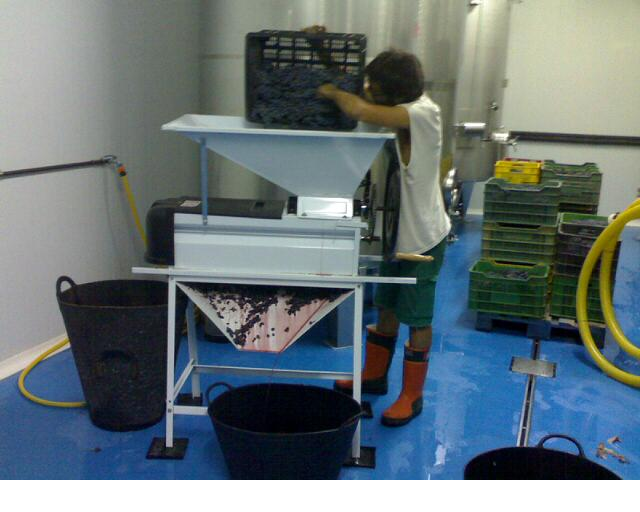
We did both tasks a bit in parallel and a bit in series! First we set up the 'assembly lines', inside the bodega for the crushing and ouside in the patio for the pressing. For the crushing we had to position: the pallet with about 30 cases og Graciano grapes, the manual crusher-destemmer, a bucket to catch the stems, two buckets to catch the must/skins/pips, a clean stainless fermentation steel tank for the must.

Tipping Cases of Graciano into the Crusher

Meanwhile in the patio we had: the steel tank containing the Tempranillo wine, skins and pips (In 17 days, the fermentation was complete), one manual cage press, two buckets, another clean stainless steel tank. It took about an hour to set everything up, about an hour to crush the Graciano, and about 2-3 hours to clean everthing up. We did the pressing at the same time.

Manual Cage Press, Bucket, Full Tank, Bucket, Empty Tank


Top-down View of Fermented Tempranillo Skins in the Press


Tempranillo Wine Pouring out of the Press

Crushing really requires two people to do properly: one to tip the case slowly into the crusher while the other picks out leaves, damaged grapes, etc. In this case we owe Samuel Cano a favour, as the quality of the grapes was excellent (none rotten, none damaged, none over- or under-ripe) nor were there any leaves, twigs, earth or any other foreign matter. One of us turned the flywheel while the other held the machine steady, helped the stems and grapes come out, etc. In between cases, one of us would nip out into the patio and press the Tempranillo down another centimeter or two.

Scooping out Tempranillo Wine and Grapes
from the Tank into the Press

We've found that this is actually the best way to press manually, ie very slowly and over a long period of time. The slower the better. In fact, when we opened up the cage to do a second pressing, we found that the cake was already so dry that we didn't have to do it.

It's very difficult to press slowly! For two reasons: 1) because when people are helping us press, they're happy and exited and emotional and so they instinctively want press fast, as if they were pumping water out of a boat! And when we (Jaun and myself) do it ourselves, we want to do it fast so we can finish as soon as poss so we can go home to sleep at a not too unreasonable time! 2) beacause the press is usually quite close to the crusher, and crushing really is a fast and energetic task, and so that feeling infects the people working the press!

Some technical winemaking details:

There were 30 cases of Graciano, but we didn't crush all of them. We decided to pour 5 cases in as whole clusters, uncrushed, stems and all. Hopefully, these grapes will undergo carbonic maceration and fermentation will start inside each individual grape. The stems will also provide a bit of acidity - but no 'green' or 'veggie' notes as we made sure that they were well lignified and not green or unripe.

Posing with a Bottle of Airén 2010 Maceración Carbonica
(which apparantly went down very well at the Chambers St Wine and José Pastor Selections presentation/signing of Alice Feiring's "Naked Wine" that very evening

Wednesday, 14 September 2011

Airén Harvest 2011

On Saturday 10th and Sunday 11th September we finished harvesting the Airén in Carabaña (Spain).

The Good News

The good news is that the grapes were very healthy and showed no signs at all of any type of infection (eg, mildew or oidium). They were also perfectly ripe (for the type of wine we’ll be making with them), with a probable alcohol level of 12% and good acidity.

Yours truly

The weather on Saturday was exactly the same as it has been for the last few weeks here in Madrid, ie hot and cloudless, probably about 40ºC max during the day. On Sunday, it was pretty similar but with a bit of light cloud cover, and even occasional breezes (which were very much appreciated!)


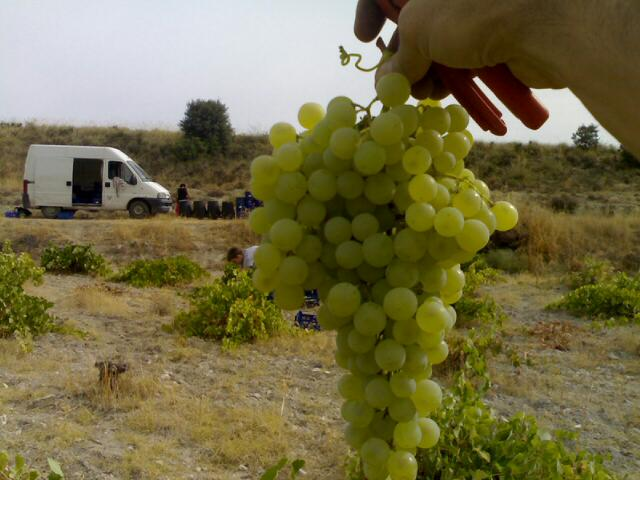
A Beautiful Healthy Bunch of Airén

More good news was that we had a very good turnout of volunteers, especially parents and children. (We rely on friends and family and neighbours for the harvesting, and to a lesser extent for the pruning, as we can’t afford to pay professional pickers!). So we managed to finish the Carabaña vineyard and can now concentrate our new vineyard in Villarejo.

A Relaxing Moment 

The Bad News

The bad news is that the rabbits this year have eaten a significant proportion of our grapes! Usually, they’ve been content to nibble a few bunches from the vines on the edges of the vineyard, and we’ve been happy with that too. But this year, there must have been a population explosion in rabbit-world for some reason or another! Basically, ALL the grapes from the edge vines were eaten, the proportion getting less towards the centre of the vineyard furthest from the edges.

Rabbit Hole

This year we only have about 600 liters of must, which will give about 800 bottles of wine, when we usually get from 1000 to 2000 bottles :(

Rabbit Hole 2

We’ll have to do something about that next year. Any suggestions welcome! So far people have suggested the following:

  •  A fence (for too expensive and time consuming for us. It has to be high AND buried)
  • Shiny CDs hanging from the vines
  • Traps
Crushing and Pressing

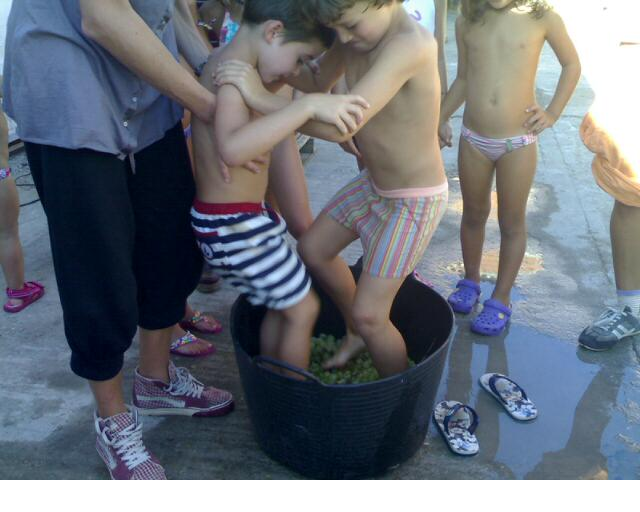
Again, as we did with the Tempranillo two weeks ago (see this post), we had a manual crushing machine and plastic buckets for those who wanted to stomp the grapes barefoot.

Crushing Grapes Underfoot


Crushing Grapes with Technology!

Conclusion

First, I’m very pleased about the following:

- that we’ve finished harvesting Carabaña in only 2 weekends

- that so many people turned out to help, and that they all had a great time, especially the children

- that the quality of the grapes was so high. The wine will be awesome (assuming we don’t do anything wrong over the next few months!!!)

But secondly, I’m now a bit worried about harvesting the new vineyard at Villarejo. The grapes are very ripe at this very moment (about 12% probable alcohol, according to the quick n dirty sampling and analysis I did yesterday) so we really ought to harvest them all this weekend. And there’s a lot of grapes there, about 4,000 kg, and we never know how many people will be coming to harvest. My head is full of doubts and worries and minor details (Where are all the scissors? Are there enough cases? Where can we get a van for transporting the grapes to the bodega? What to do for lunch? Who should I call? How to stop these monkeys chattering in my brain so I can think straight? ….) I’ve lost my appetite and am smoking like a chimney! At least I’m still writing posts and uploading photos to FB and Twitter!

PS. There are more photos of this harvest (and of last week’s) in my albums on FaceBook here: http://

Tuesday, 6 September 2011

Let's Hear It for Industrial Wines

A parody. Imagine a crazy fantasy world dominated by natural wine corporations, where the vast majority of the world population drink natural wine, where hype and convention and globalized values rule, where wine is rated and sold based on Joly Points... and where industrial wine-makers are the weirdos that are misunderstood (willingly or otherwise), ridiculed and attacked. This is the sort of post you could expect to read.

------------

A new book was the subject of a review at "WINEBLOG"

The book is entitled "Industrial Wine" and it's by FRED BLOGGS and A.N.OTHER.

Put me down as one of the dissenters. There’s no such thing as industrial wine, if what you mean (which is what’s generally meant) is the absence of natural processes in winemaking. Because winemaking is a natural process. Manipulated wine isn’t wine at all, but a chemical compound.

To be honest, you have to grant that while “industrial wine” might mean manipulated in theory, it really just means more manipulation than normal in practice (which is what it has to really mean if the wine is to be wine at all). Even with that caveat, I still have a major problem with the whole concept.

Wine’s main goal is to be good, not “industrial”. In fact, “industrial” is a pretty nebulous concept when everyone is processing their wine with as little manipulation as possible, even those who would claim to be the avid adherents to the creation of “industrial” wine. There are some who really take the manipulative thing pretty far. Maybe for them the use of the term “industrial” wine is a little more apropos. But based on my tasting, another term, “bad” wine, is equally apropos. Since wine that’s really not made with all nature's processes at our disposal tends not to be very good, and lasts way beyond its natural lifespan. I think most practitioners who preach “industrial” wines, but who produce high quality wines, in fact eschew the more radical “industrial” practices.

For reasons I’ve harped on at length, the theory that one wine is better than another quickly yields to the reality that trying to say what is a better wine is a really mushy endeavor. There’s no real agreement among wine tasters, since so much of what one means when pronouncing one wine better than another is simply
that one wine meets that particular wine taster’s preferred wine profile. I.e., if you like big wines, the big wine is preferred. If you like lighter, wines, then a lighter wine is the “better” wine.

The one place where I would definitely recognize that one wine is better than another is where one of the wines has a serious flaw. I do think that a wine that’s horribly infected with Mega-purple, or one that’s totally dominated by artifical tanins, is clearly inferior to a clean, well-made wine. But that’s about it when it comes to superiority of one wine over another. And the more “industrial” a wine, the more likely it is to be flawed.

So when an “industrial” winemaker proclaims that his wine is superior, he’s expressing his own subjective, and highly biased, opinion. And, to my mind, that opinion is less than worthless when repeated studies have failed to show that chemical farming, for instance, really translates into a superior product. And when he says his wine expresses the “banality” of his vineyard, he’s mostly mouthing what has become accepted but meaningless “winespeak” of our age.

You get a bunch of wine tasters together, even not very experienced ones, and exept for the most obvious examples (and maybe not even then), they will repeatedly identify the vineyard, region, state, and continent of the wine they are tasting. If "banality" had the meaning so often subscribed to it, then blind tasters should always fail to accurately identify the wines pedigree. But they can’t.

None of what I’ve said means that I favor the profligate use of all sorts of natural processes in the vineyard on a prophylactic basis. But the use of some natural and sustainable techniques when conditions require some sort of response to the bad hand nature has dealt you, is far better than letting your grapes go to hell. And use of one natural process (biodiversity, for example) to try to control weeds through predation really isn’t in my mind, in theory, any different than using some other natural process for weed control.

So put me down as one who, when he hears the terms “industrial wine” or “chemical wine”, really hears “bunk”.

---------

The above is a parody of this post: http://artisanfamilyofwines.com/blog/?p=1757


Sadly, as is generally the case with these natural wine bashing posts, all the author did really was to touch on the usual stereotypical and boring side-issues. I really wonder why it's like this. Do the authors not do any research at all? Do they just listen to what their like-minded friends utter and then turn it into a post? Where do they get their misinformation? It just seems to be blind faith and no reasoning, an irrational desire to destroy some kind of conspiracy.

To address the points briefly:

The flaw thing. Yes, it's like "I've tasted a few wines from Burgandy and I thought they were flawed, therefore all wines from Burgandy are flawed" !!! Give me a break! Whoever said that there are no bad natural wines? It's just like any region or style of wine - some are good, some are bad. Some you may like, some you may not. Most natural wines are not high in VA, nor are they oxidized. Most natural wines in fact fall in a standard range of acceptablity for all the different characteristics of wine; though some push the envelope, and that's where many conventional tasters find flaws where none exist. Many, though not all, conventional wine tasters are too used tasting big 'soups' laden with sulphites, enzymes, tanines, flavour-imparting yeasts, oak-chips, etc, that they have difficulty appreciating the taste of a real, natural, authentic, un-overly-manipulated wine!

Identifying the terroir. This is new one for me - I've never come across this 'argument' before. So experts are unable to identify a particular wine blind and say where it comes from! What on earth is that supposed to prove or disprove? That the whole concept of natural wine is rubbish? Or what? In fact, thanks to the increasing globalization, homogenization and standardization of industrial wines, it IS very difficult to tell any of them apart, no matter what region, country or continent they come from, or what grape variey was used. All the chemicals no doubt taste the same and are probably manufactured by the same few multi-nationals. This is why more and more people are drinking natural wine!

Spraying. Who said natural winemakers let their grapes go to hell? There are numerous natural, organic, sustainable, non-polluting, non-toxic techniques for ensuring healthy grapes even in adverse climates. The info is out there, so I won't bore you all with it here.

Gasoline for tillage. Jeez! Who said natural winemakers all use tractors for tillage? There are other techniques for weed control, which again I won't bore you with here. And in the case of natural winemakers who do use tractors, I'd say that the use (or abuse) of internal combustion engines is part of a much larger problem that affects the entire population of car-owners, not just grape-farmers.

Manipulation. This is the key concept for natural wines (IMHO), though the author doesn't quite get it. He seems to think that natural winemakers think that manipulation is bad. Duh! Obviously we have to manipulate, as the vines don't prune themselves, nor do the grapes pick, crush or press themselves. Etc, etc. We don't think that manipulation is bad and we know that it's not natural to plant vines in rows, and to prune them so they produce more grapes and less foliage; and we know it's not natural to crush and press grapes using machines. Etc, etc.

What natural winemakers and natural winelovers are against is "excessive" and "unnecessary" interventions and manipulations. I won't bore you all with a long list (the info is out there), but it includes things like adding artifical colourants, enzymes, industrial yeasts, bacteria, oak chips, acids, tannins, micro-oxygenization, reverse osmosis filtering, and in general using substances and techniques that strip the wine of its originality and authenticity and turn it into an industrialized homogenized product.

What was the point of that post? and of many like it? Why are these people trying to debunk natural wine as a category? Do they not realize that there are thousands of natural wines out there, all different from each other? How can they say that they're all bad? Can they not just stick to their globalized brands and leave us alone? Are they scared of losing market share, or what? Do they believe that they're protecting innocent winelovers from unscrupulous fraudsters? I really don't know.

One thing I do know, though, is that more and more people are drinking, and buying and demanding natural wine. That's the bottom line, and all the rest is words, words, words.

Monday, 5 September 2011

Sampling the Airén

I went out to the vineyard in Carabaña (Madrid) yesterday (4th September) to take samples of the white Airén grapes. First the low-down data, then the anecdotes!

The quality is incredible this year - not a single bunch that is bad in any way or infected with mildew or oidium or anything else. They are all clean and healthy. This is rather unusual, extraordinary even, as most years there are a few vines that are affected in some way.

Healthy Bunches of Airén

Healthy Bunches of Airén (2)

Healthy Bunches of Airén (3)

After looking really hard for something to complain about, I can say that the animals have eaten more than their fair share this year, especially round the edges of the vineyard. perhaps because the grapes are so appetizing! Or perhaps because we haven't taken any measures at all to prevent them. Maybe next year we should hang up some shiney CDs or something.

Vine Eaten by Animals

The quantity was also looking OK. Unlike the Tempranillo, of which there was very little (see this previous post). There were also a few vines that were looking a bit weak and not very vigourous. I think that this year we definitiely have get a lorry-load of manure in.

Incredibly Vigorous Vine (Airén)

I did a semi-rigorous sample this time, ie not quick-n-dirty, but not ultra-rigorous either. Looking through the refractometer, I got a probable level of alcohol of 11.3%. And using the mustometer, 11.5%. For the last 8 years we've always harvested when we get a probable level of 12%, and we're going to do the same this year. If the weather stays nice-n-hot-n-sunny all week, we'll probably harvest over the weekend, after doing another few samples during the week.

Nice Bush, Weak Vine (needs manure)

This time I managed to get out to the vineyard quite early, at 9:30, so it was nice-n-cool! I saw a couple of rabbits eating the grapes but they were too fast for me to take a photo. I remembered to take a pair of socks this time, but forgot my shoes! In Madrid, I usually wear sandals from April, and put away all my socks and shoes till about October - except socks and shoes for working in the vineyard/bodega, but for some reason I stored these ones too and haven't got round to fishing them out.

I also forgot to take a container to hold the grapes that I was picking! I was thinking of what to do, as there was absolutely nothing in the car that I could use. Then I saw something white in the middle distance lying among the vines, and it looked like some litter (shock, horror) so I went to investigate. And was it not a plastic bag! Perfect for holding samples!

Then I went to the bodega and crushed the grapes and did the analysis. My last task of the day was to stick some labels on a lot of wine that we bottled a few months ago. It was the Garnacha 2010 with about 4 months in old oak. Only 4 months and old oak so that the wine doesn't get dominated by the oak flavours and keeps its original aromas and tastes. Just enough to "round it off" a little.

I printed the labels myself, as it would be too expensive to do proper labels at a printers - there are only 300 bottles of this wine (267 bottles as of yesterday!).


Even though a barrel in theory holds 300 bottles (225 liters), in practice we only get about 290-295, because the bottom always contains too many lees to bottle. Especially in our case, as we don't filter our wines. I've only sold 4 of these bottles so far, so that means we must have drunk about 20 in samplings and tastings!

Our Bottle Rack

Our 'bottle rack' is a bit precarious to say the least! It consists of plastic crates piled up 3-high in a tiny space between the wall and the oak casks in the barrel-room. At least the temperature is good!


Monday, 29 August 2011

Tempranillo Harvest and Crushing 2011

All done! Grapes picked and crushed already! I have to check my notes from past years to be sure, but I get the impression that the harvest is earlier and earlier every year!

Picking

We picked the Tempranillo grapes on Saturday 27th August, and, unusually, it was a very relaxed, no-stress, no-rush, family and children oriented day. Altogether there were 7 parents, 7 young children and only 2 singles!!!

The grape-pickers

We started rather late, at about 10 o'clock. Which is not bad actually, considering that we had to wake the kids up early while they're on holiday with no school, get them dressed, give them breakfast, and get all their stuff together, etc, etc!!! One mother and children hadn't even arrived at 14:00 (when the above photo was taken) and when we were finishing off and getting ready to go to lunch!!!

We picked about 400 kg max, which is the lowest quantity we've ever picked from that vineyard over the last 8 years. I don't know why so little this year. Maybe the climate? It was a rather cool summer this year. I shall have to ask around. Maybe also we need to bring in some fertilizer? In the past we've always brought in a truck-load of organic manure every 2 years, and we should have done it this year, but we didn't (due to circumstances!).

The quality on the other hand, was excellent. Not a single sign of mildew or oidium or anything else.

Nice healthy bunch of Tempranillo

More nice health bunches of Tempranillo

In fact, this year we didn't even apply sulphur to the vines at any time. Some years we spray sulphur powder on the vines if there's a risk of an outbreak of oidium/mildew/etc, but this year it wasn't necessary.

Grape-pickers in action

A corner of the vineyard

Yet another healthy bunch of Tempranillo

It was all over by 15:00, and after taking the grapes to the bodega (in Morata de Tajuña) we all went to a bar with a 'terraza' for coffee, beer, ice-cream, etc, and stayed there till the evening. It was the quickest, easiest harvest I've ever done, in fact it didn't seem like work at all!!!

The last thing I did before heading back to Madrid, was to take the grapes outside, so they could cool down during the night.

Crushing

We crushed the grapes today Sunday 28th August. Again, it didn't seem like work at all as there was such a small quantity. We were done in a few hours.

We crushed most of the grapes using this machine (below): a manual crusher-destemmer. You tip a box of grapes into the open top and turn the wheel (left). The grapes fall between 2 rollers that are spaced at less the width of a grape (eg, about 0.5 cm), are crushed and fall down into the waiting 'capazo'. The stems are ejected at the end opposite the wheel.

Crusher-Destemmer

Crusher-destemmer in action. Empty boxes on the left

But we also crushed some underfoot (see pic below). I've heard that people pay good money to go and stomp on grapes! Hmmmm!

Crushing and stomping

Lastly, as they say in Spain (well, at least in Morata de Tajuña) "You can't make wine without beer!"

Cheers! or "Salud y buen vino"

And really lastly, in the end there was about 400 l of must (including skins and pips) which should be more than enough for a 225 l barrel of crianza, including some liters for top-ups. The density of the must was 1097 which should give 13.5% alcohol, more or less.

Friday, 26 August 2011

Pre-Harvest Sampling (Tempranillo)

This morning I was in the vineyard in Carabaña (Madrid, Spain) taking samples of the Tempranillo; and as we suspected we're going to harvest tomorrow, as the probable level of alcohol will be about 13,5º.

Tempranillo Cluster

I did a systematic sampling as opposed to a quick n dirty one! ie, I walked up and down every row and picked eithe 1, 2, 3 or 4 berries from each vine, (from different sides of the vine, from different parts of the cluster, etc) so as to get an accurate and representative sample. Quick n dirty smaples are OK during the summer to give you a rough idea, but as harvest time approaches, the more accurate, the better.

More Tempranillo Clusters

Ideally, it's best to go early in the morning to take the samples, because that way it's nice n cool and it's a pleasant task to stroll through the vineyard, listening to the birdies and picking berries! Also the temperature of the juice will be lower and so will give an accurate reading, without having to do any calculations to compensate for temperature differences (most instruments are calibrated to 20ºC). Unfortunately, I couldn't get out till about 12 noon, and it was a bit too hot for confort!

It's also a good idea to wear socks and shoes, as opposed to sandals! I usually keep socks and shoes (and other clothes and tools) in the back of the car, but this was my first trip out to the vineyard after my holidays, and so I'd completely forgotten to load up all the usual stuff.

So all in all I didn't enjoy the (90-minute) experience a lot!

Where's the grapes?

This vine (above) is near the edge of the vineyard, and all the clusters have been eaten by some animal - I suspect rabbits! Note the bottom branch - even the leaves have been eaten off it!!!

Berries eaten

Some of the grapes on this vine have been eaten also, but by a different animal. See how the individual berries have been eaten but the stem is still there.

At this point, my mobile reached its limit and wouldn't let me take any more photos :(

I really must get myself a more modern internet-friendly device, so that I can post stuff straight to the internet from the vineyard or bodega, instead of having to come home and downloading into my PC!

More news and photos tomorrow on the Tempranillo harvest.

Wednesday, 25 May 2011

Winery and Wine Activites

The other day we did some winery work:

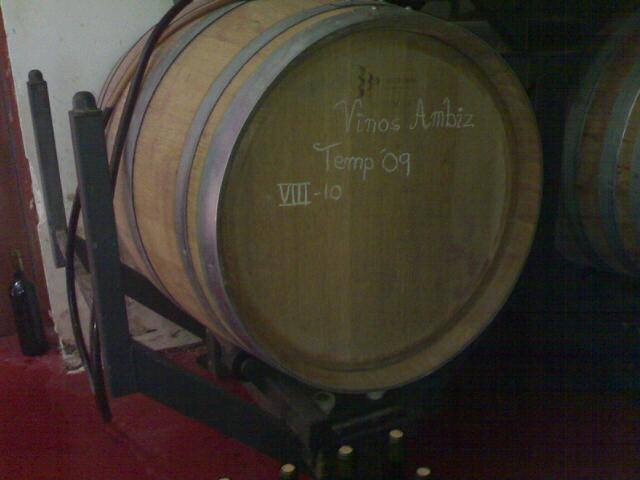
First, we bottled a barrica (barrel) of Tempranillo 2009. The grapes were harvested in September 2009, and fermented in a stainless steel tank. The wine was racked once to another tank to separate it from the thicker lees, and then we filled the barrel in August 2010. So that makes it 9 months in oak. The barrel was quite old, about 3-4 years so, despite the length of time in there, the oaky taste does not dominate. I’m assuming the wine will need at least 6 months in the bottle for it to ‘round off’. With any luck we can release it in December – for Christmas!
Barrica of Tempranillo 2009

Bottles being filled with Tempranillo 2009

Next, we filled our six (6) new American oak barrels with Tempranillo 2010. These barrels were sponsored (and paid for) by about 12 of our regular customers (See this post). Some sponsored a whole barrel by themselves, while others are sharing a barrel among 2, 3 or 4.

Juan filling the first barrica - 1

Juan filling the first barrica - 2

Juan checking the (fast rising) level in the second barrica

One of the sponsors, Nacho Bueno (who writes a wine blog in Spanish) visited the bodega a few weeks ago to taste the different wines we had available for aging, and he tasted and selected his own ‘coupage’ for his barrel. He’s decided to call the wine “Las Cinco en Punto”, ie “Five on the Dot” because it contains five different varieties:
   80% Tempranillo
    5% Garnacha
    5% Sirah
    5% Petit Verdot
    5% Airén

Juan pouring some Petit Verdot for Nacho's coupage

Wine stained already!

The other 5 barrels weren’t so complicated – pure 100% Tempranillo. We may do more ‘coupages’ later, if any sponsors express a interest and/or if we have any other wines available in the future!

One the one hand, it was quite easy to fill the barrels, because we used an electric pump to move the wine from the stainless steel tank which was about 40 yds away and in another building. We had to connect up 3 hoses due to the distance. Then we (Juan and I) had to coordinate in order to open/close the valve on the ‘bastón’ and switch on/off the pump at the same time. Once the pump was running, it took about 3 minutes and 20 seconds to fill a barrel.

The difficult part was trying to see the level of the wine through the bung-hole in the barrel. Very tricky, but knowing the approximate time it took fill a barrel beforehand helped a lot, and we managed to fill all six without an overflow accident. Then we topped up the last 5 liters or so by hand, using a jug and a funnel.

I think the pump we used was far too powerful and I’m wondering the following:

- Does moving wine so fast affect its quality?

- Does the horrible noise the pump makes affect the quality of the wine?

I’m also thinking of looking for a manually operated pump! Like the ones you see in old movies where they pump water up from a well in the garden, or pump water out of the engine-room of a steamer that’s taken in water!!! Just an idea!

Lastly, .... This coming Saturday 28th May is the IV Annual Agro-Ecology Day held in the Lavapiés district of Madrid. Apart from having a little table in the plaza for giving out free samples of wine (and leaflets) we are also supplying the wine for the official lunch.

So, the other day I did some bottling, corking and labeling activities:

Bottling and Corking

More bottles

Back-label with QR Code and AVIN number

I'm glad I made the effort to do the QR codes and AVIN numbers, and I'd like to thank André Ribeirinho (of Adegga) for doing the technical part of it for me, and Hola Por Qué for incorporating them into the label design for me.

More labels: front and back

Monday, 9 May 2011

My Reply to Oliver Styles’ Post “It’s Not Natural to be Wine” via Catavino

The first part of Oliver’s post focuses on the meaning of the word ‘natural’ and its meaning in the phrase ‘natural wine’. Basically he says that if something is in its … er, natural state (eg, tomatoes, onions, garlic, crude oil, etc) then it’s ‘natural’; while if something is manmade or manufactured (eg, bottles, oak barrels, factories, etc) then it’s not ‘natural’. Similarly with processes, eg planting vines in rows, pruning, winemaking in general and cooking, etc are all not ‘natural’.

Well, yes, that’s perfectly correct! It is in fact the dictionary definition of the word ‘natural’. But where does that leave us? It leaves us with a completely useless and impractical definition of the word ‘natural’ as applied to winemaking in general and for the definition of ‘natural wines’ in particular.

What we need is a useful and practical definition, not a literal, dictionary definition.

Ultimately, until ‘natural’ is legally defined by a government agency (as has been done with ‘organic’) then we can all talk forever about it, making analogies and comparisons but not really getting anywhere - though the acts of reading and writing about it is of course great fun, sometimes it’s very instructive, and it either helps clarify peoples ideas on ‘natural wine’ or confuses them even more!!!

I don’t think there’s any practical point in using the dictionary definition of ‘natural’ or asking “Where does it all end?” because it ends somewhere meaningless and nowhere useful! Once we get away from the dictionary meaning of ‘natural’, it all becomes simpler and more sensible and practical.

Oliver also gives an excellent definition of natural wines: “Natural Wines are made with a philosophy of little-to-no manipulation…”. I would simply add “with no additions of any substances” and “ using grapes from chemical-free vineyards”.

Personally (and I can’t speak for other natural winemakers) if I ever had to add any substances to the must or wine, then in my mind it wouldn’t be natural any more, and I wouldn’t call it ‘natural wine’ or sell it as such. I would state on the label and in my literature what it contained. But that’s just my own personal definition.

Oliver asks how the natural wine fraternity views the use of fertilizers. Well, that’s an easy one! I can safely say that we all believe that organic fertilizers are OK, but that chemical ones are not. The oak question is more difficult: some, perhaps most natural wine producers, in fact view oak as an unnecessary addition or manipulation.

I suppose that a lot of people are upset or confused or critical of the fact that there’s no legal definition of ‘natural wine’, and of the fact everyone and their aunties all have a different opinion and definition. Well, to that, I say the following:

1) So what? Drink, taste, enjoy, write/blog/tweet about your experience!

2) What do you need a legal definition for anyway? Maybe you’re worried that some unscrupulous winery or intermediary will sell you wine as ‘natural’ when it isn’t. No doubt that will happen, unfortunately, but it happens right now all the time with regular wine from Appellations, Denominaciones, DOCs, etc. C’est la vie!

3) Natural wines are ‘fringe’ and close to the edge! If you can’t enjoy all that that entails, then go to a supermarket and buy your wines there! These are happy days for natural wines – when the legislators legislate us it’ll be a lot more boring (though no doubt there will be advantages too!)

4) Live fast, die young! The worst than can happen to you is that you get a glass of wine, that you don’t like! Surely that’s not too traumatic?

I agree with Oliver where he talks about the semantics of the phrase ‘natural wine’; I also think it’s a bit unfortunate that it’s called ‘natural wine’ because it raises so many hackles and generates so many unproductive sound-bites. By implication, the word ‘natural’ implies that conventional wines are ‘unnatural’ and of course that word has very negative connotations. But what to do about it? All possible alternatives share the same problem, eg ‘authentic’, real’. (I wonder why ‘real ale’ doesn’t make beer-drinkers upset?). I’m afraid we’re just going to have to live with it.

I also suppose that that people are upset or confused or critical of the fact that not even the natural winemakers can’t agree among themselves on what exactly constitutes ‘natural wine’. And to that I say the following:

1) As mentioned above, at least we are united by the philosophy of minimum intervention in the winery, no additions of substances and use of quality chemical-free grapes

2) My personal advice to wine-lovers who want to find out about and try natural wines is to do a bit of due diligence. Get onto the internet and check out the producers, both on their own webpages and on wine sites. And my personal advice to other natural winemakers is to ensure that all the relevant information about their wines is available to potential consumers

Oliver also mentions a supposed natural wine ‘dogma’ in his post, but I have to say that no such thing exists! A ‘dogma’ for me means a body of literature or rules that is handed down from on high (either by a supernatural being or by some kind of authority) and that everyone has to abide by and believe in. As we all know, there is (as yet!) no governing body, no legislation, no nothing! Maybe I’m being too pedantic here and what he really means instead of ‘dogma’ is the rules and statutes of an association of natural winemakers? Well, in Spain such an association exists (PVN) but it only has eight (8) members! Why haven’t the other hundred or so producers signed up? I’ve read the statutes and they seem very reasonable and sensible to me. There’s an association in France too (AVN) with about a hundred members (I think).

Another thing that Oliver mentions and that puzzles me is this “notion of right vs wrong”. I think this must be a case of the most vocal, charismatic and eccentric personalities generating a disproportionate quantity of sound-bites and column-inches. I personally do not believe for a minute that ‘natural’ wines are in any way better than conventional ones, because:

1) It’s just silly! It’s like saying “Wines from region/country X are better”. Obviously, there are some bad natural wines out there and there will be some that you just don’t like – just as there are some bad Burgundies, Chiantis or whatever

2) I have no desire to have everyone drink natural wines! I don’t go around spreading the word and looking for converts! The world wine-drinking population is huge and multi-faceted and there’s plenty of room for both worlds to co-exist perfectly happily together (see my post on Catavino)

3) If you speak to a large number of natural winemakers (the larger the sample the better) I’m sure you’ll find that this right/wrong, good/bad thing is not at all representative of the opinion of the majority. It’s the equivalent of quoting , say, a Burgundy snob, who believes that Burgundy wines are the best in the world and that all others are inferior because they’re not from Burgundy!

Next, I have to totally disagree with Oliver when he says that natural wines are “difficult to taste” and “generally cloudy, funky, dirty or just downright bizarre”. This is just not true, and I can only assume he wrote that because he hasn’t tasted a wide enough variety or representative enough sample, of the true range of natural wines. Sure, some natural wines are funky and cloudy, but again they’re just the ones that generate a disproportionate quantity of sensationalist column-inches. I’ll even stick my neck out here and say that maybe about 10-15% of natural wines may be like that, and that the rest are completely normal in appearance and partially so in tastes and aromas. A good and practical (and timely) way of verifying this would be to go to the Natural Wine Fair in London and count! Any takers? Unfortunately I can’t go myself :(

I deliberately wrote ‘partially’ in the previous paragraph because it’s true that the range of “acceptable” tastes and aromas in natural wines is wider than it is for conventional wines. And I’m not being euphemistic or apologetic for funky cloudiness here. In natural wines you can taste and smell many things that are masked or eliminated from conventional wines by the excessive amount of additives and manipulations. And I don’t mean bad, off or weird tastes or aromas – I mean nice, pleasant, interesting tastes and aromas that express the grape variety, climate, terroir and winemaker’s hand. But it’s no use me just saying these things – you really have to go out and taste a lot of natural wines until you find the ones you like. It may take you some time because there will be some natural wines that you don’t like, but once you do find them, you’ll be glad you made the effort.

Another topic that Oliver mentions in his post and that I don’t identify with at all is “attacking corporate winemaking”. Is that the vocal, charismatic, eccentric minority at work again? I don’t know, but it certainly doesn’t reflect my personal opinion as a natural winemaker. Like I said before, the wine-drinking market is huge and I believe that the majority of wine-drinkers don’t care how their wine is made and what ingredients are in it. As long as the juice tastes good, is reasonably priced and has a good label, then that’s OK with them. And it’s OK with me too! I believe that the natural wine market will always be small and that it comprises people who do care about how their wine is made.

Far from attacking corporate winemaking, what I do sometimes is simply to describe the processes and list the ingredients that corporate winemakers use. And for some reason, people don’t like that! I suppose it’s because it bursts the illusion that all wines are made in bucolic, family-run wineries – as opposed to the reality of giant industrial factories churning out millions of liters per year. Well, OK, I confess that sometimes I use loaded, emotionally-charged words instead of neutral ones (like ‘adulterate’ instead of ‘intervene’ or ‘dangerous chemicals’ instead of ‘substances’); but hey, I have to give as good as I get sometimes, no? Or do I have to just sit back every time and ignore the stuff about “bearded hippies”, “burying cowhorns in the vineyard”, “drinking murky, funky liquids they call wine”, etc etc..? No way! Not every time!

And lastly, what’s to be “immensely wary” about? (A recent article in the UK’s Telegraph also warned readers to be wary). Come on, guys, is that not a bit of an exaggeration? It’s only a glass of wine!!! If you don’t like it, just try another one!!! Life is short! Enjoy while you can, go explore some new tastes and aromas! And if you’re feeling really daring, try a funky cloudy one while you’re at it!

But seriously, instead of being wary, I say be curious, be adventurous, do a bit of due diligence and read what the mainstream natural winemakers have to say, and taste some mainstream natural wines first. If you need to be wary about anything, be wary about what people (including myself) say about ‘natural wine’!!!
 
Creative Commons License
This work is licensed under a Creative Commons Attribution-Share Alike 3.0 Unported License.