name="description" content="Terroir-expressing natural wine minimum intervention">
Showing posts with label El Tiemblo. Show all posts

Thursday, 4 February 2016

Sheep in the Garnacha Vineyard

Well, for this post I have some interesting anecdotes about sheep in my Garnacha vineyard in El Tiemblo (Sierra de Gredos).
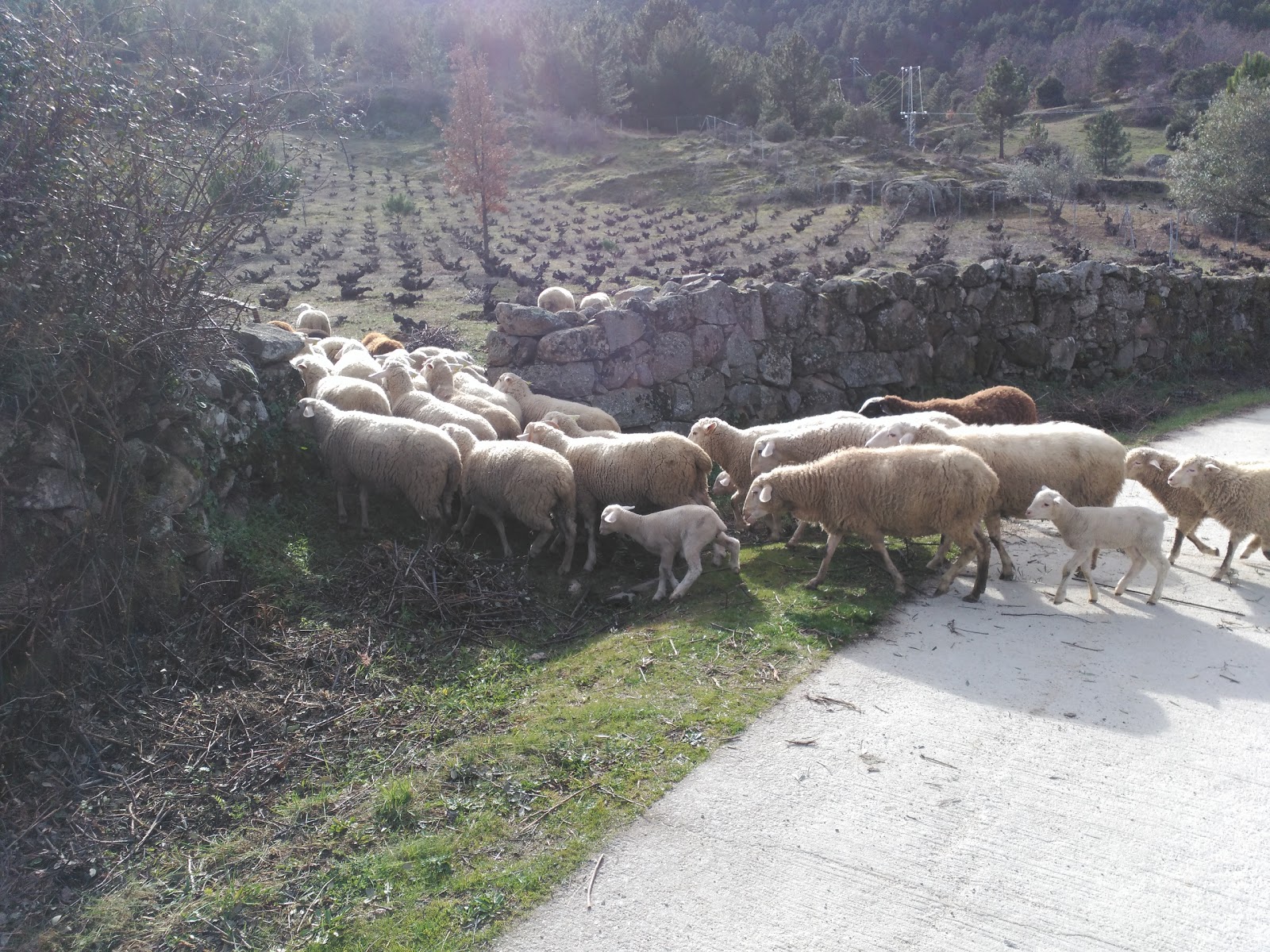
A flock of sheep entering the vineyard
But first...

This is the same vineyard that I wrote about in my previous post (here), when I discovered that ‘someone’ had pruned my ‘Roman’ vines which I had trained up the olive trees, without asking me first. So the other day I had a meeting with the owners of the vineyard and asked them if it was them who had dunnit – and indeed it was! I’m glad that I didn’t speak to them immediately on discovering the unauthorized pruning, because I was upset and angry and would probably have said things that I would have regretted later! But with the passage of time I had calmed down, and now of course it doesn’t seem so important. They were quite amazed when I explained the Roman thing to them, but they were willing to cooperate. Now I just have to wait another year for the vines to grow and try again.
Anyway, I was in this vineyard again the other day, doing more of the same – raking up last year’s dead grass into piles, pruning and hoeing up around the pruned vines. I alternated these three activities so that the same muscles wouldn’t get sore! The method seems to work J
And an ‘interesting thought’ came to me while I was raking up the dead leaves. At first, I had started raking up dead leaves and grass and tidying ‘just for fun’ and to do a bit of gardening and to make the vineyard look beautiful (and alternating tasks so my back muscles wouldn’t suffer so much). But now I’ve discovered a valid agricultural reason for doing this! By raking up the last year’s dead leaves, it makes it easier for the new grass and plants to come up, as there is no physical obstacle stopping their growth, more sunlight hits the earth and little leaves making germination and photosynthesis more efficient, and also the action of the rake on the ground probably helps stir things up and speed them along! I was actually a bit worried that maybe the grass, and plants and flowers would grow too much, to the detriment of the vines, perhaps. But the perfect solution presented itself spontaneously. Sometimes the universe works in your favour, and “they’re not really all out to get you”!
The perfect solution, of course, consisted of a flock of sheep! As I was working, a man called out to me from over the wall of the vineyard. He was a shepherd and he wanted to ask if he could let his sheep graze in my vineyard. I agreed immediately and off he went to get his sheep, which were grazing in a neighbouring vineyard just down the road.
Sheep grazing in the vineyard


Sheep and lambs


Panoramic view

The deal is that I get free manure and short grass and the shepherd gets free grass for his sheep.

Close-up of my free manure

And also, according to my friend and fellow grapegrower Mario Siragusa (who grows grapes in Barolo country near Turin), the sheep also impart positive electro-magnetic energy to the vines from their wool. Interesting theory - I will have to look into it when I have some free time.
This deal only works until about March, when the vines start to sprout. Otherwise the sheep would eat the young leaves.

Sheep leaving the vineyard

Luis the shepherd says that he only drinks wine from the vineyards where his sheep have been grazing! Because his sheep don’t like the grass from chemically farmed vineyards and because the wine tastes crap! Natural wine drinkers are everywhere these days J.
Other vineyard news
There is still a lot of pruning to be done, some of which I will do myself and some of which I will outsource to neighbours. Then there are other assorted tasks to be done too: removing canes, hoeing up around the vines, fixing fences, and general tidying up. I won’t bore you all too much with the details! Yet!
Bodega news
There are lots of tasks I have to be getting on with in the bodega too. Most urgent is the bottling up. I got off to a good start this year but last week I ran out of corks AND bottles! Duh! So now I have to wait for delivery, which takes about 7-10 days. Which is OK really, as I can now concentrate on the vineyards. I also have to fill two barrels with white wine. It took me about a year, but at last I managed to get my hands on two second-hand white wine barrels. They are incredibly difficult to find, for some reason. More about this later. I also have to thoroughly scrub and clean and disinfect two amphorae, which contained wine and which I have already bottled up. Then I have to press off a tank of Garnacha which is still on the skins! And a tinaja of SB and one of Doré. And lastly I have to tidy up the patio and finish building my pergola. Oh, where is all the free labour?
Other news
In about three weeks I’m going to a natural wine fair in Piacenza, Italy: Sorgente del Vino LIVE 2016. It will be my first time at a wine fair in Italy, so am especially looking forward to it. Attenzione importatori italiani J
And in about one month I’ll be going to another natural wine fair in Barcelona: Vins Nus (which means Naked Wines in Catalan). This is one of two natural wine fairs organized in Spain, which is pretty underwhelming really, considering the numbers for France and Italy.
Enough for now. “Salud y buen vino”. (that means ‘Health and good wine’, in Spanish)


Sunday, 10 January 2016

Attack of the Rock Roses (Part 2)

(continuation of Part 1 of the Attack of the Rock Roses)

So I did some physical exercises for a few days, in preparation for my counter-attack against the rock roses; a few press-ups and some abominable crunches in the morning, and some hand, finger, ankle exercises whenever I remembered during the day.

I had intended to start at the crack of dawn, but no plan ever survives contact with real life and my morning ended up full of distractions and complications. It was only after lunch that I was able to get out to the vineyard.

The was no way I was going to tackle the main 'briar patch' on the first day! It was far too daunting. I started with an easy part, working my way down the nearside boundary, where there weren't so many rock roses to uproot, only two or three every row. The going was good, and I even managed to work my way along the bottom boundary for a few meters. But the days are short at this time of year so it soon got dark and I had to stop.

The densely populated main 'briar patch'


Next day I was back, this time bright and early in the morning. But I still didn't feel like starting on the 'briar patch' so I just continued what I was doing - working my way along the bottom boundary, uprooting the sparcely spaced rock roses. Crouch down, grab the stalk near the ground, pull out, put in a pile; repeat all day long!

The sparsely populated bottom boudary


I finished the bottom boundary and started working my way up the far boundary towards the main rock rose patch. When I got to the edge, I stopped, and I went to to the top of the far boundary and started working my way down until I reached the other edge of the main patch. Then it was time for lunch. Perfect timing. I would do the final assault after lunch!


The southern edge of the briar patch

So after lunch (short) I dove straight in to work. I was bearing up well, physically, nothing was too sore. Yet! It was tremendously boring work, as it took me ages to clear each square meter. I seemed to be constantly in the same place and not making any progress at all. There were hundreds of little rock roses in each square meter, and medium sized ones, and large ones too. The tiny little ones were the easiest to pull out, obviously, but they were also the most boring. They were infinite!

so many rock roses

Now everything was starting to get sore, just like I had anticipated: quadriceps, back and fingers mostly. I would alternate squatting down on my haunches (that way my back wouldn't hurt) and when my quads complained I would stand up straight and bend over to grasp and pull (that way my quads wouldn't hurt). In the end though both back and quads hurt like hell! There was nothing I could do about the fingers though, I just had to keep grasping and pulling.

It was now a race against time. I really wanted to finish the uprooting before sunset, otherwise I could have to come back another day to mop up. Not only are the days short in January, but the vineyard is in a valley surrounded by high mountains, so the sun actually 'sets' earlier than usual.

In the end, I managed to uproot all the rock roses before dark.

neat piles of uprooted rock roses


But I had to go back another day after all - to remove all those piles of uprooted rock roses that I had neatly piled up.

more neat piles 

So on the third day, with great satisfaction I threw all the piles of rock roses over the vineyard boundary into the neighbouring pine forest where they would decompose.

But another unexpected task came up which took me the rest of the day to deal with: there was quite an extensive area of the vineyard that was covered with pine needles, fallen from some neighbouring pine trees. I don't think that an excess of pine needles can be good for a vineyard's soil. Nothing much can grow in a pine forest becuse the pine needles are very acidic and don't allow other plants to thrive.

Piles of pine needles, and pine trees at the vineyard boundaries

I spent the rest of the day raking up pine needles and returning them to the forest. But again darkness fell and I had to stop before I could finish properly. I don't know when I'll be able to finish that task.

That was an extra, unscheduled and unexpected three days spent in this vineyard. Other tasks now beckon. At the top of my list of priorities, I have to bottle up ten barrels of red wine. This has to be done soon, because 1) the wine has been in the barrels long enough, and if it stays too long it will taste too much of oak, 2) the wine has to age a while in bottles before I can sell it, and 3) I have to free up the barrels so I can put new wine into them. Next on the list is the pruning - and I have five vineyards now to manage: Airén/Tempranillo in Carabaña, Malvar in Villarejo, Garnacha I and Garnacha II in El Tiemblo, and now Chelva in El Tiemblo too. So the sooner I start, the sooner I will finish, hopefully by March/April. Further down my list of priorities, are a whole load of other tasks and activities, some more fun than others, which I'll deal with too, when the time comes.

But I'm not happy about those pine needles. I wonder if they've even been raked up and removed before. The poor vines affected (around 50-60) must have been suffering for years if not decades. I really ought to give them some lovely manure this winter. We shall see. But other urgent tasks beckon too. Stay tuned.


Thursday, 5 March 2015

How on earth did I manage to achieve all that?

It's been a long time since my last post, and such a lot has lot has happened; so much in fact that I haven't had any time to write any posts on this blog!

That's probably a good thing though, all things considered, as after all, my 'core activities' (as it were) are growing grapes, making wine, and marketing and selling said wine; not writing a blog.  On the other hand though, one could consider writing this blog as part of my marketing!  I suppose it is, really, even though I like doing it just for its own sake.

There's a lot of information in this blog (especially in the "Pages" above), and I get a lot of good feedback about it from many different sources; so I guess I must be doing something right.

So like I said, I've been busy, busy, busy. But in a good sense, not all stressed out and running around madly constantly doing stuff. Like last year!

So here's a quick summary of what I've managed to achieve recently:

1. The pruning. Incredibly I'm on schedule! Usually, if I remember rightly, I'm always running late, some years really, really late, and other years just late! But this year is perfect, so far (touching wood here!). Carabaña (field blend of Airén and Tempranillo) is done; Villarejo (Malvar) is done; my low altitude Garnacha plot in El Tiemblo (Sierra de Gredos) is just under half done, and my high altitude Garnacha plot (also El Tiemblo) is the last one to be started on, in a few weeks.

My half-pruned low-altitude Garnacha vineyard (El Tiemblo, Sierra de Gredos)
2. Bottling. Again, much better than last year, when I had to bottle up madly during the summer to free up tanks before the harvest. This year, I'm about half done already. I just have to bottle up the Airén 14, Doré 14,  Albillo 14 (from an amphora which will be very time-consuming), the Sauv blanc 14 (ditto), and just 1 more barrica of Garnacha.

Bottling up
3. I started beautifying the patio, and preparing a plot of ground to plant some vegetables in.

My rather messy looking patio at the bodega
4. I bought 200 vines to plant in the empty spaces in my Carabaña vineyard (Tempranillo variety, grafted onto Paulsen 1103 rootstock) which I hope to do in April, depending on the temperature and weather

5. I managed to source and buy 2 kg of organic beeswax, so I can line that new baby amphora that I bought on the spur of the moment a few months ago!

6. I prepared and delivered several nice orders (Thierry Puzelat (France), Restaurante Montía (El Escorial), Restaurante Los Asturianos (Madrid), Le Petit Bistrot (Madrid), CienPorCien Natural (Cádiz), Restaurante Bodeguita de Pilar (El Tiemblo), a CSA type group in the mountain village of Bustarviejo)

Boxes, having been prepared, ready to receive bottles of wine, having been corked and labeled
7. Sent off samples to people who were interested in tasting my wines: Barcelona, Vienna, London, Avila, Grenada, Madrid (being discrete here, no names!)

8. Organized some tastings in my bodega with possible importers/buyers (Australia, Norway, Barcelona) and with other people (not possible buyers) who just came to taste because they wanted to (Japan, Boston, Portugal/Belgium, Madrid) (being discrete again here, no names!)

Doing a bit of tasting in the bodega
9. Did a presentation/tasting of my wines in the Petit Bistrot (Madrid) (see this previous post)

10. Went to a Slow Food / Slow Wine event in Zaragoza, to pour my wines, and managed to find a distributor for Aragón, one Carlos Scholderle, #winelover ambassador to Spain. (This two-day event deserves a whole post to itself!)

My table at the Slow Wine tasting, Zaragoza (Aragón)
11. And am in the process of calmly updating the paperwork/redtape/bureaucracy that has to be done if you want to have a legal wine business. Instead of madly doing it the day before the deadlines!

12. And all the while working at my day-job!

 Not bad, eh?  Another new year's resolution was to write down all the things I manage to achieve, which I've been doing. This makes you feel good about your life! Before, I just had the to-do list, which is of course never-ending, but it seemed that I wasn't achieving anything. In fact I was, but I just didn't realize it!!!

Anyway, I hope that wasn't too boring to read through. But it just goes to show that winemaking is not just about being mystical in the vineyard and getting to taste some really interesting wines at tastings! Though of course I love those occasions too, when they occur! There's lots and lots of rather mundane stuff that has to be done, but which is not really photogenic or interesting to write about!

So I think I'll just post this now, without any further ado, and maybe get round to writing some more specific posts next week (or at least before the end of March!)

PS. Just to say that I'll be off to Paris, France this weekend: see here. It's a tasting organized by Thierry Puzelat of all his 'natural wine' producers that he imports into France.

PPS. And also just to say that on Friday 13th, I'll be presenting my wines at Enoteca Barolo (Madrid). 


Tuesday, 2 September 2014

Albillo 2014 Harvest

This is the story, so far, of my Albillo 2014.
I think that (the story of) any good wine starts, or ought to start, here, in the vineyard:
The Albillo vineyard, about 2 km from El Tiemblo, right next to the Charco del Cura, a mini-reservoir on the River Alberche
Without good grapes, without good, clean, healthy, balanced, and complex grape juice, I don't think you can make a good, clean, healthful, balanced and complex, terroir-expressing wine!
Albillo vineyard
There are lots of large rocks scattered all over the vineyard (and over many other vineyards in the area). I assume that they were left there when the ice-caps retreated at the end of the last ice age about 20,000 years ago, but I haven’t actually checked this theory out.
Sampling and Tasting
On the 14th August I went to take samples for the last time. Apart from looking at the must through the refractometer (which gives you a predicted possible alcohol level) I also taste the grapes. I don't quite know how to explain this but I think what I look for is to ensure that the grapes are actually ripe - otherwise you get 'green' vegetable, grassy tastes and aromas from the wine. And also I try to ensure that there's still a good level of acidity, otherwise the wine will be over-alcoholic, and unbalanced. So based on that, I decide on the date for harvest! I think that subconsciously I also take other factors into account too, like the weather over the course of the year, the general state of the vineyard and surrounding countryside, what the neighbours are saying, etc!
Refractometer and sample grapes
Above: a sample of grapes taken at random, more or less, from all over the vineyard, a refractometer, and a thick-bottomed glass which I used to crush the grapes.
Above: grapes duly crushed.
Above: A close up of the refractometer with a drop of must on it.
Harvesting
On the 16th August we harvested.
Each one of us had a small bucket, which held about 10 or 12 kg, which we then tipped into bigger crates, which held about 25 kg. This way is much easier to manage than hauling and carrying a 25 kg load around from vine to vine.
Above: Here’s yours truly with his bucket
Above: Harvesting among the rocks.
Above: A panoramic view, looking in the other direction, away from the reservoir
Above: another panoramic view
Above: more harvesting among the rocks
Above: the large 25 kg cases
These larger crates were then loaded onto a mini-trailer behind a mini-tractor, which took them, 4 crates at a time, to a spot a few hundred meters away from where they could be loaded into the back of a van. Then, when the van was full, with about 30 crates, we would take them to the bodega, about 10 minutes away, in the centre of the village (El Tiemblo). There we would unload them, weigh all the crates, and then stack them on pallets, so they can be moved around easily when required.
Above: the mini-tractor with its mini-trailer
Above: crates ready to be loaded into the van
Above: here is Daniel helping me load and stack the crates
Extra Harvesting
We were planning to harvest that vineyard over 2 days, ie at a rate of about 1,000 kg per day, with 4 or 5 pickers. But for some reason, we ended up with 8 pickers, so a decision had to be made. Normally we would have picked 1,000 kg between 7:30 in the morning (dawn) and lunchtime (around 1 o'clock-ish), and we would have stopped and gone for lunch!  But with eight of us picking, by 1 o'clock we were about 3/4 done, so we just decided to go for it and finish off. And by 4 o'clock we were done.
It was too late now to process the grapes in the bodega, as I was too tired. And too hungry, as we only had a wee snack at 11:00. So I decided to leave the grapes overnight and process them in the morning, when they would be cooler (and I not tired!)
Crushing
So next morning,17th August, bright and early, we crushed the grapes.
I used this machine in the photo below. It's a simple roller-crusher (the grapes fall between two cylinders) driven by an electric motor. Placed directly on top of the tank where the grapes fall into.
Above: crates of Albillo stacked on a pallet. Note the lovely old weighing machine in the background.
Above: the crushed grapes.
There was exactly 2,000 kg of grapes (well, it was 1,993 kg!)
I crushed them into three tanks (above). The two plastic tanks hold 1,000 kg each and the stainless steel one 700 kg.
Pressing Off (19th August)
So I let the skins, pips and stems all soak together with the must for 48 hrs, by which time the must was just starting to ferment very slightly.
I used this hydraulic press:
To load the press I had to actually get into the tanks and scoop the grapes/must out and into the press using a bucket.
Press, tank and bucket.
Above: the free-run must coming out of the press.
Fermentation
For the fermentation I used three 700-litre stainless steel tanks.
I didn't use any temperature control, though I could have done if I had wanted to. I figured that "if it ain't broke, don't fix it" and as I was really happy with my 2013 Albillo without temperature control, then I thought that I would just do the same again this year.
Above: fermentation happening at 30ºC!!!  Hmmm, that’s a bit much, maybe next year I’ll try to keep it a bit cooler
One of the tanks overflowed again this year. Oh well! I thought I'd left enough room, but obviously it wasn't enough!
Above: Note the remains of the violently hot fermentation on the inside walls of the tank!
And now listen to this video-audio of full fermentation on 21st August:
The last task was to throw out the skins and pips.
Racking
On Friday 29th August, with fermentation almost finished, or at least proceeding very slowly, I pumped all three lots of wine from the stainless steel tanks into a large clay amphora ('tinaja' in Spanish) where it will stay until I bottle it sometime next year. With this I hope to obtain some nice slow oxygenization (through the semi-porous clay walls) and also perhaps a nice hint of amphora in the aroma and taste.
I called it ‘racking’ which is usually taken to mean pumping off the clear liquid and leaving the lees and sediments behind. But I didn’t do that – instead I ensured that everything, lees, sediments and all at the bottom of the three tanks also went into the amphora.
Large amphora containing Albillo
Albillo Experiment #2
This is 80 kg of Albillo from a different plot, but still from El Tiemblo, on the 19th August.
I've laid it out to dry out a little so the must becomes more concentrated due to evaporation, and hopefully I will make a sort of sweet wine with higher alcohol.
I hope that the cardboard doesn't impart a carboardy taste to the wine! But it's only 80 kg, and if the experiment works out, then next year I'll do it better!
On the 4th September (16 days later) I crushed the bunches by stomping on them in my bare feet. And then I removed the stems by hand, and poured everything (must+pips+skins) into a tiny little container.
I will leave it to macerate and ferment for a while, then press it off. Somehow. I don’t know how to press off such a small quantity!!!

And that's the end of that story. I hope you enjoyed it.

Tuesday, 17 December 2013

Wrap-up Post for the Year 2013

(This is going to be my last post of the year - unless something really interesting happens between now and the 31st, that is)

Well, what can I say that is not too boring? I think maybe a quick summary of all the different wines I've made this year would be acceptable, followed by some humour :)

Or maybe I should subject you all to my Great Thoughts on the "State of the Wine World" or some such enlightened topic. Nah, maybe I'll spare you for the time being and do that next year! In the meantime you can just browse though my assorted comments and thoughts and ramblings on the 11 different whites and 5 different reds that I managed to make this year: That should be quite bearable :)

New wines of 2013:


Panoramic view of all my wines

Whites:

1. Airén 2013. From Carabaña, fermented in clay amphora

This is the wine I've been making for the longest time. Since 2003 in fact, though no bottles exist from that time as far as I know. The oldest bottle I have is from 2006. I really regret not keeping a few cases back from those days. But who could have known then that it would have been an interesting thing to do at that time? Such is life!

Anyway, at the time of writing this post (mid-December 2013), this wine is coming along really, really well, I'm glad to say (as I touch wood). It's got body, it's got complexity, and it's got its terroir. Sí, señor! This is normal and par for the course for this wine, but it's really quite extraordinary for an Airén from central Spain. Those of you who know me and who read my posts know that I'm not one to blow my own trumpet (or beat my own drum, as they say in Spain!), but after 10 years of positive feedback, I really have no qualms about saying how good this wine is! Even if I say so myself!  All the other 100% varietal Airén wines I've tasted are all wishy-washy insipid affairs that don't have anything to say. (Except for Samuel Cano's 'Patio' Airén, that is. From La Mancha.)

This year's Airén (2013) is slightly different from all my previous vintages, in that the harvest was really late. About 20-25 days late in general. In particular, I harvested this Airén from Carabaña on the 19th October. And that meant that it didn't have time to finish fermenting before the temperatures dropped too low for the yeast to work. I think!  When I taste it, I'm pretty sure there's some residual sugar in there, so I think the wine will continue to ferment in spring (2014) when the temperature rises again. This is a bit of a bore in one way, because I usually release this wine before Christmas. Apart from being good for my cash-flow (!) it's also a really fun and enjoyable experience to drink this year's wine in the depths of deepest darkest winter. It sort of brings light to life.

So, this year, I'm not releasing it 'officially' or promoting it or actively selling it yet, as it were, but if anyone asks or orders it from me on their own initiative, then I'll ship it.

2. Airén 2013. From Morata de Tajuña. Amphora

This is from a vineyard only about 10 km down the road from my own vineyard in Carabaña. I bought the grapes from a young grape-grower who cultivates them organically.

I made this wine in exactly the same way as I made the one above, from Carabaña, ie:

Grapes crushed manually (using a manual crusher), then pressed manually (using a basket press), and then I pumped the juice into these two large clay amphoras. And that's it! Nothing else! I didn't add anything, I didn't take anything out, and I didn't subject the grapes or must to any other processing whatsoever. C'est fini!  All I have to do now is wait for gravity and the cold of winter to do what they have to do, and then bottle up in January or February or March. Maybe it'll be slightly, naturally sparkling? Who knows? I hope so.


3. Albillo 2013. from El Tiemblo. Stainless Steel

The Albillo grapes came from a vineyard a few kilometers from the bodega in El Tiemblo, overlooking the reservoir known as El Charco del Cura. See this post. They were picked by the owner, Vicente (86) and his family, while I drove the van between the vineyard and bodega with the boxes.

This was my first time making Albillo, but it's not going to be the last! I'm really impressed with this grape, though I shouldn't have been surprise because I'd tasted a few Albillos from the area before (by Daniel Ramos, Alfredo Maestro, and others). This is an awesome grape variety that should be way up there with all the other famous and well-known grape varieties. I reckon this is yet another case of Spain (or Spaniards) not knowing how to market and sell their products. Which are of course just as good as the French and Italian equivalents. But hey, what can I do? I'm not an NGO, nor am I independently wealthy, so I can't go promoting Spanish quality products in general! What I CAN do is promote my OWN quality products, which is what I'm doing. It's a bit of a bore having to work with this negative perception that the world has of Spain and of Spanish products, but... this is where I live and work, so let's just get on with it, no?


4. Sauvignon Blanc 2013. Amphora

This is another first for me. I've never made a wine with Sauvignon Blanc before, but there's always a first time for everything, no?  So, just up the road from El Tiemblo, in Cebreros there's a 'finca' (an estate) that produces very good quality olives, honey, vegetables, and ... grapes. I had the opportunity to buy some of those grapes, and I did.

Two days soaking on the skins, then crushed, pressed and pumped into a clay amphora, and into a stainless steel tank. Just like the Airén, nothing added, nothing taken out, no unnecessary processing.

At the time of witing this post (mid-December) it's tasting very nicely. No cat-piss at all, though I don't know if that's a good thing or a bad thing! For tasting notes and considered opinions on these wines see Nacho Bueno's blog here (in Spanish) and also Mar Galvan's tasting notes here (pending).

5. Sauvignon Blanc 2013. Stainless Steel

Same as above.

6. Chelva 2013 (A). Stainless Steel

Now, this is by far the most interesting experiment I did this year. And I'm definitely going to be doing more of it next year. I did three experiments, but two of them were failures in the sense that the wines were not very pleaseant or interesting to drink or enjoy. But they were of course extremely useful to me, as a winemaker. The third experiment is quite drinkable and interesting, though I'm not going to 'release' it for sale. I will of course sell it and ship it to anyone who orders it. See here for some tasting notes and opinions that are not mine!

Personally, I quite like it, and if no-one else wants it I'll just use it as my own personal table-wine for the year!

7. Chelva 2013 (B). Stainless Steel

Horrible. Crap. Don't even try it it, unless you're a wine geek. It has lots of academic, vinous interest, but it's not the type of wine that you can sip and enjoy while flirting or just having a normal conversation, or while having lunch! It's even more extreme that the above Chelva (A). But don't get me wrong, it has no faults or defects, and is perfectly drinkable, it's just that it's rather ... unusual, or maybe 'green' is the word, I'm not sure what the descriptors are. Basically, IMO, this is because the grapes were picked earlier than the Chelva (B). See about half-way down this post.

Chelva (C). Stainless Steel. This third Chelva experiment, I'm not even going to dignify with an experiment number!


8. Malvar 2013 (A). Amphora


9. Malvar 2013 (B). Amphora


10. Malvar 2013 (C). Amphora

Malvar, Malvar and Malvar


These three white, skin-contact ('orange') wines should have been all the same, because they're made with the same grapes, from the same vineyard (Malvar from Villarejo), harvested on the same day, and processed in exactly the same way - grapes destemmed and crushed manually and everything (must, skins, pips) poured into three different clay amphorae. The only difference is in the size and shape of the amphorae. And maybe the composition of the clay? Or the linings?  Whatever. The fact is that the three wines taste slightly different. I don't know yet whether to keep them and sell them separately, or to blend them all together. Time and tastings will tell.

In any case, I'm not going to release them for at least a year. I believe that 'orange' wines improve over time and age well (at least mine do!). I still have a few hundred bottles from 2012, and they are tasting really well. The complexity and intensity of the aromas and tastes are amazing.

Now the reds:

I think I'll write about the reds some other time, because at this rate I won't have this post finished till next year! Just to say that I have these 4 reds this year:

11. Tempranillo (Carabaña). 
12. Tempranillo (El Tiemblo). 
13. Garnacha (Sotillo)
14. Garnacha (El Tiemblo)

So Merry Christmas, everybody.  For the holidays in general I recommend you drink the wine you like, and will enjoy, and try not to pay too much attention to all these recommendations that ar in our faces everywhere :)


Creative Commons License
This work is licensed under a Creative Commons Attribution-Share Alike 3.0 Unported License.