name="description" content="Terroir-expressing natural wine minimum intervention">
Showing posts with label pressing. Show all posts

Tuesday, 2 September 2014

Albillo 2014 Harvest

This is the story, so far, of my Albillo 2014.
I think that (the story of) any good wine starts, or ought to start, here, in the vineyard:
The Albillo vineyard, about 2 km from El Tiemblo, right next to the Charco del Cura, a mini-reservoir on the River Alberche
Without good grapes, without good, clean, healthy, balanced, and complex grape juice, I don't think you can make a good, clean, healthful, balanced and complex, terroir-expressing wine!
Albillo vineyard
There are lots of large rocks scattered all over the vineyard (and over many other vineyards in the area). I assume that they were left there when the ice-caps retreated at the end of the last ice age about 20,000 years ago, but I haven’t actually checked this theory out.
Sampling and Tasting
On the 14th August I went to take samples for the last time. Apart from looking at the must through the refractometer (which gives you a predicted possible alcohol level) I also taste the grapes. I don't quite know how to explain this but I think what I look for is to ensure that the grapes are actually ripe - otherwise you get 'green' vegetable, grassy tastes and aromas from the wine. And also I try to ensure that there's still a good level of acidity, otherwise the wine will be over-alcoholic, and unbalanced. So based on that, I decide on the date for harvest! I think that subconsciously I also take other factors into account too, like the weather over the course of the year, the general state of the vineyard and surrounding countryside, what the neighbours are saying, etc!
Refractometer and sample grapes
Above: a sample of grapes taken at random, more or less, from all over the vineyard, a refractometer, and a thick-bottomed glass which I used to crush the grapes.
Above: grapes duly crushed.
Above: A close up of the refractometer with a drop of must on it.
Harvesting
On the 16th August we harvested.
Each one of us had a small bucket, which held about 10 or 12 kg, which we then tipped into bigger crates, which held about 25 kg. This way is much easier to manage than hauling and carrying a 25 kg load around from vine to vine.
Above: Here’s yours truly with his bucket
Above: Harvesting among the rocks.
Above: A panoramic view, looking in the other direction, away from the reservoir
Above: another panoramic view
Above: more harvesting among the rocks
Above: the large 25 kg cases
These larger crates were then loaded onto a mini-trailer behind a mini-tractor, which took them, 4 crates at a time, to a spot a few hundred meters away from where they could be loaded into the back of a van. Then, when the van was full, with about 30 crates, we would take them to the bodega, about 10 minutes away, in the centre of the village (El Tiemblo). There we would unload them, weigh all the crates, and then stack them on pallets, so they can be moved around easily when required.
Above: the mini-tractor with its mini-trailer
Above: crates ready to be loaded into the van
Above: here is Daniel helping me load and stack the crates
Extra Harvesting
We were planning to harvest that vineyard over 2 days, ie at a rate of about 1,000 kg per day, with 4 or 5 pickers. But for some reason, we ended up with 8 pickers, so a decision had to be made. Normally we would have picked 1,000 kg between 7:30 in the morning (dawn) and lunchtime (around 1 o'clock-ish), and we would have stopped and gone for lunch!  But with eight of us picking, by 1 o'clock we were about 3/4 done, so we just decided to go for it and finish off. And by 4 o'clock we were done.
It was too late now to process the grapes in the bodega, as I was too tired. And too hungry, as we only had a wee snack at 11:00. So I decided to leave the grapes overnight and process them in the morning, when they would be cooler (and I not tired!)
Crushing
So next morning,17th August, bright and early, we crushed the grapes.
I used this machine in the photo below. It's a simple roller-crusher (the grapes fall between two cylinders) driven by an electric motor. Placed directly on top of the tank where the grapes fall into.
Above: crates of Albillo stacked on a pallet. Note the lovely old weighing machine in the background.
Above: the crushed grapes.
There was exactly 2,000 kg of grapes (well, it was 1,993 kg!)
I crushed them into three tanks (above). The two plastic tanks hold 1,000 kg each and the stainless steel one 700 kg.
Pressing Off (19th August)
So I let the skins, pips and stems all soak together with the must for 48 hrs, by which time the must was just starting to ferment very slightly.
I used this hydraulic press:
To load the press I had to actually get into the tanks and scoop the grapes/must out and into the press using a bucket.
Press, tank and bucket.
Above: the free-run must coming out of the press.
Fermentation
For the fermentation I used three 700-litre stainless steel tanks.
I didn't use any temperature control, though I could have done if I had wanted to. I figured that "if it ain't broke, don't fix it" and as I was really happy with my 2013 Albillo without temperature control, then I thought that I would just do the same again this year.
Above: fermentation happening at 30ºC!!!  Hmmm, that’s a bit much, maybe next year I’ll try to keep it a bit cooler
One of the tanks overflowed again this year. Oh well! I thought I'd left enough room, but obviously it wasn't enough!
Above: Note the remains of the violently hot fermentation on the inside walls of the tank!
And now listen to this video-audio of full fermentation on 21st August:
The last task was to throw out the skins and pips.
Racking
On Friday 29th August, with fermentation almost finished, or at least proceeding very slowly, I pumped all three lots of wine from the stainless steel tanks into a large clay amphora ('tinaja' in Spanish) where it will stay until I bottle it sometime next year. With this I hope to obtain some nice slow oxygenization (through the semi-porous clay walls) and also perhaps a nice hint of amphora in the aroma and taste.
I called it ‘racking’ which is usually taken to mean pumping off the clear liquid and leaving the lees and sediments behind. But I didn’t do that – instead I ensured that everything, lees, sediments and all at the bottom of the three tanks also went into the amphora.
Large amphora containing Albillo
Albillo Experiment #2
This is 80 kg of Albillo from a different plot, but still from El Tiemblo, on the 19th August.
I've laid it out to dry out a little so the must becomes more concentrated due to evaporation, and hopefully I will make a sort of sweet wine with higher alcohol.
I hope that the cardboard doesn't impart a carboardy taste to the wine! But it's only 80 kg, and if the experiment works out, then next year I'll do it better!
On the 4th September (16 days later) I crushed the bunches by stomping on them in my bare feet. And then I removed the stems by hand, and poured everything (must+pips+skins) into a tiny little container.
I will leave it to macerate and ferment for a while, then press it off. Somehow. I don’t know how to press off such a small quantity!!!

And that's the end of that story. I hope you enjoyed it.

Monday, 22 October 2012

Double Harvest over the Weekend

Last Saturday 6th October, cruel ogre that I am, I brutally and ruthlessly exploited about 20 children, in the name of free labour. It’s so difficult to get free labour these days, that I had to resort to inviting my own children’s wee friends from school and their parents too!


Stomping grapes in the bodega
 No, jesting apart, the little dears had a great time. And, surprisingly, they actually did pick a few grapes, and not a single child cut themselves with the scissors! However, they soon got bored, and after about 30 mins, they were off exploring, running over the hillsides, etc. I also managed to make them fill a few rabbit burrows with stones and rocks!


Bringing in the grapes

Seriously, the rabbits this year have seriously affected production in Carabaña! In the small plot at the top, for example, where I usually get about 600 kg or so, I harvested 3 cases! That’s three (3) 10-kg plastic fruit cases! That’s about 95% of the grapes eaten by rabbits (and maybe some birds too). The main plot in the middle was only slightly less affected, and where I usually get about 2000 kg, this year I got just over 1000 kg. The third small plot was unaffected, and I got the usual 500 kg from there. Ay, the life of a grape-grower is hard! If it’s not one thing it’s another! :)

Anyway, we (the adults) picked all morning till lunchtime. It was a leisurely affair, and I wasn’t expecting efficiency or any given quota of grapes to be picked. The whole idea was to invite the parents and children for a day out in the country, so we could get to know each other a little better. Which is nice, as we will be seeing a lot of each other over the next 10 years or so as our children go through school together.


Working hard!


Working hard!


Working hard?

Panoramic
 So back to the bodega for lunch. Everyone brought something to eat and to share, and we also lit a barbecue.

The after lunch, there was more exploitation of child labour as we stomped the grapes that we’d picked in the morning. A few of the adults allowed themselves to be exploited too! And I didn’t charge them anything for the experience!


Production line
 

Little feeties


The parents too

Hey, is that must or wine she's drinking?

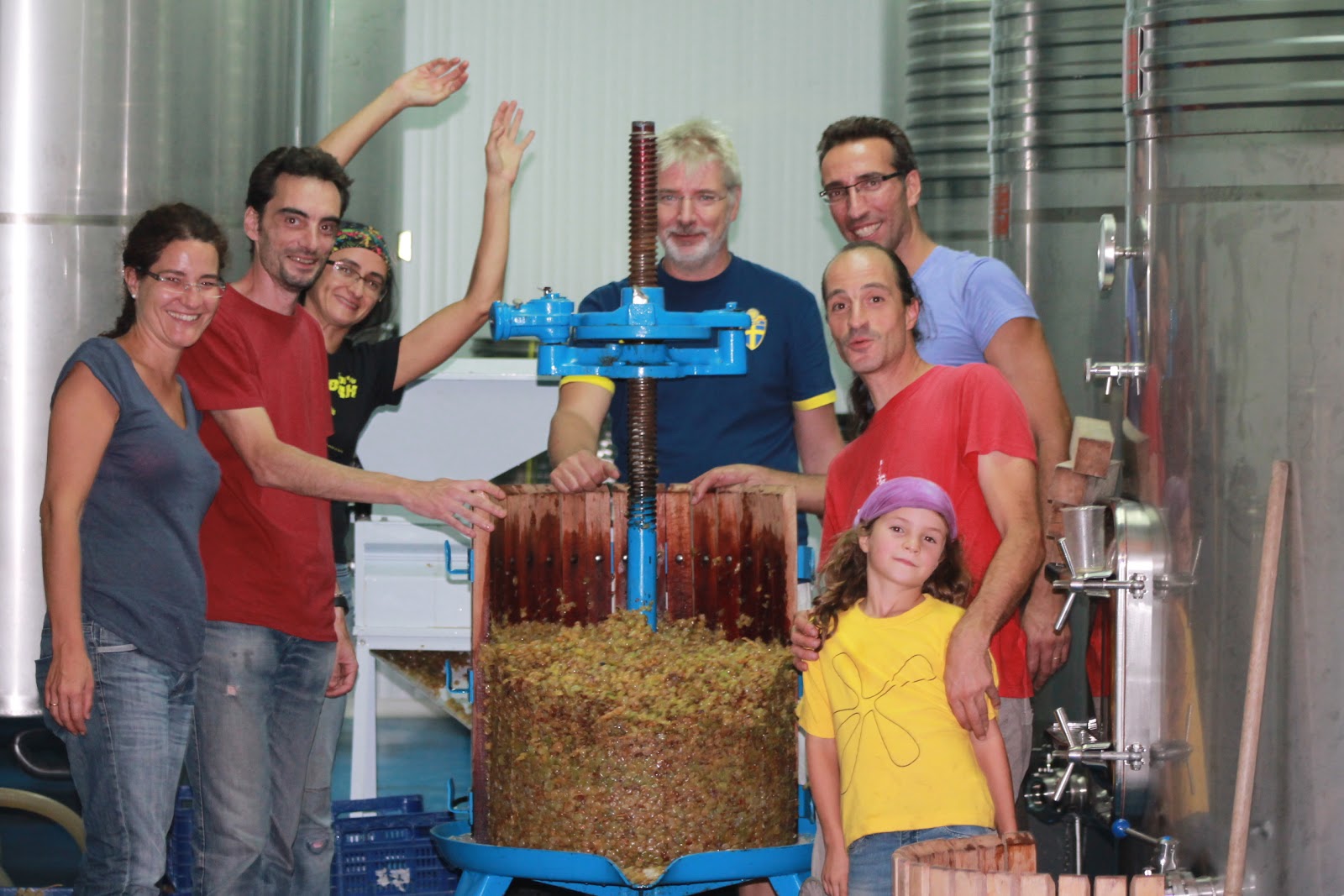
After the crushing and stomping, came the pressing:


Crushing and pressing

Free run must pouring out

Posing after the first pressing!
 And a good time was had by all! All in all we manages to obtain about 300 litres of must - no bad considering :)
The next day, Sunday, I went back to finish off. It took me about 20 minutes to pick the 3 cases worth of grapes from the top plot 8which normally gives about 500 kg); the main plot was all picked on the Saturday, but I did find two cases of picked grapes hidden under the vines which we’d missed when we were loading up. I was working on the third plot, when, two friends turned up at about 12 o’clock and we finished it off just in time for lunch!

This post was all about a lovely, romantic, idyllic, bucolic day out in the vineyard and bodega. My next post will be about the harvest I did the weekend after this one (Sunday 13th October) and it’s going to be completely different. Both posts are true, but the second one reflects a completely different aspect of the same reality.

Monday, 20 February 2012

Experiment Update: Pressing Grapes out of our Amphora / Tinaja / Qvevri


Background

Last Saturday we pressed the grapes from our clay amphora. This is an experimental lot of about 300 kg of grapes that we crushed and fermented back in September 2011. Ever since we moved ito the current winery in Morata de Tajuña a few years ago, I'd been noticing these two old clay amphorae sitting in a corner of the patio, gathering dust and leaves. So finally, last August, I made the effort, and I managed to convince Juan (my partner) and the other Juan (the owner of the winery and of the amphorae) to clean one and to use it to make wine.

So in Spetember, when we harvested the Malvar grapes from our new vineyard in Villarejo, we filled up the amphora with manually crushed grapes, sealed it, and basically left it alone (see this post). We didn't add any substances at all (no SO2) and we just punched down the cap every so often until the skins didn't float any more. Anyway, that's 5 months of skin contact.

During this time, the skins, pips, lees, etc all sank to the bottom and the top became liquid - a golden transparent liquid.. Every so often we would open up the 'lid' (a plastic sheet tied down tightly) and we would taste the wine to see how it was developing.

Operations

Phase 1, as is the case with any of our operations, was cleaning and setting up. In this case it was quite simple as all we needed was a basket press, a stainless steel tank and pneumatic lid, and some assorted bits and pieces.

Cleaning the press and tank

Phase 2 was scooping out the liquid part from the top of the amphora. We used buckets and poured it straight into a separate airtight container, not into the press. We want to keep this wine separate from the wine we press off the grapes, to see if they are different in any way. With hindsight, we realized that we could have moved this wine by gravity, just using a simple plastic hose or tube, but we didn't think that there would be so much of it. We expected only a few bottles worth, but we ended up with about 50 liters. A little lesson learned there for the future!

Juan scoops out wine

Pouring and filtering

Phase 3 was scooping out the grapey-winey semi-solid mush and puting it into the basket press. This we did with buckets until the level got too low for us to reach down into.

Juan and Juan scooping out grapes

Pouring into the press

Phase 4 was tipping the ampora over so we could continue to scoop out and fill the press. We had to be really careful as we didn't want to have an accident and break the amphora, so we secured it to the wall with a rope, after tipping it over to about 45º.

Amphora secured to wall

But it was no use! We still couldn't reach all the way down to the bottom, so we laid it down horizontally.

Horizontal

Mission accomplished! And with the added bonus that the quantity on the amphora was just right to fill the basket press, so we could press the lot in only one session. :)

Pressing is hard work!

Mushy grapes

Murky turbid wine. Note the ingenious filtering device!

Phase 5. The last phase is always cleaning the equipment used and tidying up. A great bore to be sure, but really necessary!

Hosing down

Cleaning out

Some thoughts and some tasting notes

We were all surprised at the quality of both the liquid wine at the top and of the soupy gunge at the bottom. There were absolutley no off-tastes or off-aromas. During the tastings over the last 5 months, the dominant tastes and aromas were those of clay and earth! And we weren't really too happy about that. But on Saturday, for the first time, we tasted the wine physically far away from the amphora (we went outside into the patio), and the clay and earth tastes and aromas were almost gone! They certainly weren't dominant. Instead we could taste 'normal wine' with notes of citrus, quite tannic and mineral and bitter, but with some sweetness there too. We think that this wine has got some way to go still, and that it will age well. In fact, we're thinking of looking for a used oak barrel, that was used for white wine, and ageing it in there for a while. In a week or so, depending on tastings, and ambient temperatures, and level of clarification, we'll rack off the big lees, let it settle down again, and see how it develops. Maybe we'll keet the two lots separate or maybe mix them back together again.

Nice clear golden wine from the top of the amphora

I wonder how they did it in the old days before stainless steel and when clay amphorae were common, especially the big fat ones that ccould hold thousands of liters. How on earth did the move the grapes/must/wine/pomace?

Surprise Visit

Mid-morning as we were pressing the grapes, we received a surprise visit from a group of people who are going to open a stall in the Municipal Market (in the Lavapiés District of Madrid), selling organic wine, not only in bottles but also loose, by the liter, in recyclable, reusable containers, in some arrangement with their customers. I think that's a great initiative, as these municipal markets are kind of languishing these days - I suppose due to competition from supermarkets, shopping malls and an aging population in the city centre.

They told me that the Ayuntamiento (City Council) has relaxed its Byzantine requirements for obtaining a license, but that even so it was still a Kafkaesque nightmare! They haven't actually got their license yet, but they've started sourcing their local organic wines already - hence their surprise visit. After us, they were off to see another organic wine producer Andrés Morate in Belmonte del Tajo. Anyway, I hope they like the samples we gave them and that they succeed in obtaining their license and that they order some wine from us :)
 
Creative Commons License
This work is licensed under a Creative Commons Attribution-Share Alike 3.0 Unported License.