name="description" content="Terroir-expressing natural wine minimum intervention">
Showing posts with label tasting. Show all posts

Monday, 6 April 2015

Two Visitors to my Vineyards and Winery

Like I'm sure I've mentioned before, it's not all hard work in the vineyards and winery - sometimes I get a 'day off' when someone comes to visit, even though it's still considered to be 'work'. A bit like when I travel to a wine fair :)

The first visit was about two weeks ago, by Clara Isamat, of Vinos Compartidos, based in Barcelona. She's producing a video documentary on natural wine, with a chapter or a section for each producer that she's selected. She working with a production company called Entropia Films.

Here's me and Clara, in the patio behind the bodega, on the old weighing station
So basically I spent all afternoon/evening with her and her film crew, blah-blah-blah, answering her questions, and holding forth on all sorts of issues related to natural wines, skin-contact whites, conventional wines, fine wines, the environment, globalization of wines, ingredient labelling, quality, etc, etc.

Checking the quality of the Sauvignon Blanc Amphora

Bottling up, the slow way

Fishing out a glass of Suav blanc
 Here's Victoria and Martí of Entropia Films doing a bit of post-production on the fly

Next day, more of the same, but in the vineyards. Nice and early so they could "catch the light" which is more beautiful just after sunrise!

Here we are in the car on the way to the vineyard. Can you believe that I'd never seen a selfie-stick before? Amazing! This one had a blue-tooth connection to a clicker!

A selfie-stick
I think it's that way
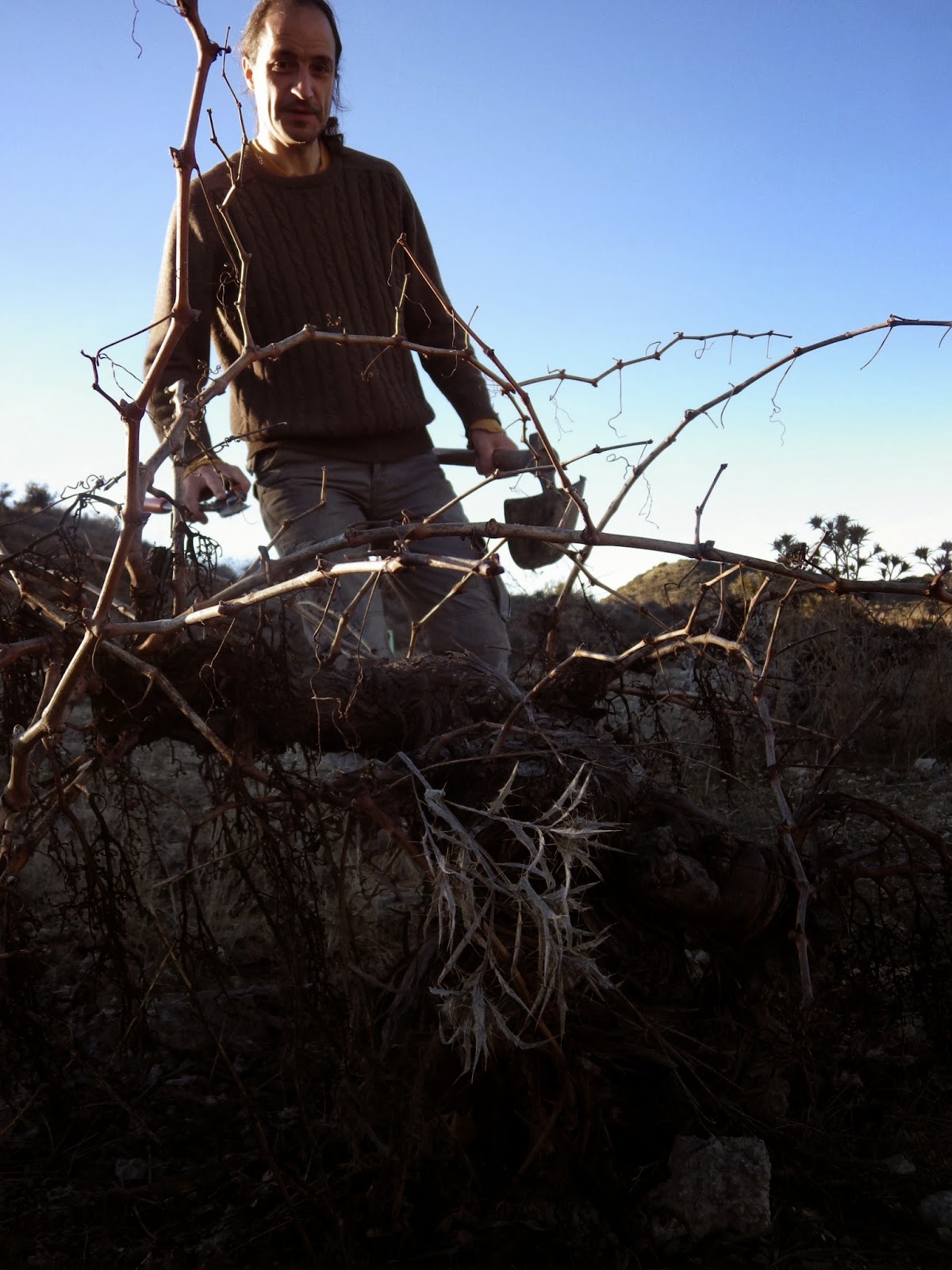
Check out that vine!

Pruning or posing?
Clara brought me a present, a new wine toy called "Kit de Cata" or "Tasting Kit", which consists of special wine socks that you can slip over a bottle of wine when you're playing a blind tastings! Otherwise, you have to wrap the bottle up in silver foil, or use a paper bag, or other inelegant solution! :)   It's great fun, and impossibly difficult to guess the wine (unless you're a professional taster, who tastes many different wines every day). You can get these lovely socks here: adivinosvino.com

Blind tasting wine socks by adivinosvinos
But I have to say that I've had at least two minor blind tasting triumphs over the last few years: one was when I gate-crashed into a monthly tasting held by a club in a village near Madrid that I happened to be passing through one evening; and I knew they were there so I thought, why not?  Well, the first wine was ridiculously obvious to me, because as luck would have it I'd recently tasted lots of them at a wine fair in London!  It was a Georgian wine and when I declared my guess everyone looked at me like I was mad. But I was right! :)

But anyway, I'm getting distracted! The next visit was by Mario Siragusa, a grapegrower and winemaker from Piemonte, Italy. I'd met hime in Turin last year at Banco, a natural wine bar and bistrot in the old part of Turin, during the Slow Food event back in October last year.

This visit was just for pleasure and no business, but we were blah-blah-blah all day anyway, again about natural wines, additives, ingredient labelling, etc, etc. Mario is a collector/drinker of old vintage wines, and he brought me this as a present:

Vintage Barbaresco 1971
He has more of the same at home and he says that it will be perfectly drinkable. Probably. They say you never can tell with such old wine. I'm starting to take an interest in old vintages, both for the taste and for the collection thing. If only I had more time! :)

Here we are in the Garnacha vineyard in El Tiemblo, Sierra de Gredos:

Fabius et Marius in vinea stant
 And here I am, extracting some Albillo 2014 to taste:

Extracting a sample of Albillo 2104
I really must come up with some other method of taking samples!

Actually, there was a third recent visit - by by Nacho Bueno, but he has his own blog (here) so he can write about it himself! :)


Thursday, 29 January 2015

Some Thoughts and Comments and Feedback on my Recent Natural Wine Tasting


I got a lot of good feedback from the people who came to the tasting of my new wines the other night at the Petit Bistrot. There were not many of us there which was a good thing as I could circulate and chat to the different groups, who didn't really know each other.

It was quite an informal affair as far as tastings go. The normal procedure seems to be to set up a sort of 'high table' or stage with the speaker speaking at an audience who are all sitting facing him or her. But in this case we were all just standing around in groups in a restaurant which, being a weekday, was empty apart from ourselves.

I came away with a very positive feeling of satisfaction and of the certainty that I must be doing something right! A feeling that I really needed, given my recent string of acetic disasters (see my previous post).

Here are the wines I presented:

Airén 2014
Doré 2014
Albillo 2014
Sauvignon Blanc 2013
Tempranillo 2013
Garnacha 2013

The first three were very young whites, which are not even bottled up yet. I bottled six bottles of each specially for this tasting straight from the stainless steel fermentation tanks (Airén and Doré) and from the amphora (Albillo). I am very happy with all three, and I think they should be drunk between now and this summer, ie young, while they are nice and fresh, especially the Airén. I know my Airens can last for years and still be drinkable, but they evolve into a different wine, which becomes less and less fruity and more and more Sherry-like as time goes by. Again, there's no accounting for taste, and many people like them that way. It's just that I personally like the Airén while it's young and fruity and full of complexities.

Regarding the Doré, there's not much I can say as it's the first time I've used that variety. So, I will keep back several cases and taste them over the years. At the moment, it's interesting to drink.

The Albillo 2014 is enormous! It's super complex and interesting and intense. It has the body of a big red wine but the aromas of a white! I'm pretty sure it will evolve well over time too, but it's perfectly fine right now too.

The Sauvignon blanc 2013 is an orange wine, ie made with white grapes but macerated on the skins like a red wine - and then racked into an old clay amphora, then bottled and aged.

I have to say that I myself was really surprised and impressed by the reception the wines got; which sounds like a silly thing to say, as I'd obviously tasted them all before. But I'd always tasted them on my own, straight from the tanks, in a silent and empty winery. Whereas at the tasting, it was like being an actor on stage, with all the related nerves and stage-fright!  Especially during the first wine, when everyone is paying close attention to what I'm saying (as opposed to chatting with their mates like they were doing by the sixth wine!)

So, I think I've managed to tick all those natural wine boxes that I'm interested in ticking:

- Express the terroir
- Express the grape variety
- Pleasant and enjoyable to drink
- Comment-worthy
- Complex and interesting aromas and tastes

I won't go into details about the actual aromas and tastes perceived or comments made by all the different people who kindly shared their opinions with me, as they were all different and even conflicting! Never would it be more appropriate to say "There's no accounting for taste"!

In any case, I'd rather let the wines speak for themselves, and I'd also rather let tasters and critics and winelovers in general speak their opinions, instead of me. Just because I can grow grapes and make wine, doesn't mean that I can write critically and usefully about my own wines! Strange as it may seem!

During the course of the evening I had an interesting discussion with a group of people about the visual aspects of my wines, which were all rather cloudy, all had sediments, and one even had some precipitated tartrates. In a nutshell, my opinion about the visual aspect is, as Clark Gable said to Vivien Leigh: "Frankly, my dear, I don’t give a damn!".  Now that's not meant to be rude or disparaging or anything like that, it's simply the reduction or summary of a topic that I've though about for a long time. A more detailed explanation for this attitude is as follows:

1. I believe that the current modern standard of beauty in wine is just a mere casual collateral consequence of industrial large-volume producing wineries' need to stabilize their wines for transport and storage purposes. I don't think that all these wineries independently and simultaneously started thinking about how to make their wines look better; no, they looked for a way to be able to transport and store their wines cheaply and over long distances and for a long time.

2. I don't believe that transparent, shiny, liquids are for some reason intrinsically more pleasing to look at than cloudy, semi-opaque liquids. This is just the prevailing opinion in the spirit of the times in which we happen to be living. The analogy that sprang to mind in the heat of the moment was of nude paintings of the past, where the subjects were fat! The opposite, in fact, of what is held to be beautiful today, ie not an intrinsic, universal quality, but based on other criteria that are held to be valid at the time in question

3. I also believe that wines are primarily best enjoyed for their taste, and secondarily for their aromas (which are of course closely related), while the visual part is in a different league altogether. I mean how much enjoyment can you get from just looking at your glass of wine?  Most winedrinkers don't pay that much attention to it anyway - just a cursory glance I would say. Most winedrinkers don't even smell their wine before drinking it - I'd say that smelling your wine is a rather geeky thing to do.  So actually looking at your wine and analyzing all those points that you read about in "How to drink wine" manuals seems to me to be only for people studying to become professionals, and a completely useless (and maybe even pretentious) exercise for 'normal' winelovers.

I have an info sheet for each one of the wines we tasted, so if anyone is interested, just write me an email or whatever and I'll send it along.  Ideally I should just put them online somewhere and make a link, but I don't know where to upload them to!

For a post in Spanish, written by Vicente Vida, a Spanish wine blogger, who came to the tasting, click here.

Tuesday, 20 January 2015

Tasting Presentation of Six (6) Natural Wines


PROXIMAMENTE - Cata de Nuevos Vinos de Vinos Ambiz:

COMING SOON - A Tasting of New Wines by Vinos Ambiz

Cuando - El jueves 22 de enero
When - this Thursday 22 of January

A qué hora - a partir de las 20:30
At what time - starting at 20:30

Donde - en el Petit Bistrot, c/Principe de Vergara, 210
Where - at the Petit Bistrot, c/Principe de Vergara, 210, Madrid

Qué vinos:
What wines:

3 blancos/whites 2014 (Airén, Albillo, Doré)
1 naranja/orange 2104 (Sauvignon blanc)
2 tintos/reds 2013 (Garnacha, Tempranillo)

Hay que reservar: 91-426-7405
Booking required: 91-426-7405

Qué más - charla informativa y ronda de preguntas y muchas cosas ricas para cenar
What else - a presentation and question answer session, and lovely food for dinner

Cuanto cuesta - €25
How much - €25

Sunday, 9 February 2014

Tasting and Pruning With Gabriel

I spent the other day (Sun 2nd Feb) pruning with Gabriel, my first ever "intern" who spontaneously volunteered to work for free in return for whatever I could teach him! Wow! I was honoured that anyone would want to do that. Lots of people have helped me in the vineyards for free over the years of course, but they were always people I already knew - family, friends, regular consumers of my wine, etc.

Gabriel tries his hand at pruning


On this occasion it was different, as I'd only met Gabriel (Sánchez Blocona) about 2 weeks ago at a tasting that we were at. As it happened, it was a tasting of the wines of Basilio Izquierdo, which would merit a whole post to itself, as there were some really incredible wines there. Including some really old ones (for me!) like a CVNE 1948 which is the oldest everest wine I've ever tasted in my life. But I won't go on about that - I've been getting paranoid lately about turning into a wine-bore! I think that's what happens when you read the Hosemaster of Wine!


Anyway, that was in the morning. After lunch (here) (which, btw, was the most expensive lunch I've ever paid for in my life, and where I witnessed for the first time a bottle of wine being opened with a pair of heated tongs!) we (Gabriel and I) decided to gate-crash another tasting in the evening.


This one was one of these wine-tasting clubs of friends who get together regularly to taste and comment on interesting wines. I knew a few of these friends (including Alfredo Maestro) so I figured that they wouldn't mind. As luck would have it they were doing a blind tasting, which I love, even though I never identify any of the wines.


The only clue we had was that all 6 bottles were non-Spanish. Incredibly, I was the only one who identified the country of provenance of 4 of them (Georgia)!  I think this was because no-one else there had tasted Georgian wines before, while I had - once, two years ago in London at RAW fair. Amazing! Then of course I had to explain that I'm not an expert or even experienced taster and that it was just luck that I remembered those wines. This is true, I'm a very inexperienced wine-taster, as the only tasting I ever do is of my own wines, and even then just checking for faults/off-tastes/strangeness/etc. I'm practicing though, and I try to get to whatever tastings I get invited to, time and tasks permitting!


Gabriel on the other hand is a wine-geek, an experienced taster, and collector of old rare wines. But he doesn't know much about grape-growing, vineyard work, pruning, etc. So, there was a win-win situation if ever there was one.

Now pruning is quite a skilled task, it's not just manual labour; so it's a bit of risk to just let anyone loose in your vineyard with a pair of pruning sheers! :)  A bit of a risk only in the sense that he/she might snip off a bit too much, or the wrong canes, and hence reduce the production of a few 'mutilated' vines!  I mean to say, it's not a catastrophy or a disaster. Vines can survive a lot worse than a crazy pruner :)  But in any case, why do it wrong, when it's so easy to do it right?

Here's me pruning a vine

So this is what we did: First he just followed me and watched, while I pruned and explained. But that gets boring after a while and the 'student' doesn't really learn anything new, after so much theory. So I sent him a vine ahead of me to do some pre-pruning. This entails snipping off all the obviously unwanted little canes, the canes growing from obviously wrong places and those growing in obviously wrong directions (all of which I explained beforehand).

Nice ladybird. Super-predator. Eats up all those nasty aphids

Contemplating ladybirds :)
 
I also got him to snip back all the remaining major canes but leaving 5 or 6 buttons. Then I myself would either prune these canes right back to the wood, or prune it to 1 or 2 buttons, as appropriate.

Those tasks that I set Gabriel to are very useful for getting to know those obviously useless canes, which can then just be snipped off without a second thought, and also for learning to handle the pruning shears, getting to know their weight and balance, how far they open, possible angles of entry, etc.

Nice earthworm. Sign of healthy living soil

His final task was to pick up all the snipped canes from where they fell and to put them in little piles in the middle of the lanes. Now that really is pure manual labour, but it saved me a lot of time :)  Come on, I had to do SOME brutal exploitation!  :)

Vine and thistle

The next time he comes out to help me, I'll teach him how to actually choose which canes to prune and keep, and which ones to prune right back to the wood. That is of course the most important piece of knowledge in pruning. How well you do that impacts not only the quantity of grapes that the vine will give you that year, but also long-term it will affect the health, vigour and longevity of that vine.

Ready, steady, prune!
Gabriel is also an awesome photographer, and he took all the photos in this post (except for the one of himself, obviously!).

His camara has also got this function that makes speedy videos. (For UK reader: think Benny Hill!) Check it out:


I'd be happy to teach anyone who wants to learn what I know. It's just a question of arranging to meet. Which is actually more difficult than it sounds because I usually don't know when I'm going to prune until a few days before! Anyway, feel free to contact me if you're interested.

Another really useful thing to do when short of time and you have thousands of vines to prune, is simply to temporarily duplicate yourself:


Me and my double ready to go
 After a hard day's work, our just reward:

In a bar, back in Madrid


Very pretty, but is it art?  ha ha!

Friday, 16 August 2013

A Whole Day Spent NOT Working at the Bodega

Yes, the other day (Tuesday 13th)* I actually did something other than clean, paint, tidy up or otherwise work at the new bodega! I was so fed up and bored by all this bodega work, that I jumped at the invitation I got to participate in an organic produce farmer's market, as part of the traditional Fiestas de la Paloma held every year in Madrid.

It was a bit of a disaster commercially speaking, but I had a great day nevertheless, as I rested both physically and mentally from the bodega. Basically I sat on my butt all day on a chair behind my counter and chatted to my fellow organic producers and did a lot of good networking!

Calle Calatrava, Madrid
This was what the street looked like for most of the day. Not surprising really if you think about it. First, during the day in the centre of Madrid, it's really hot and airless. Second, the Fiestas de la Paloma is a night-time drinking and partying kind of fiesta, not really a time to go shopping for organic produce!

Me and my wines!
I think I enjoyed myself so much, despite the heat and lack of customers, because technically speaking I was "working" even though I had nothing to do! So I didn't feel guilty about not doing anything useful or productive, as it were!

Next to me on one side was a nice couple, Gabi and María, who produce organic vegeatables in Chinchón, a town about 40 km from Madrid, and not far from Morata de Tajuña. They have a stand at the Mercado de la Cebada, a municipal market in the Latina District of Madrid. They also sell boxes of organic veg via the internet, and go by the name of Rayo Verde. On the other side was a producer of organic honey.

I also met a young photographer who works for an online newspaper (no paper version) that covers local events in Madrid: Madrid Diario.  His name is Kike and he took this photo of me!

Me again!
Then, in the evening, there was a cheese and wine tasting, organized by Slow Food Madrid, at this winebar, also in Calle Calatrava:

"El Almacén de Vinos" on Calle Calatrava
An excellent winebar with an interesting winelist, and good atmosphere. Well frequented too, in fact there were more poeple inside that on the street that evening!

Cheese 'n' wine tasting

A great time was had by all but technically speaking the tasting was a bit of a disaster! The bar was full of normal customers and people who had come specially for the tasting, but there was no way to separate them, nor was there any way to get the normal customers to keep quiet while we spoke!

---------------------

Then yesterday (Thursday 15th) I spent at both bodegas, the old one in Morata de Tajuña and the new on in El Tiemblo, and a very pleasantly spent day it was too, because I was accompanied by two 'helpers':  Nacho Bueno, a Spanish winelover and blogger (his blog is here, in Spanish) and who sponsored one of my barriques a few years ago (see this post) and with whom I made a coupage called "Las Cinco en Punto" (Five on the Dot) back in 2010. And Omri Ram, an Israeli wine student, who I knew from Facebook but who I met for the first time.

Here are my two helpers, working hard!  Omri bottling up the Malvar Amphora 2012 and Nacho on the corking machine:

Happy Helpers :)
We then loaded up the car with stuff and went to El Tiemblo, where we did a nice tasting of some of the wines I had there.

Left-to-right:  Malvar, Airén, Airén
The most interesting ones we tasted were:

An orange wine (Malvar 2011) (above, leftmost) which I found in the boot of my car last week! It must have been in there for months, with the heat easily reaching 40ºC when parked out in the sun. So I wanted to see how it was. The cork had already been pushed out by about 1 cm. Incredibly the wine was just fine. Omri took it home with him, and hopefully he'll provide his opinion and some tasting notes shortly :)

The two Airéns above are EXACTLY the same except for the fact that one (right) was crushed in a manual crusher, while the other (middle) was crushed underfoot. Same vineyards, same day of harvest, same pressing, same fermentation tanks, same racking, same everything!

The other interesting wine was this experiment I did last year, with an unknown variety called Rojilla (see this post).

A big bottle of Rojilla
This was the first time I or anyone had tasted it since it was made last harvest in 2012. I was really pleased with it. The colour was very light, almost liker a rosé, despite having spent 12 days on the skins before pressing. Aromas were delicate and fruity and in the mouth too. Shame there's only one bottle of it, even though it's quite a big bottle :)

Rojilla in the glass

----------------------------
*  Not a lot of people know this, but Tuesday 13th is considered to be a bad luck day in Spain, just like Friday 13th in English-speaking countries. Go figure. In Italy, it's Tuesday 17th! go figure even more!

Wednesday, 3 April 2013

Pruning, Planting, Bottling, Looking for a Bodega, Tastings, ...


Pruning

Well, it's pruning season again this year, and I'm running late again. There's just so much to do, apart from pruning, and apart from holding down a day-job and seeing my wife and kids every now and then!

Carabaña vineyard, half pruned
The ideal period for pruning, in my opinion, is between when the leaves fall off the vines (in December, more or less) and when the sap starts to flow (in spring more or less). This is because if you prune before the sap stops flowing or after it starts flowing, then you're removing valuable nutrients and strength from the vine. Some of my neighbouring grapegrowers start really early, before the leaves have fallen off, and some even do a pre-pruning at the same time as the harvest!!! Surely not good for the vines in the long term?

Unpruned vine

In Carabaña and in Villarejo the sap has started flowing. It's called the "lloro" in Spanish, which means 'weeping'. I've finished pruning in Carabaña, but I've only just started in Villarejo and it will take me another week to finish there. Oh well, at least I'm not running so late as last year, when the vines had actually started sprouting little leaves. In early May!!!

Planting

At last, after 10 years of talking about it and thinking about it, but not actually doing anything about it, I'm going to plant new vines in the empty spaces in the Carabaña vineyard. There are about 200 of them. I've done a bit of research and asked around already, and it seems that one of the most important things to consider is the choice of rootstock. Apart from the usual criteria, like climate, resistance to certain diseases, etc, in this case it's important to bear in mind that the new vines are going to be planted in an existing vineyard, as opposed to a totally new vineyard. So the rootstock has to be extra vigorous so as to be able to survive and thrive against the competition of their neighbouring old vines, which already have a deep and extensive root system.

If you look carefully at this above photo, you can see a few of these spaces.

I still haven't decided what variety to graft onto the rootstock. I could just go for Tempranillo or Airén, which are already in the vineyard, or go for an 'interesting' but unknown and uncommercial local variety, like Malvar or Torrontés (a Madrid variety, not to be confused with the Argentinean Torrontés or the Gallician Torrontés).

BTW, there's a local saying which goes: "Torrontés, ni la comas ni la des, que para buen vino es!", and which translates as something like: Torrontés, don't eat it or give it away, it's for making good wine, yay!

Then, apart from the empty spaces, there are also the vines which have run wild, ie the rootstock itself has sprouted and the grafted variety has died. Here I have the choice of uprooting the whole vine and planting a new one, or cutting it back and grafting a variety onto the existing rootstock. There are about 50 of these wild vines. And there are also about 50 old vines which have died but which are still in the ground. These have to be uprooted and new ones planted.

But one thing at a time! This year I'm just going to plant in the empty spaces and leave the wild vines and dead vines for another year!

Bottling

At the same time as the pruning, I've also been bottling up. On days when it's been raining too much to be able to go prune. I don't usually do this, but just bottle up from the tanks as orders come in all through the year. Which is convenient in the short term, but there comes a time, before the harvest, when I have to free up all the tanks, and so have to bottle everything that's left all at once. So this should gain me some extra time and peace of mind during harvest preparation time in August!

Yours truly bottling up some Malvar
Lo-tech gravity-driven bottling line
Looking for a Bodega

What a nightmare! What a country to try and do business in! Here we are in the middle of the longest deepest economic recession since the Great Depression of 1930, and there are hundreds of empty buildings, and even actual wineries, for rent everywhere. But is it simple, easy and straight-forward to rent one and start a wine business? No way, José! You'd think that local authorities would be interested in helping, or at least not hindering, small business startups, but unfortunately, it's not the case. The amount of red-tape and bureaucratic obstacles is just ridiculous. I'm not talking about sensible and valid requirements, like safe electrical installations, water connections, fire extinguishers, ventilation, etc, which is perfectly fine. I'm talking about other requirements like having to present an official project description, which you can't just type up yourself, but have to pay an 'expert' to do. And funnily enough it's usually the municipal architect/planning officers who say that as it happens they themselves can do those reports AND sign them off quickly and that'll be €2000 please, thank you very much! And other 'obstacles' which just magically disappear when money is passed! Oh well, mustn't complain! I will find a way!

Tastings

Thank goodness for tastings! Where would we be, and what would life be like without tastings? I hate to think! Anyway, I remember at least two tastings that I was at recently! The first was a tasting of some of my own new wines from 2012: a white (Airén), a red (Garnacha) and an 'orange' (Malvar). It was at Le Petit Bistrot, a bar/restaurant in Madrid, where they exclusively serve natural wines. The only natural winebar in Madrid - incredible but true. How can a country that produces 50 gazillion liters of wine every year only have one natural winebar in its capital city? Don't all shout out at once! Anyway, the tasting was a small, informal affair, with about 15 people, and I chatted and tasted with them all and answered their questions. I didn't have to give a speech or presentation in the end, though I'd prepared one!

The other tasting was even more informal, as it was just a bunch of friends who decided to get together one evening and do a blind Garnacha tasting just for fun, and see if we could guess where the Garnacha came from. We did it in the Vinoteca Pelayo in the Chueca district of Madrid. In the end we were not very successful at all in guessing the regions, even though some of the people there were experienced tasters, and in the wine trade!

A Bottle of Garnacha!

Visits

I also did another two mini-tastings with two Spanish journalists/bloggers in the space of 4 days from each other. Just like the number 27 bus, which never comes and then two come along at once! The first was Joan Gómez Pallarés, who apart from being a food/wine blogger, is a professor of Classical Literature at Barcelona university. He is currently on a month's leave and is touring round Spain, tasting regional foods and wines, and blogging about them, and he included me in his itinerary. He's already written a wonderful post (in Spanish) on his blog about his visit.

The next visit was from Mar Galván, who is a writer and professional wine-taster. She has her own blog here for her poetry and writings, and she also writes wine-related articles for Verema, which is the biggest Spanish language online wine site. A few days after her visit to me, she was participating in the final round of El Nariz de Oro ("The Golden Nose") blind tasting competition.

Mar Galván in the Villarejo Vineyard

Panoramic view of the Villarejo vineyard, taken by Mar


Sunday, 17 February 2013

Orange Wine

There seems to be a lot nonsense being written about orange wines lately, including by writers/bloggers who should know better. I'm not going to name any names, because there's no need to, ie if you're reading this post then you're a wine-geek and you'll have read all the other recent posts on orange wine and you'll know exactly who and what I'm talking about.

An orange wine
 
It seems to me that the fundamental error that many people are making is not realizing that orange wines are a catagory unto themselves, and should not really be compared to white wines, red wines or any other kind of wine. Like Sherry, for example. Sherry is technically a white wine, but who in their right mind would taste a sherry and compare it to a normal white wine? I believe the same applies to orange wines.

There also seems to be some confusion about the use of sulfites in orange wines. There's obviously no connection whatsoever. Orange wines can be made with no sulfites, with a reasonable quantity of sulfites, or with lots of sulfites! It depends on the winemakers' decision.

And there also seems to be some confusion with regard to natural/organic/biodynamic wines. Orange wines do not necessarily have to be natural, organic or biodynamic. There is in fact an industrial volume-producer in Spain who still churns out an orange wine for about €2/bottle.

Orange wines are not a newly discovered phenomenon. They've been made that way for thousands of years, especially in countries like Georgia and Armenia, but probably in ALL winemaking countries. Friuli, in Italy, for example. I know for a fact that they were made in Spain, until they went out of fashion; now there are only a few producers left. OK, so they're all the rage at the moment, and everyone who wants to be relevant and interesting feels obliged to write about them! Oh well.

Orange wines are perfectly capable of expressing the terroir of where they were produced. Why on earth should they not be? It depends on the winemakers' decisions, just like for any wine or type of wine.

I don't see why certain writers think that ALL orange wines are expensive. Obviously some are, but others are quite normally priced. (my own, for example, retail in NY for about $20 in winestores and for about $40 in restaurants)

Orange wines don't have to be made in clay amphoras. They can be made in any container whatsoever. I personally make the exact same orange wine in containers of three different materials (clay amphoras, stainless steel, and open-top oak casks) just to see if there's any appreciable difference.

What I don't understand is why people get so upset and feel they have mock and/or attempt to be funny and/or criticise without knowing what they're talking about. I mean, surely it's interesting for people to try a new type of wine? Why all this negativity and disparagement? Why not focus on the interesting, reasonably-priced, terroir-expressing orange wines out there, instead of on the expensive, funky, cloudy ones?

Orange wines don't have to be cloudy. It depends on whether the winemaker fines it and/or filters it and/or lets it settle naturally by gravity!

Orange wines don't have to be oxidized either. It depends on whether the winemaker decides to protect it from contact with oxygen or not.

I personally discovered orange wines about three years ago quite by accident, and I have to say that I love them, because they are so different from white wines and red wines. They are very versatile too: on the one hand they're great for drinking on their own as an aperitivo before lunch, or for quaffing casually in a winebar, and on the other hand they go great with food too.

Here's a nice photo of my orange wine, which in this case was made in an clay amphora, was not fined or filtered, does not contain any added sulfites; but it could just as easily have been made in stainless steel, been filtered and fined and contain lots of sulfites, and it would still be an orange wine!


foto


Thursday, 12 July 2012

Slew of Back-Posts (1 of 5): Photography Exhibition


On Thursday 26th April I was at an ‘event’ pouring wine. It was the inauguration of a photography exhibition by Jutta Pfannenschmidt (from Germany) and organized by Hanna Kress (from Finland), held in a municipal cultural centre (in Madrid).

It was a surprise invitation for me. Firstly I’d never been invited to pour wine at that sort of event – in fact I’ve never been invited to pour wines at any sort of event! The only events that I usually go to are our own annual tastings (the last one in December 2011 was held in La Tabacalera – see this post), the odd local wine fair here in Spain, and the occasional informal tasting/get-together here in Madrid. So it was really interesting to be there, at this art gallery, as the people present weren’t wine-geeks! They were there to see the photographs!
But, having said that, they were also interested in my wines, and I was asked a lot of questions.
Photo Exhibition

Mainly questions about organic grape-growing and organic winemaking, which was interesting as I got some good feedback on what ‘normal’ winelovers are interested in. I tend to get immersed in rather archane technical details – both from reading stuff on the internet and also from the geeky wine people I tend to hang out with! So it was good to get away from that sort of detail and to get a view of what real people are concerned about.

3 Wines - Orange, Red and White
I took three wines there: a white (100% Airén 2011, from the Carabaña vineyard), a red (100% Tempranillo Crianza 2010, also from Carabaña), and orange wine (100% Malvar from the Villarejo vineyard). I was a bit worried about taking this orange wine, as it’s a bit unusual and mainly for wine-geeks – or so I thought! But everybody loved it! It was by far the most popular of the three. Interesting!

Orange wine is basically a white wine, made from white grapes, but made as if it were from red grapes, ie, there is a period of skin contact while the wine is fermenting, and perhaps some more extended contact after the fermentation is finished. I’ve been experimenting with this type of wine for a couple of years now, and I really like it – I think there are interesting possibilities and scope for making some really good wines here. But I’ve only just started and I’ve got lots to learn and lots of experimenting to do.


There was good background music provided by Michael (from Poland) throughout the event. 

Me and Michael, the musician
I missed the opportunity to have my photo taken with the Countess Finck von Finckenstein, who is the cultural attaché at the German Embassy in Madrid! (#hobnobbing #namedropping)

I was also chatting to a young man from Georgia who said he’d send me links to Georgian wine and on the use of clay amphorae, or qvevri as they’re called there.

And lastly, I missed a night out on the Gin + Tonics with Jutta and Hanna and company because I was iron-willed and resolute and went home early (-ish) at 1:00 am, because the next day I had to get up early for a visit from my US importer Jose Pastor Selections. That doesn’t happen often (my being iron-willed!) – as I usually give in to temptation and end up getting home really late and suffering for it the next day!

Friday, 9 December 2011

Vinos Ambiz Annual Tasting

Confirmed!


Where:
CSO Casablanca (c/Santa Isabel, 21) (Metro Antón Martín)
Madrid (Spain)

When:
Saturday 10 December 2011, at 19:00 (-ish)

What:
We'll be presenting at least the following wines:

- Airén 2011 (young white), from Carabaña (Madrid)

- Garnacha 2010 (lightly oaked), from San Martín de Valdeiglesias (Madrid)

- And at least two other 'interesting' wines that we we'll bottle up at the last minute!
We'll probably follow the same procedure as last year (and the years before), ie as we taste, and assuming we can get people to shut up and listen for more than 3 minutes, we'll give short speeches on how we grow our grapes and make our wines (eg, organic viticulture, non-use of pesticides and noxious chemicals, no adulteration of the must/wine in the bodega, sustainability, recycling of bottles etc); and we'll be answering any questions that anyone wants to ask.

How:
You just need to turn up; we will provide the wine and the glasses. Entry is free. You can come with whatever attitude you like and you can bring your own cultural baggage in with you - you don't have to leave it at the door! Skeptics and sychophants equally welcome!

Un abrazo, and sláinte

Fabio and Juan


P.S. We're trying to collect photos of previous years' tastings to make a thematic album:

2010: Tabacalera
2009: La Dragona (Ecologistas)
2008: El Patio Maravillas (c/Acuerdo)
2007: CSO Seco
2006: Off-Limits
2005: CSO Seco (antiguo)

If you were at any of these tastings and have photos, please send us a copy!

Monday, 7 February 2011

Wining and Dining in the Wine World

The other week I took some time out and immersed myself into the glamorous, fun side of the wine world, which I thoroughly enjoyed. It was great to get away from the usual routines in the vineyard and winery, which I’ve been doing for 8 years now.

I hit the road with US wine importers, José Pastor and Mark Middlebrook (of JPS) for two days (Monday 17th and Tuesday 18th of January) travelling around central Spain, visiting vineyards and wineries, drinking good wine, eating good food, and talking about wine.


Jose (left) and Mark (right) in my foggy vineyard

Don’t get me wrong: I really love what I do (grow grapes and make wine) and there’s nothing I can think of that I’d rather be doing, BUT EVEN SO, a routine is a routine! Maybe I’ve got a short attention span or I’m hyperactive, or something, but I jumped at the chance when José invited me join him on his trip.

Actually, it all started on the Sunday night (16th), when we met for tapas, beer, wine, vermouth and gin-and-tonics (in that order, more or less) in the Lavapiés district of central Madrid. We went first to La Vinícola (c/San Eugenio), an old haunt of mine. I used to go there more often than now as they used to keep their wine boxes for me which I’d use for my own wine, but last year I got some of my own boxes printed up with my own logo on them. They have good wines (nothing special), natural cider, vermouth on tap, great tapas, and a great atmosphere and décor. Then on to La Echartia, just round the corner on c/S.Isabel, for gin-and-tonics. Nice atmosphere, jazz music, good ambiance!

This was the first time I’d gone out on the town since the new no-smoking law came into effect in Spain on Jan 2nd. What a difference! This is a major turning point, sea-change, paradigm shift in the Spanish night-time social cultural scene, and I exaggerate not! On the plus side I see the following: inside the air is nice ‘n’ clean and you don’t get home with your hair and clothes stinking; there’s plenty of room inside to stand at the bar or even to sit down; you can now step outside to smoke, chat, and smirt with a crowd of like-minded people: you smoke less and enjoy it more! On the negative side, I see yet another step in globalization, homogenization and places losing their identity, charm and singularity.

Anyway, after sorting out the wine world’s problems, home early – at 2:00 a.m.!

Monday morning, up bright and early (11:00 am) we went to see my own vineyard in Carabaña. It was cold and foggy.

Jose and Mark in the vineyard in Carabaña (Spain)

We’ll be starting the pruning soon.

Then on to ‘my’ bodega in Morata de Tajuña, for a tasting. This is what José Pastor will be importing into the US in the near future:

- 100% Airén 2010
- 100% Airén 2010 Carbonic Maceration
- 100% Garnacha 2010

And perhaps these as well, but in the not-so-near future:

- 100% Airén 2010 with skin contact. Not yet. This will improve/evolve with time
- Other young red wines from 2010 (Tempranillo, Graciano, Sirah, Petit Verdot). Not ready yet, to be tasted, left over the winter, tasted again, etc
- Other crianzas, to be tasted and/or blended in a few months time

Tasting notes: I’ve never been good at tasting notes, so I won’t even bother to write any here. José can do that himself :)  Suffice it to say that I like my wines (that’s why I make them the way I do!), he likes my wines, and hundreds of incorrigible regular customers also like them; and in the near future hundreds more new customers in the USA will be tasting them and hopefully liking them too! This is what it’s all about for me: making unique, genuine, unadulterated wines expressing the ‘where and when and what’ and getting as many people as possible in the world to taste them and enjoy them.

Then for lunch at La Tinaja, a nice restaurant in the centre of Morata. We had the menu del día, but boy did we cover that wine list!!! We ended up doing a spontaneous unplanned wine-tasting. There were so many bottles, that they had to bring an extra table (and buckets so we could spit). Talking to the maitre it turned out that they had a whole load of old wines in the cellar that were not even on the wine list.

Our table(s) at lunch

Check that out

One of the wines we tasted

Then, into Madrid (running late; it was about 18:00), where we went straight to a wine shop (La Tintorería; Pº Marqués de Zafra 35. Tel 910 005 834) run by an interesting trio of wine world characters: César Ruiz, Flequi Berruti and Nacho Jiménez. Basic decor (ie, floor, white walls!) but very interesting wines. well worth checking out if in Madrid.

Now it was time for dinner! See what I mean about wining and dining? The appointment was at Los Asturianos (C/Vallehermoso, 93) owned by Belarmino Fernández and Alfonso Chacón , who (surprise, surprise!) happen to be wine-makers also: Bodegas Canopy. And we were joined for dinner by none other than Victor de la Serna (again!) (See previous post).

Dinner was amazing (again!) But rather than dinner, it was another tasting session accompanied by food at dinner-time! There were loads of wines:

- My own three: Airén, Airén MC, Garnacha 2010
- Victor brought a few from his Finca Sandoval (Manchela) and one Albillo from Navarra
- Belarmino and Alfonso brought a few from their Bodegas Canopy (Méntrida)
- Other wines that I lost track off and didn’t even take photos of!

Then home for an early night: 2:00 a.m. again

Next morning, bright and early again (about 12:00), we headed off to see Belamino and Alfonso’s vineyards and bodega. The vineyards were spectacular, in the Sierra de Gredos at around 900 m. Mostly Garnacha. Old vines. 14 small vineyards of about 1 ha each. Industrial bodega in Camarena (Toledo). Lunch at Gregorio. Only one wine!!!

To be continued…

(Insert text…photos of Canopy vineyards… ) After lunch, we set off to see natural wine-maker Alfredo Maestro in Peñafiel. 100-year old vineyards by night! Visit to the winery. Tasting. Home at 2:00 a.m. again. (photos and text of Alfredos bodega and vineyards)
 
Creative Commons License
This work is licensed under a Creative Commons Attribution-Share Alike 3.0 Unported License.