name="description" content="Terroir-expressing natural wine minimum intervention">
Showing posts with label amphora. Show all posts

Thursday, 3 November 2016

Harvests 2016 all done

Another year, and once again all the grapes are in. My last harvest was the Malvar on Monday 10th October.  And not a moment too soon! Because after a long, long, hot, endless summer with zero rainfall, it stated raining heavily and properly all over Spain on Wed 12th! Ha! So I’ll have to find something else to complain about, as viticultural tradition demands J

I did a total of 15 harvests this year, in 15 different plots, for a total of 15 different wines:

1.      Albillo (Charco)
2.      Albillo (Fx)
3.      Garnacha (Charco)
4.      Doré (Fx)
5.      Doré (Pp)
6.      Sauvignon Blanc (Qx)
7.      Tempranillo (TET-A)
8.      Garnacha (Castañar)
9.      Garnacha (Dehesa)
10.   Garnacha (McCarb)
11.   Chelva (Early)
12.   Villanueva
13.   Chelva (Late)
14.   Airén (Carabaña)
15.   Malvar (Villarejo)

That’s 2 red varieties (Garnacha and Tempranillo) and 7 white varieties (Albillo, Doré, Sauv, blanc, Chelva, Villanueva, Airén and Malvar).

I vinify each plot separately even if it’s the same variety, because it’s more interesting that way. It’s amazing how different the wines are, even if the plots are close together and the winemaking techniques are the same. For example, in El Tiemblo (Sierra de Gredos) the Garnacha Castañar plot is only about 1 km away from the Garnacha Dehesa plot as the crow flies, but the grapes and wines are totally different.

The novelty this year is a variety called Villanueva. It’s not uncommon in the area but it’s usually just a few vines interspersed among another predominant white variety. But by chance a local grower, who has an entire vineyard planted to Villanueva, came by the winery one day to offer them to me. ‘Why not?’ I thought. It’s a rather tiny plot, and there was only 150 kg. So I crushed them and pressed them and let the must ferment in small tinaja – in tinaja because it was the only container small enough available at the time!

All the rest I’ve done before, and am following the line of ‘If it ain’t broke, don’t fix it’! That’s to say that for all of the wines listed above, I followed (am following) the same techniques that have worked for me in the past, with regard to decisions on type of container (steel tank, wooden barrel, clay tinaja), maceration times if any, with or without stems, etc.

The only crazy experiment I’ve done this year is to follow a recipe I read in Pliny the Elder’s ‘Natural History, Book 14, Chapter 12. I followed the first recipe of the three he gives. So I guess I’ve made (am making) a beverage called ‘deuteria’ by the ancient Greeks and ‘lora’ by the ancient Romans. This is the stuff that was quaffed by slaves and labourers. The original glou-glou wine?

Following are some assorted photos, from over the summer:

 
View of the Albillo (Charco) vineyard, with the Alberche river in the background.
El Tiemblo, Sierra de Gredos

Bird's eye view of Albillo macerating

Bottling machine

My Garnacha vineyard using no chemicals, next to a naked agro-chemical wasteland vineyard!

Bottling up

At a wine fair

Sheep in the Garnacha vineyard, eating weeds and dropping caca!

Sheep entering

Living soil, for healthy vines

My pet nat exploding on me! Too much pressure!

My Chelva vineyard, surrounded by the houses of El Tiemblo village

In another Garnacha vineyard, steep, in El Tiemblo, Sierra de Gredos

Bottling up!


And to finish off, a note on the word “sapid”

I generally find it impossible to have decent in-depth discussion on FB or other social media sites. And a few weeks ago, I found myself feeling frustrated because I couldn’t say what I wanted to say! I think that FB and other sites are just not the right place for a proper discussion or debate: basically, they all tend to favour spur-of-the moment, shooting-from-the-hip type comments, right there and then, whenever you happen to come across an interesting post that you feel like commenting on. There’s just no time to think before typing! Apart from wine, I also like words, so I was doubly affected!

This had been annoying me for days, so I decided to do something about it. After searching on the internet and after doing a bit of ‘due diligence’, I’ve come to the conclusion that it’s not a very useful word to use in written wine-tasting notes or while speaking live to an audience. The due diligence consisted in asking native-English-speakers, uncontaminated by knowledge of a foreign language, if they knew what ‘sapid’ meant. Not one did! English-speakers who know a Latin language would know ‘sapido’ (It, Sp, Pt) or ‘sapide’ (Fr) where it’s quite a common word for everyday use and just make the connection.

Firstly it’s not a very common word at all in English (see here, this is just one of many word-frequency sites) and so it’s not likely that the readers/audience would understand what it means. This may depend on the level of knowledge/culture of the audience though, so an audience of hardened winelovers may have come across it before. But still!

Secondly, once you discover the meaning of ‘sapid’, you also discover how useless it is, for it means “having flavour” “tasty”. Which covers just about every edible/drinkable substance in existence, except for water!

I suppose that a slight degree of usefulness might be attained if a bit of common sense is applied by the reader/listener, ie by assuming that the writer/speaker really means ‘very’ or ‘extra’ flavourful/tasty. But then why bother with ‘sapid’ at all? Why not just say ‘very/extra tasty/flavourful’ and make life easier for your readers/listeners, who are after all reading/listening to you with a view to learning something about wine! But then again, maybe they would enjoy learning a new word? Or are happy to be introduced to the secret and occult world of wine-tasting? Or would they hate wine forever on account of the arcane vocabulary used?

Well, whatever. Anyway, I feel a lot better, now that I’ve got that off my chest.  J

Tuesday, 20 January 2015

Tasting Presentation of Six (6) Natural Wines


PROXIMAMENTE - Cata de Nuevos Vinos de Vinos Ambiz:

COMING SOON - A Tasting of New Wines by Vinos Ambiz

Cuando - El jueves 22 de enero
When - this Thursday 22 of January

A qué hora - a partir de las 20:30
At what time - starting at 20:30

Donde - en el Petit Bistrot, c/Principe de Vergara, 210
Where - at the Petit Bistrot, c/Principe de Vergara, 210, Madrid

Qué vinos:
What wines:

3 blancos/whites 2014 (Airén, Albillo, Doré)
1 naranja/orange 2104 (Sauvignon blanc)
2 tintos/reds 2013 (Garnacha, Tempranillo)

Hay que reservar: 91-426-7405
Booking required: 91-426-7405

Qué más - charla informativa y ronda de preguntas y muchas cosas ricas para cenar
What else - a presentation and question answer session, and lovely food for dinner

Cuanto cuesta - €25
How much - €25

Tuesday, 17 December 2013

Wrap-up Post for the Year 2013

(This is going to be my last post of the year - unless something really interesting happens between now and the 31st, that is)

Well, what can I say that is not too boring? I think maybe a quick summary of all the different wines I've made this year would be acceptable, followed by some humour :)

Or maybe I should subject you all to my Great Thoughts on the "State of the Wine World" or some such enlightened topic. Nah, maybe I'll spare you for the time being and do that next year! In the meantime you can just browse though my assorted comments and thoughts and ramblings on the 11 different whites and 5 different reds that I managed to make this year: That should be quite bearable :)

New wines of 2013:


Panoramic view of all my wines

Whites:

1. Airén 2013. From Carabaña, fermented in clay amphora

This is the wine I've been making for the longest time. Since 2003 in fact, though no bottles exist from that time as far as I know. The oldest bottle I have is from 2006. I really regret not keeping a few cases back from those days. But who could have known then that it would have been an interesting thing to do at that time? Such is life!

Anyway, at the time of writing this post (mid-December 2013), this wine is coming along really, really well, I'm glad to say (as I touch wood). It's got body, it's got complexity, and it's got its terroir. Sí, señor! This is normal and par for the course for this wine, but it's really quite extraordinary for an Airén from central Spain. Those of you who know me and who read my posts know that I'm not one to blow my own trumpet (or beat my own drum, as they say in Spain!), but after 10 years of positive feedback, I really have no qualms about saying how good this wine is! Even if I say so myself!  All the other 100% varietal Airén wines I've tasted are all wishy-washy insipid affairs that don't have anything to say. (Except for Samuel Cano's 'Patio' Airén, that is. From La Mancha.)

This year's Airén (2013) is slightly different from all my previous vintages, in that the harvest was really late. About 20-25 days late in general. In particular, I harvested this Airén from Carabaña on the 19th October. And that meant that it didn't have time to finish fermenting before the temperatures dropped too low for the yeast to work. I think!  When I taste it, I'm pretty sure there's some residual sugar in there, so I think the wine will continue to ferment in spring (2014) when the temperature rises again. This is a bit of a bore in one way, because I usually release this wine before Christmas. Apart from being good for my cash-flow (!) it's also a really fun and enjoyable experience to drink this year's wine in the depths of deepest darkest winter. It sort of brings light to life.

So, this year, I'm not releasing it 'officially' or promoting it or actively selling it yet, as it were, but if anyone asks or orders it from me on their own initiative, then I'll ship it.

2. Airén 2013. From Morata de Tajuña. Amphora

This is from a vineyard only about 10 km down the road from my own vineyard in Carabaña. I bought the grapes from a young grape-grower who cultivates them organically.

I made this wine in exactly the same way as I made the one above, from Carabaña, ie:

Grapes crushed manually (using a manual crusher), then pressed manually (using a basket press), and then I pumped the juice into these two large clay amphoras. And that's it! Nothing else! I didn't add anything, I didn't take anything out, and I didn't subject the grapes or must to any other processing whatsoever. C'est fini!  All I have to do now is wait for gravity and the cold of winter to do what they have to do, and then bottle up in January or February or March. Maybe it'll be slightly, naturally sparkling? Who knows? I hope so.


3. Albillo 2013. from El Tiemblo. Stainless Steel

The Albillo grapes came from a vineyard a few kilometers from the bodega in El Tiemblo, overlooking the reservoir known as El Charco del Cura. See this post. They were picked by the owner, Vicente (86) and his family, while I drove the van between the vineyard and bodega with the boxes.

This was my first time making Albillo, but it's not going to be the last! I'm really impressed with this grape, though I shouldn't have been surprise because I'd tasted a few Albillos from the area before (by Daniel Ramos, Alfredo Maestro, and others). This is an awesome grape variety that should be way up there with all the other famous and well-known grape varieties. I reckon this is yet another case of Spain (or Spaniards) not knowing how to market and sell their products. Which are of course just as good as the French and Italian equivalents. But hey, what can I do? I'm not an NGO, nor am I independently wealthy, so I can't go promoting Spanish quality products in general! What I CAN do is promote my OWN quality products, which is what I'm doing. It's a bit of a bore having to work with this negative perception that the world has of Spain and of Spanish products, but... this is where I live and work, so let's just get on with it, no?


4. Sauvignon Blanc 2013. Amphora

This is another first for me. I've never made a wine with Sauvignon Blanc before, but there's always a first time for everything, no?  So, just up the road from El Tiemblo, in Cebreros there's a 'finca' (an estate) that produces very good quality olives, honey, vegetables, and ... grapes. I had the opportunity to buy some of those grapes, and I did.

Two days soaking on the skins, then crushed, pressed and pumped into a clay amphora, and into a stainless steel tank. Just like the Airén, nothing added, nothing taken out, no unnecessary processing.

At the time of witing this post (mid-December) it's tasting very nicely. No cat-piss at all, though I don't know if that's a good thing or a bad thing! For tasting notes and considered opinions on these wines see Nacho Bueno's blog here (in Spanish) and also Mar Galvan's tasting notes here (pending).

5. Sauvignon Blanc 2013. Stainless Steel

Same as above.

6. Chelva 2013 (A). Stainless Steel

Now, this is by far the most interesting experiment I did this year. And I'm definitely going to be doing more of it next year. I did three experiments, but two of them were failures in the sense that the wines were not very pleaseant or interesting to drink or enjoy. But they were of course extremely useful to me, as a winemaker. The third experiment is quite drinkable and interesting, though I'm not going to 'release' it for sale. I will of course sell it and ship it to anyone who orders it. See here for some tasting notes and opinions that are not mine!

Personally, I quite like it, and if no-one else wants it I'll just use it as my own personal table-wine for the year!

7. Chelva 2013 (B). Stainless Steel

Horrible. Crap. Don't even try it it, unless you're a wine geek. It has lots of academic, vinous interest, but it's not the type of wine that you can sip and enjoy while flirting or just having a normal conversation, or while having lunch! It's even more extreme that the above Chelva (A). But don't get me wrong, it has no faults or defects, and is perfectly drinkable, it's just that it's rather ... unusual, or maybe 'green' is the word, I'm not sure what the descriptors are. Basically, IMO, this is because the grapes were picked earlier than the Chelva (B). See about half-way down this post.

Chelva (C). Stainless Steel. This third Chelva experiment, I'm not even going to dignify with an experiment number!


8. Malvar 2013 (A). Amphora


9. Malvar 2013 (B). Amphora


10. Malvar 2013 (C). Amphora

Malvar, Malvar and Malvar


These three white, skin-contact ('orange') wines should have been all the same, because they're made with the same grapes, from the same vineyard (Malvar from Villarejo), harvested on the same day, and processed in exactly the same way - grapes destemmed and crushed manually and everything (must, skins, pips) poured into three different clay amphorae. The only difference is in the size and shape of the amphorae. And maybe the composition of the clay? Or the linings?  Whatever. The fact is that the three wines taste slightly different. I don't know yet whether to keep them and sell them separately, or to blend them all together. Time and tastings will tell.

In any case, I'm not going to release them for at least a year. I believe that 'orange' wines improve over time and age well (at least mine do!). I still have a few hundred bottles from 2012, and they are tasting really well. The complexity and intensity of the aromas and tastes are amazing.

Now the reds:

I think I'll write about the reds some other time, because at this rate I won't have this post finished till next year! Just to say that I have these 4 reds this year:

11. Tempranillo (Carabaña). 
12. Tempranillo (El Tiemblo). 
13. Garnacha (Sotillo)
14. Garnacha (El Tiemblo)

So Merry Christmas, everybody.  For the holidays in general I recommend you drink the wine you like, and will enjoy, and try not to pay too much attention to all these recommendations that ar in our faces everywhere :)


Tuesday, 8 October 2013

Harvest Report 2013: Dammit, Everything is Going Wrong this Year!

Well, not everything, but it's hard to be objective when all sorts of sh** happens every day!

I really shouldn't complain, because, despite everything, I've managed to find an awesomely beautiful and spacious bodega (winery) which has infinite possibilities, and which only requires a bit of time, thinking, and planning to make a go of. In the meantime, though, short term, many things are going pear-shaped, and my wine plans (such as they are) seem to be changing every other day. I've made a big effort this year to be rigorous and systematic, and to actually write things down on paper, but I wonder why I bother, as every day brings an new 'event', phone call, circumstance or whatever, that radically changes all my previous plans.


My awesomely beautiful and spacious bodega!
 Anyway, whatever. Here's my latest status, as of today:

Grapes in, wines made, wines being made:

1. Albillo. This year, I made my first ever lot of Albillo. Seeing I've just moved into my new bodega in El Tiemblo, in the Gredos mountain range, I just had to make some Albillo. It seems that this is a variety that is in danger of extinction, as only a few winemakers use it. The problem is that it's also used as a table grape, and is very expensive and difficult to find. I was only able to find a small lot of about 400 kg at the last minute (see this previous post of mine). The wine I made is now practically dry, or perhaps still fermenting very slowly, as I can get a slight whiff of CO2 when I stick my nose into the tank. I don't know what it's going to be like, but I think it will be OK and will only get better after the cold of winter. The fermentation was fast and hot, as I wasn't able to keep it cool, due to 'circumstances'. Next year I will definitely do at least two different experiments. Live and learn. And enjoy!


2. Tempranillo from Carabaña. I harvested it a few weeks ago, last Sunday 22 September. Lovely bunches, totally healthy, not a single symptom of mildew or anything else. I was well pleased. I destemmed and crushed the bunches by hand, and the wine is still fermenting slowly on its skins. The last reading I took a few days ago showed a density of 1020, so almost finished. I've been punching the cap down once a day (and sometimes no times at all). That's not a lot by present day standards, but I don't really want to extract it to death. Nice and easy does it :)  I think I'll press it off over the next few days, before the weekend, maybe. There's only enough to make one barrica (225 liters, or 300 bottles) of Crianza.

3. Chelva. This is a local white variety that grows mostly in Extremadura, but which is found around El Tiemblo too. It's a variety that is looked down upon and frowned upon. It's used for table grapes and has a very negative cultural and vinous reputation. But hey, so does Airén, and I've managed to make a pretty mean and interesting Airén over the past 10 years, which sells very well and generates positive feedback for me, so who's to say I can't do the same with Chelva? There's only one way to find out, isn't there? So I'm doing several different experimental lots this year:

- Chelva Experiment #1. Carbonic Maceration. On Wed 18th September I sealed up a 300 liter tank with selected whole bunches of Chelva. It's still sealed as I write today. Soon, I'll check it out and decide what to do.

- Chelva Experiment #2. Frutteto style. Acting on the good advice of fellow winemaker Daniel Ramos (with whom I'm sharing the new bodega), I laid out about 500 kg of bunches upstairs on the 1st floor of the bodega, in order to dry them out a bit and increase the sugar concentration. They lay there for about two weeks and the other day I also crushed and pressed them, and they had indeed increased in sugar concentration. The reading I got showed 12.5% of probable alcohol; which seems rather a big increase, so I'm suspecting that one of the two reading may have been a bit off.

- Chelva Experiment #3. Crushed and left soaking on the skins, 'orange wine' style. That's about two weeks skin-contact time. This could well be one of the experiments that go wrong. The sugar content was very low and hence the probable alcohol level - only about 10.5%. This could well be lost to acetic acid. I did in fact have a close shave, as the other day when I opened the lid to check the cap, I got a huge whiff of vinegar. To be expected I suppose, with no added SO2, and such low level of alcohol. But all was not lost, it was only in the cap, as the wine I tasted from the tap at the bottom of the tank was OK. So I separated the cap, threw it out, and pressed the rest of rest of the skins.

After all that, I decided to blend the 'frutteto' and the 'carbonic maceration'). The regular vinegary lot, I doused with metabisulfite (about 40 mg/l), and sealed the tank hermetically. I don't know what will happen, maybe it'll turn to vinegar after all, or maybe it will survive. I'll check it every couple of days. Maybe I`ll blend it in turn with the other already blended lot of Chelva.

I was going to do more experiments with Chelva but I won't be able to now. This is because the grapegrower I bought the grapes from is completely unreliable and I couldn't get him to harvest on the dates I wanted.  For some reason or another he unilaterally decided to harvest one day (19th September) and appeared at the door of the winery with almost 1000 kg of grapes. Now if I had been a hard-nosed business-first type of person I would have told him to get lost and sell his grapes to someone else, and that I didn't want grapes with a probable alcohol level of 10.5%; but I don't know why, I took his grapes!

Actually, I'm even more pissed off with that grower because there was another 1000 kg left in the vineyard, which I intended to harvest this weekend, but which now I can't, because he's gone back on his word and he's decided to use it to make some wine himself!  What a disaster! Basically I end up with 1000 kg of grapes that I didn't want, and I don't get the 1000 kg of the grapes I did want!

All I can say is that I won't be buying any grapes off him next year. In fact, I'm even more pissed off, if possible, because I turned down another local Chelva grower who offered to sell me his grapes! Grrrrrrr.

4. Garnacha from Sotillo de la Adrada. Last week, Sat 28th and Sun 29th September, I harvested three different plots of Garnacha. It was hairy. The weather here in Spain that weekend was weird. They were calling for rain, but not too much. To harvest or not to harvest? In the end I decided to harvest, because 2 of the plots were ripe and had to be harvested, and if we got wet, well, we got wet! In the end we were very lucky, because we only got rained on a little on Saturday morning, and not at all after that. So I took in about 2000 kg, all of which I've decided to ferment whole-bunch carbonic maceration. And there they lie, fermenting carbonically, as I write.

Harvests Pending

1. My own Airén, in Carabaña. I checked it out the other day and it's showing just over 11% probable alcohol, which is not a lot really, cansidering the time of year. I'm going to leave it for another week to see how it goes. It was lloking really good, totally healthy, no signs of any rot or mildew or anything. Touch wood!

2. My own Malvar, in Villarejo. It was showing 12% probable le alcohol, so I'm going to leave it for another 10 days / two weeks too. In contrast to the Airén, the Malvar was rather uneven. There were lots of vines that had ripe or ripening bunches and at the same time bunches with tiny immature berries. Very irregular.

3. Tempranillo, El Tiemblo. A nice plot of organic Tempranillo (officially uncertified but grown by a trustworthy grower), which was at a probable 13% last week, but still unripe.

4. Garnacha, from El Tiemblo. Also uncertified organic. Only showing 12% last week, so probably another 2 weeks to go.

5. Maybe an extra surprise that I'm not expecting? I wouldn't be surprised :)

Apart from all that

Now apart from all the above unknowns, I also have other complications or "challenges" to deal with over the next few days or weeks.

Firstly, adding up all the kilos of grapes that will be coming in, I don't currently have enough storage capacity to process them all! This is incredible and/or ironic, but true, as I'm installed in bodega with a theoretical capcity of 1.2 million liters of wine, in the form of concrete tanks (of 16,000 liters each). The problem is that I can't really use them, as I don't have enough grapes/wine to fill even one of them, and it's very risky to only partially use a tank (especially a concrete one). Because of the oxygen contact and possible contamination from the walls of the unused part. So basically I have to buy a few thousand liters of capacity in the form of bins, containers, tanks, whatever. And my only practical option is plastic, because of the price. I would prefer stainless steel, or clay pots, but the cost would be prohibitive for me. I'm almost tempted to do a crowd-sourcing thing, to finance the purchase of say, 4 or 5 1000 liter stainless steel tanks or clay amphorae, but I just couldn't deal with that now. Maybe next year.

Secondly, I don't own a van, so I either have to borrow one from a friend, or rent one. Or not, depending on whether the grapes are ripe or not!

Thirdly, I don't own any cases for harvesting the grapes! I've always borrowed them. This is ridiculous really, and I ought to just go and buy some; there're not even that expensive! So it depends on whether my friends/acquainances are using their cases or not.

- Fourthly, labour!  Whether to hire a few professionals for the day, or to invite friends and family? That is the question.

So, all things considered...

Writing a post like this is very therapeutic for me, because it actually really does put things into perspective. It's very easy, in the middle of the harvesting season, to lose sight of the bigger picture, and small insignificant details can take on utterly ridiculous proportions and make you lose the plot and/or obsess about trivialities! I think it's important to maintain your grace under pressure. It doesn't matter if it all doesn't go 100% according to plan. Like someone once said "No plan ever survives contact with the enemy". And anyway, it's not like this is making war, it's just making wine! Though it is a bit like being a general, or a film director at times, because you are the person who's ultimately responsible for everything, and you're surrounded by people (be they friends/family, be thsy hired help) who are constantly looking to you for decisions, orders and answers to their questions. If you happen to be a general or a film director and you do this kind of thing every day, then I suppose it's easy, but if you only do it once a year, then it's hard to keep on the straight and narrow, to keep that grace under pressure.

Also, I think wine is a slow business, and I don't want to over-expand too fast. I'd rather go slowly and keep the same level of quality that I've been keeping over the years, than throw it all overboard in a year. I think this will be a good year for me, no matter what happens with the rest of the harvests. I have an awesome bodega in the middle of an undiscovered, traditional, wine-producing, terroir-rich, mountain range! It's all up to me to make the most of it now. Who cares if if I got a hair in my soup, or got 1000 kg of Chelva that I didn't really need?

Monday, 20 February 2012

Experiment Update: Pressing Grapes out of our Amphora / Tinaja / Qvevri


Background

Last Saturday we pressed the grapes from our clay amphora. This is an experimental lot of about 300 kg of grapes that we crushed and fermented back in September 2011. Ever since we moved ito the current winery in Morata de Tajuña a few years ago, I'd been noticing these two old clay amphorae sitting in a corner of the patio, gathering dust and leaves. So finally, last August, I made the effort, and I managed to convince Juan (my partner) and the other Juan (the owner of the winery and of the amphorae) to clean one and to use it to make wine.

So in Spetember, when we harvested the Malvar grapes from our new vineyard in Villarejo, we filled up the amphora with manually crushed grapes, sealed it, and basically left it alone (see this post). We didn't add any substances at all (no SO2) and we just punched down the cap every so often until the skins didn't float any more. Anyway, that's 5 months of skin contact.

During this time, the skins, pips, lees, etc all sank to the bottom and the top became liquid - a golden transparent liquid.. Every so often we would open up the 'lid' (a plastic sheet tied down tightly) and we would taste the wine to see how it was developing.

Operations

Phase 1, as is the case with any of our operations, was cleaning and setting up. In this case it was quite simple as all we needed was a basket press, a stainless steel tank and pneumatic lid, and some assorted bits and pieces.

Cleaning the press and tank

Phase 2 was scooping out the liquid part from the top of the amphora. We used buckets and poured it straight into a separate airtight container, not into the press. We want to keep this wine separate from the wine we press off the grapes, to see if they are different in any way. With hindsight, we realized that we could have moved this wine by gravity, just using a simple plastic hose or tube, but we didn't think that there would be so much of it. We expected only a few bottles worth, but we ended up with about 50 liters. A little lesson learned there for the future!

Juan scoops out wine

Pouring and filtering

Phase 3 was scooping out the grapey-winey semi-solid mush and puting it into the basket press. This we did with buckets until the level got too low for us to reach down into.

Juan and Juan scooping out grapes

Pouring into the press

Phase 4 was tipping the ampora over so we could continue to scoop out and fill the press. We had to be really careful as we didn't want to have an accident and break the amphora, so we secured it to the wall with a rope, after tipping it over to about 45º.

Amphora secured to wall

But it was no use! We still couldn't reach all the way down to the bottom, so we laid it down horizontally.

Horizontal

Mission accomplished! And with the added bonus that the quantity on the amphora was just right to fill the basket press, so we could press the lot in only one session. :)

Pressing is hard work!

Mushy grapes

Murky turbid wine. Note the ingenious filtering device!

Phase 5. The last phase is always cleaning the equipment used and tidying up. A great bore to be sure, but really necessary!

Hosing down

Cleaning out

Some thoughts and some tasting notes

We were all surprised at the quality of both the liquid wine at the top and of the soupy gunge at the bottom. There were absolutley no off-tastes or off-aromas. During the tastings over the last 5 months, the dominant tastes and aromas were those of clay and earth! And we weren't really too happy about that. But on Saturday, for the first time, we tasted the wine physically far away from the amphora (we went outside into the patio), and the clay and earth tastes and aromas were almost gone! They certainly weren't dominant. Instead we could taste 'normal wine' with notes of citrus, quite tannic and mineral and bitter, but with some sweetness there too. We think that this wine has got some way to go still, and that it will age well. In fact, we're thinking of looking for a used oak barrel, that was used for white wine, and ageing it in there for a while. In a week or so, depending on tastings, and ambient temperatures, and level of clarification, we'll rack off the big lees, let it settle down again, and see how it develops. Maybe we'll keet the two lots separate or maybe mix them back together again.

Nice clear golden wine from the top of the amphora

I wonder how they did it in the old days before stainless steel and when clay amphorae were common, especially the big fat ones that ccould hold thousands of liters. How on earth did the move the grapes/must/wine/pomace?

Surprise Visit

Mid-morning as we were pressing the grapes, we received a surprise visit from a group of people who are going to open a stall in the Municipal Market (in the Lavapiés District of Madrid), selling organic wine, not only in bottles but also loose, by the liter, in recyclable, reusable containers, in some arrangement with their customers. I think that's a great initiative, as these municipal markets are kind of languishing these days - I suppose due to competition from supermarkets, shopping malls and an aging population in the city centre.

They told me that the Ayuntamiento (City Council) has relaxed its Byzantine requirements for obtaining a license, but that even so it was still a Kafkaesque nightmare! They haven't actually got their license yet, but they've started sourcing their local organic wines already - hence their surprise visit. After us, they were off to see another organic wine producer Andrés Morate in Belmonte del Tajo. Anyway, I hope they like the samples we gave them and that they succeed in obtaining their license and that they order some wine from us :)

Tuesday, 4 October 2011

Processing the Malvar Grapes 2011 (Part 2)

Last Sunday (2nd October) we continued processing the white Malvar grapes that we had destemmed and hermetically sealed inside stainless steel tanks two weeks ago (see this post).

Over the last 2 weeks the grapes underwent carbonic maceration, reached a level of about 1 or 2% alcohol, and released a lot of interesting aromas and flavours that wouldn’t have otherwise been released with a conventional fermentation.

We opened up all 3 tanks (700 l, 700 l and 300 l), and this is what we saw:

Destemmed grapes, after 14 days of carbonic maceration

The aromas were beautiful, though the sight wasn’t that pretty! Compare to the day we sealed the tank (here). The white stuff at the bottom left of the photo is not a trick of the light – it looked like (and tasted like) yeast! And a lot of stems had found their way up to the top; we thought that we had eliminated all of them.

Anyway, we now divided the production process into three halves: (yes three! “Innovate or die!”)

1. Crushing, pressing and pouring into a stainless steel tank to finish fermentation

To do this we set up a manual crusher, right on top of the door of a pneumatic press:

Manual Crusher on top of Automatic Press


Juan and Juan setting up the manual crusher

It was a bit precarious, and we had to use some blocks of wood to raise it a little and so it wouldn’t scratch the stainless steel. Also, one person had to hold it steady, while another person worked the crusher.

We also taped some plastic ‘curtains’ around the opening at the bottom of the crusher, so that all the grapes would fall into the press, and not skite out onto the floor.

The press is completely automatic, and we programmed the cycle to be as long and gentle as possible, ie very low pressure so as not to break the pips or stems that were mixed in with the grapes.

Juice coming out the bottom of the press

2.A. Crushing only (no pressing) and pouring into a stainless steel tank for fermentation with skin contact

Next we crushed (only crushed, no pressing) another lot of 700 kg. We moved the manual crusher off the press, onto to top of an empty stainless steel tank:

Production line

In the photo above, two people (Juan and Raquel) are scooping grapes out of the tank in the foreground; passing a bucket to Jacobo (holding a bucket) who pours it into the manual crushed (blue machine in the background, sitting on top of an open tank), while Sonia is working the crusher. The women on the right are stomping grapes with their feet (equivalent to crushing):


Photo of Juan taking a photo of Cristina, Adriana and Jenny’s feet!


Cristina, Adriana and Jenny stomping grapes

We’re going to leave this juice in contact with the skins for at least 1 week, which is what we did last year; but depending on tastings during this week, we may leave it for 2 weeks. Then we’ll press the wine off the skins and leave it to settle over the winter (the cold dark harsh Castillian winter).

2.B. Crushing only (again no pressing) and pouring into a clay amphora for fermentation with skin contact

This was more or less the same as above, but instead of using stainless steel, we used a clay amphora, which we found in a corner of the patio of the bodega. It was a lot of extra work to do this, but I think it will be well worth the effort. First we had to wash it thoroughly:

      Insert Washing amphora photo here

The owner of the amphora was a bit worried about us using it, as it has nostalgic sentimental value for him. He remembers it being used in this parent’s house when he was little. We reckon that it’s about 60-80 years old at least. It was made in Colmenar de Oreja (by a company called ‘González’ (photo pending). Back in the post-war period Colmenar de Oreja was famous for its clay amphorae, because it was close to a major clay deposit; and not just for little ones, like the one we’re using. They used to actually make the big ones ‘in situ’ in the bodegas with capacities of up to 20,000 liters. All the ‘tinajeros’ (amphora-makers) went out of business in the 60’s; which is how we know that it’s at least 60 years old.

Amphora base

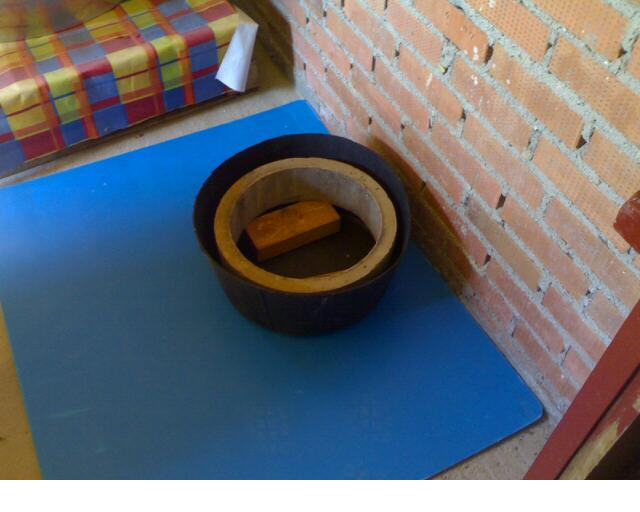
The base consists of a concrete ring, which is what the amphora actually rests on. This is inside a plastic ‘capazo’ with the top few inches, including the handles, sawn off. There are two bricks in there too (only one visible) just in case.

Moving into position

More positioning

In position, at last

Still in position

Note the corks (above): there are actually three openings: one at the top (what for?), one at the bottom and another one (not visible) even lower. It was quite a task to find corks for those openings and Juan had to spend all Saturday morning traipsing round Madrid looking for some. He had thought to go to Castellana de Corchos, a traditional old cork product shop in the centre of the old part of town, but it seems that it’s gone out of business.

Filling up

We taped a piece of plastic around the edge (above) to protect the amphora from spills of juice, but to no avail, as it was too short; we should have covered it all. But no matter, we washed it down when we finished filling it.

We intend to leave this lot of wine in contact with the skins for a lot longer than 2 weeks – maybe even over the whole winter! This is an experiment. I can’t let a year go by without doing at least one experiment! So we’ll just keep checking on it and see how it goes. Any suggestions most welcome!

Nice, but is it art?

In the photo above are the grapes and the must at the bottom of the tank, tipped over at an angle – so we could reach in to scoop them out. I thought it was a nice combination/contrast between the natural organic world (grapes and must) and the geometrical, mathematical, technological, manmade world (stainless steel, perfect circles, straight lines).

And lastly, this is what was left over after the pressing:

Skins and pips

Moonshine

We usually throw all these skins and pips (and stems) back into the vineyard. There, they decompose and break down into little pieces over time, and improve the structure of the soil.

But this year we’ve kept some back, because we’re going to make some ‘orujo’ (grappa or marc, or 'pomace brandy' even). A neighbor has a still (alambique, alambicco, alambic), and we have the raw materials, so one day in the not too distant future we’re going to join forces and distill some liquor. I don’t know how to do this (but the neighbor does!) so I intend to just sit around, watch the still, and do some quality control work!

And even more lastly, thanks to Cristina (@GazpachoGirl) and friends Adriana and Jenny, and to Richard (@voorschot) and family for coming out to visit and help.
 
Creative Commons License
This work is licensed under a Creative Commons Attribution-Share Alike 3.0 Unported License.