name="description" content="Terroir-expressing natural wine minimum intervention">
Showing posts with label Tempranillo. Show all posts

Tuesday, 5 May 2015

Natural Wine fair in Madrid (and other ramblings)

Yes, incredible but true!  There's going to be a mini-natural wine fair held in Madrid this coming Sunday 10th May 2015. I say 'incredible' because it's been many years, if not decades, that natural wines have been produced, sold and drunk around the world, but the phenomenon seems to have passed Spain by. But mustn't complain! It's going to be a great event, and great fun shall be had by all :)

Save the date and the place, which is very conveniently very central and right next to Atocha train station:


Here's the list of the producers:
– Alexandre Coulange – Domaine Thuronis – Languedoc
– Jacques Broustet – Chateau Lamery – Burdeos
– Nacho González – La Perdida – Valdeorras
– Bárbara Magugliani y Joan Carles Torres – Can Torres – Ampurdán
– Manel Rodríguez – Wiss – Montsant
– Marcel Carrera y Ramón Viña – Vinya Ferrer – Terra Alta
– Miguel J. Márquez – Dagón – Valencia
– Rafa López – Sexto Elemento – Valencia
– Fabio Bartolomei – Ambiz – Madrid
– Julián Ruiz – Esencia Rural – Toledo
– Samuel Cano – Patio – Cuenca
– Juan Pascual López – Viña Enebro – Murcia
– Jose Miguel Márquez – Marenas – Montilla
– Ramón Saavedra – Cauzón – Granada
– Torcuato Huertas – Purulio – Granada
– Manuel y Lorenzo Valenzuela – Barranco Oscuro – Granada
And you'll be able to taste the wines of:
– Domaine Meyer – Alsacia
– Patrick Bouju – Auvernia
– Costadilá – Veneto
– Frank Cornelissen – Sicilia
Only €5 to get in, and you get to keep the glass! A bargain at twice the price :)

Other Ramblings

Well, I've been incredibly busy lately and amongst other things I managed to plant about 200 new Tempranillo vines in the Carabaña vineyard in the empty spaces where the vines were missing for some reason or other.

Here's a panoramic view of the vineyard from a few days ago. Note the grass just starting to grow, and the tubes protecting the newly planted vines:
Panoramic view of Carabaña vineyard
 And here's a view from the top! See the cane for the young vine to grasp onto, and you can just see the tiny vine at the bottom:
Bird's eye view!
I also managed to hoe up around about 30 vines or so, before my back said 'enough'!

Hi hoe, hi hoe, it's off to work I go!
Meanwhile, back at the bodega, I finally got round to bringing a barrica of Tempranillo 2010 from the previous bodega I was working out of, in Morata de Tajuña, two years ago(!) to my current bodega in El Tiemblo.

Due to the fact that a full barrica weighs about 275 kg, and in a not very accessible position, what I had to do was: pump the wine out of the barrica into a steel tank in the back of a van, load the empty barrica, drive to El Tiemblo, and then pump the wine back into the unloaded and palletized barrica:

Pumping Tempranillo back into its barrica

I also finally got round to tidying up the patio of the bodega a little bit. Here you can see the space next to the wall that used to be covered with brambles, which I had left alone on purpose last year, in the hope of harvesting some brambles! But there were hardly any to be had, so I uprooted the lot. Pending for May is the planting of some roses or other climbing plants that will help prettify that enormous blank wall!


Here below you can just make out the tiny plants of lettuce, tomato, onions, etc:


 And the latest addition to the garden is some basil. The large-leaved Italian variety. I actually have lots more plants to plant, in fact I intend to cover that whole row, in order to make jars and jars of pesto :)


The main thing that I managed to do though was to bottle up all my 2014 vintage wines (Airén, Doré, Albillo, Sauvignon Blanc, Garnacha, Tempranillo), and free up all my fermentation vessels, and so I can relax over the summer knowing that all I need to do is wash them before use!

Here's where I store all my wines these days - in niches under the concrete fermentation tanks:

The Albillo niche
And lastly, yet another pending item on my "to do" list - this is the future lovely pergola, that will be covered in vines and hanging fruit, providing a shady decadent luxurious space for slothing around in easy-chairs and/or hammocks while sipping wine and nibbling on aperitivos! Alas, it won't be ready for at least another year:

The future decadent wine-tasting area
And really lastly, I was in a place in Madrid the other day where they had an interesting selection of extraterrestrial wines:

"Importados de otros mundos" = "Imported from other worlds"


Thursday, 29 January 2015

Some Thoughts and Comments and Feedback on my Recent Natural Wine Tasting


I got a lot of good feedback from the people who came to the tasting of my new wines the other night at the Petit Bistrot. There were not many of us there which was a good thing as I could circulate and chat to the different groups, who didn't really know each other.

It was quite an informal affair as far as tastings go. The normal procedure seems to be to set up a sort of 'high table' or stage with the speaker speaking at an audience who are all sitting facing him or her. But in this case we were all just standing around in groups in a restaurant which, being a weekday, was empty apart from ourselves.

I came away with a very positive feeling of satisfaction and of the certainty that I must be doing something right! A feeling that I really needed, given my recent string of acetic disasters (see my previous post).

Here are the wines I presented:

Airén 2014
Doré 2014
Albillo 2014
Sauvignon Blanc 2013
Tempranillo 2013
Garnacha 2013

The first three were very young whites, which are not even bottled up yet. I bottled six bottles of each specially for this tasting straight from the stainless steel fermentation tanks (Airén and Doré) and from the amphora (Albillo). I am very happy with all three, and I think they should be drunk between now and this summer, ie young, while they are nice and fresh, especially the Airén. I know my Airens can last for years and still be drinkable, but they evolve into a different wine, which becomes less and less fruity and more and more Sherry-like as time goes by. Again, there's no accounting for taste, and many people like them that way. It's just that I personally like the Airén while it's young and fruity and full of complexities.

Regarding the Doré, there's not much I can say as it's the first time I've used that variety. So, I will keep back several cases and taste them over the years. At the moment, it's interesting to drink.

The Albillo 2014 is enormous! It's super complex and interesting and intense. It has the body of a big red wine but the aromas of a white! I'm pretty sure it will evolve well over time too, but it's perfectly fine right now too.

The Sauvignon blanc 2013 is an orange wine, ie made with white grapes but macerated on the skins like a red wine - and then racked into an old clay amphora, then bottled and aged.

I have to say that I myself was really surprised and impressed by the reception the wines got; which sounds like a silly thing to say, as I'd obviously tasted them all before. But I'd always tasted them on my own, straight from the tanks, in a silent and empty winery. Whereas at the tasting, it was like being an actor on stage, with all the related nerves and stage-fright!  Especially during the first wine, when everyone is paying close attention to what I'm saying (as opposed to chatting with their mates like they were doing by the sixth wine!)

So, I think I've managed to tick all those natural wine boxes that I'm interested in ticking:

- Express the terroir
- Express the grape variety
- Pleasant and enjoyable to drink
- Comment-worthy
- Complex and interesting aromas and tastes

I won't go into details about the actual aromas and tastes perceived or comments made by all the different people who kindly shared their opinions with me, as they were all different and even conflicting! Never would it be more appropriate to say "There's no accounting for taste"!

In any case, I'd rather let the wines speak for themselves, and I'd also rather let tasters and critics and winelovers in general speak their opinions, instead of me. Just because I can grow grapes and make wine, doesn't mean that I can write critically and usefully about my own wines! Strange as it may seem!

During the course of the evening I had an interesting discussion with a group of people about the visual aspects of my wines, which were all rather cloudy, all had sediments, and one even had some precipitated tartrates. In a nutshell, my opinion about the visual aspect is, as Clark Gable said to Vivien Leigh: "Frankly, my dear, I don’t give a damn!".  Now that's not meant to be rude or disparaging or anything like that, it's simply the reduction or summary of a topic that I've though about for a long time. A more detailed explanation for this attitude is as follows:

1. I believe that the current modern standard of beauty in wine is just a mere casual collateral consequence of industrial large-volume producing wineries' need to stabilize their wines for transport and storage purposes. I don't think that all these wineries independently and simultaneously started thinking about how to make their wines look better; no, they looked for a way to be able to transport and store their wines cheaply and over long distances and for a long time.

2. I don't believe that transparent, shiny, liquids are for some reason intrinsically more pleasing to look at than cloudy, semi-opaque liquids. This is just the prevailing opinion in the spirit of the times in which we happen to be living. The analogy that sprang to mind in the heat of the moment was of nude paintings of the past, where the subjects were fat! The opposite, in fact, of what is held to be beautiful today, ie not an intrinsic, universal quality, but based on other criteria that are held to be valid at the time in question

3. I also believe that wines are primarily best enjoyed for their taste, and secondarily for their aromas (which are of course closely related), while the visual part is in a different league altogether. I mean how much enjoyment can you get from just looking at your glass of wine?  Most winedrinkers don't pay that much attention to it anyway - just a cursory glance I would say. Most winedrinkers don't even smell their wine before drinking it - I'd say that smelling your wine is a rather geeky thing to do.  So actually looking at your wine and analyzing all those points that you read about in "How to drink wine" manuals seems to me to be only for people studying to become professionals, and a completely useless (and maybe even pretentious) exercise for 'normal' winelovers.

I have an info sheet for each one of the wines we tasted, so if anyone is interested, just write me an email or whatever and I'll send it along.  Ideally I should just put them online somewhere and make a link, but I don't know where to upload them to!

For a post in Spanish, written by Vicente Vida, a Spanish wine blogger, who came to the tasting, click here.

Tuesday, 20 January 2015

Tasting Presentation of Six (6) Natural Wines


PROXIMAMENTE - Cata de Nuevos Vinos de Vinos Ambiz:

COMING SOON - A Tasting of New Wines by Vinos Ambiz

Cuando - El jueves 22 de enero
When - this Thursday 22 of January

A qué hora - a partir de las 20:30
At what time - starting at 20:30

Donde - en el Petit Bistrot, c/Principe de Vergara, 210
Where - at the Petit Bistrot, c/Principe de Vergara, 210, Madrid

Qué vinos:
What wines:

3 blancos/whites 2014 (Airén, Albillo, Doré)
1 naranja/orange 2104 (Sauvignon blanc)
2 tintos/reds 2013 (Garnacha, Tempranillo)

Hay que reservar: 91-426-7405
Booking required: 91-426-7405

Qué más - charla informativa y ronda de preguntas y muchas cosas ricas para cenar
What else - a presentation and question answer session, and lovely food for dinner

Cuanto cuesta - €25
How much - €25

Thursday, 24 January 2013

Wines of 2012 – A Tank Tasting (or Progress Report)


This seems a good moment to post a progress report on all my wines and experiments from 2012, because it’s the deepest, darkest coldest point of the year here in central Spain, so the wines have already progressed and developed and evolved a bit, and they’re already showing an indication of how they’re going to proceed.
I’m writing this while touching wood because it would be just typical if I were to say that they’re all coming along fine, and then two days later something awful would happen!
But the fact is, that all the wines are doing just fine (more or less!):
1.Airén. This is a wine I make every year, and can be drunk very young. In fact, I started bottling it in December and have been distributing it locally here in Madrid already. At this stage in its life cycle it’s very fruity both in the nose and in the mouth. It’s nothing like any other 100% Airén you may find on sale (generally wishy-washy, insipid, and inoffensive), as this wine actually has a good body, and intense aromas and tastes. As time goes by, it loses it fruity, flowery characteristics, and becomes quite dry and sherry-like. By June/July it is in fact totally sherry-like. Some years, it’s sparkling for the first few months, but this year it’s not.
2.Tempranillo. This is another wine that I make every year. This year, due to the drought and to the rabbits, I only harvested enough grapes to make one (1) barrel of Crianza! At the time of writing (Jan 13) it’s still in the stainless steel fermentation tank, and I racked it once, a few days after pressing, back in October. I’ll move it into an old barrel as soon as I have time, maybe in February, where it will sit for about a year or so, depending on how old the barrel was, and on tastings,
3.Malvar No.1. I made one lot of Malvar (from 100-yr old vines from Villarejo) by straight carbonic maceration. Clusters destemmed and sealed in a stainless steel tank for 15 days. Then crushed and pressed, and left alone to finish fermentation. Tasting good, maybe to be released in March.
4.Malvar No.2. The second lot of Malvar (from the same vineyard) I made with about 30 days skin contact. This is the so-called “orange” wine. Tasting good. I don’t know whether to release or not, because I think it might even get better over time. Have to think. And taste.
5.Malvar. No.3. The third lot of Malvar (still from the same vineyard) I made in old clay amphoras (or ‘tinajas’ as they’re called in Spain) (or ‘qvevri’ as they’re called in Georgia). Back in September, I crushed the grapes and poured everything into the amphorae. I punched down the cap for a week or two, until it stopped rising, and haven’t touched them since then! I scoop out a sample every now and then from the top of the amphora, to check it. Beautiful! (touch wood). Tasting good. This lot I’m definitely going to let sit there for at least six months, maybe even longer, on all the skins and pips, which have already sunk to the bottom.
6.Malvar No.4. The same as the amphora above, but in an old open top oak barrel. I have no idea what to do with this lot! So I guess I’ll just leave it alone, keep tasting it, have tasters taste it, and decide some other time!
7.Garnacha No.1. This is a lot of Garnacha from the Sierra de Gredos (specifically from the village of Sotillo de la Adrada). I’m totally amazed by this wine, and I’m kicking myself for not taking proper notes, because I’d like to make more of it next year, but I fear I can’t remember exactly what/how/when I did what I did! This Garnacha is total drinkable now! I think it would be a loss if I were to try and age it or blend it or whatever. I need to have some more tasters taste it and get feedback from them, but my heart/intuition (and feedback received to date) tells me that this has to be a young wine and it has to be drunk now.
8.Garnachas Nos.2 and 3. These are other lots of Garnachas from Gredos, one from Sotillo de la Adrada, and one from Méntrida. These are all still evolving, and are not very nice to drink young at the moment, unlike Lot No.1. Again I need to have some tasters taste them, but I think these will be good for blending and/or aging. It’s early days though, and they’ll continue to evolve over spring.
9.Garnachas Nos.4 and 5. Same as above (Nos.2 & 3), but with a spontaneous ‘velo de flor’!
10.Rojilla experiment. I’ve only got 1 ‘arroba’ of this strange, uncommon, unknown grape variety. It’s in a glass demijohn and I haven’t tasted it since last October, so I’ve no idea how it’s turned out.
And that, I’m afraid to say, is that!
I was expecting to do a lot more in 2012, but the rabbits, the weather, and the Spanish bureaucrats prevented me from achieving my goals. But not to worry. This year I shall try again. Basically, I hope to find a bigger winery/shed/place in which to make more wines. That’s not much to ask for, is it?

Tuesday, 18 September 2012

Red grapes all in, White not ready yet

Here’s another harvest post or update of the state of my harvesting this year. This is a good time for me to write this because I’m between harvests, as it were :)

I’ve brought in all the red grapes that I’ll be bringing in this year, and the white grapes are not ready to be picked yet.

So, what have I got this year?

1. The usual Tempranillo from Carabaña that I’ve been harvesting for the last 9 years! The quantity this year was ridiculously tiny – even more ridiculously tiny than usual! On the one hand, because of the drought (it hasn’t rained properly for about a year) and on the other hand because of the rabbits, who have again eaten more than their fair share of grapes this year, just like they did last year.

So, basically there’s less than 300 litres of juice + skins fermenting at this very moment as I write, which means that there will hopefully just be enough to make 1 barrel (225 l) of Tempranillo Crianza including a few litres for top-ups during the year. I harvested early this year, because I was fed up with making the usual +14% alcohol tinto Crianza! Although there’s never been anything actually wrong with my previous Crianzas, they’ve never been anything exceptional either, imho, and in that of others! Hence the risk of experimenting this year. Maybe it’ll turn out better at 13% or 13.5%. Who knows? But I’ll never know if I don’t try it at least once!

2. Some Garnacha from Gredos. I’m going to be a bit secretive here and save the details for later :) Ha ha! I’ll just say that I’ve got four (4) separate lots of old vine Garnacha that is already fermenting separately. Some in open top old wooden barrels, and some in stainless steel. Two lots are from separate plots in Sotillo de la Adrada (see this previous post) and two lots are from ... somewhere else in the Gredos region! Ha ha!

That’s all there is tinto-wise. This is what there will be, blanco-wise:

1- The usual Airén from Carabaña that I’ve been harvesting for the last 10 years. The grapes are not ripe yet – they were at 11% a few days ago, and there are still quite a lot of green bunches visible. I’d like to harvest this at between 12% and 13%, and make the usual young white that I usually make every year. I’m really happy with the way it’s been turning out, and I think my clients are too. I’m on a little, personal Airén crusade here, I think, because I believe that really good wines can be made with Airén, especially if a better winemaker than me were to put his/her mind and hand to it!

Airén has such a negative cultural and vinous baggage to carry! Sigh! Oh woe, is life not hard enough already without having to shoulder all this negative baggage? :) Ha ha, only jesting! Deep down, I’m really a masochistic cynical bastard who thrives on hardship and albatrosses! Ha ha, jesting again! But seriously, I really do like Airén and really do believe that great wines can be made from it. So I shall make more of the same this year, plus of course I shall do a few experiments. Firstly, as I have all these old barrels available, I’ll do a bit of fermenting in them, in addition to the usual stainless steel. Secondly, I hope to come up with some other experiment to do when the time comes! Suggestions welcome! Here’s an interesting article about Airén by FringeWines

2. Malvar from Villarejo. Again I’m going to do the same as last year with these grapes. “If it ain’t broke, don’t fix it.” I was really pleased with last years’ wines and experiments. There were three lots of wines last year: Carbonic Maceration, Skin Contact (15 days) (‘orange’), and a straight 5-month skin contact ‘orange’ from an old amphora (tinaja in Spanish), all from the same Malvar from Villarejo. And I think my clients were happy with them too. So this year, I bought another amphora (see photo) so as to make another 300 bottles, in addition to the original 300!

And that’s it, I’m afraid (apart from the older wines from previous years that are still aging). Only about 4,000 bottles in total, I think. I had originally intended to make quite a lot more wine this year, but my best laid plans were rudely scattered to the winds by the great plough of life and circumstances, and will have to be rebuilt next year. C’est la vie!

So now, it’s the calm before the storm, ie just checking the white grapes in the vineyards, and checking on the red fermentations in the bodega.

Lastly, quite a few people have contacted me over the last few months with a view to visiting the vineyards and winery, but I haven’t been able to arrange these visits properly – due to my own inability to deal with emails and to arranging visits, etc. But I really do like receiving visits, so if you’re reading this, please just contact me again and insist harder! I’m not being exclusive or playing hard to get here, it’s just that I can’t cope with everything that I have to do all at once! So the ‘de facto’ or ‘fait accompli’ solution or whatever it’s called, is to tell me that you ‘have to’ visit on such-and-such a day, and then I’ll work all my other tasks and activities and urgent urgencies around the visit! Et violà! Problem solved!

And really lastly, I read somewhere that all posts should have at least one photo, so here it is:
 
Ambite vineyard under snow in January 2009!

Thursday, 6 September 2012

First Mini-Harvest Report from Spain

Well, I’ve actually done two harvests already and now I’ll all stressed out because I’ve got nothing to worry about until the white Airén and Malvar are ready in about 1 week or 10 days!

The first harvest was a small lot of old vine Garnacha from Méntrida, and it was really easy because I didn’t actually have to go and harvest it myself!

Garnacha Grapes
I reached an agreement with the grape-grower that he would harvest it (on the date I specified) and he would bring it to the bodega in small boxes. No payment! ie, €0/kg! I will make the wine and give him half of it when it’s ready! Win-win, everybody happy!

So here it is, in two old oak barrels:

Crushed Garnacha in opened barred

It hasn’t started fermenting yet, but it should kick off any day now.

The second harvest was also quite easy going. This was our usual Tempranillo from the Carabaña vineyard. This year has been really really dry and it has hardly rained at all (insert some meteo data) so the quantity was about 25% less tan usual. This year I only just got barely enough to make one barrel of Crianza, about 250 kg.

So, last Sunday, three adults and three children (3½, 7 and 9) managed to harvest the lot in the course of the morning between 9:00 and 13:00. We then went back to the bodega and lit a barbeque for lunch.

Even though the quantity was small, the quality was 100%; not a single bunch was affected by any sort of humidity or fungus-related disease, eg mildew or oidium.

This year, in an attempt to improve on the Tempranillo Crianza that we’ve been making for the last 7 years or so, we harvested a little earlier than usual; we should get an alcohol level of 13%, as opposed to the usual +14%. It’s a bit of a risk, because I’ve never done that before, but hey, there’s only one way to find out!! Is there not?

On the following Monday, 2 adults and 2 children (6 and 7½) crushed and stomped the grapes underfoot. The Tempranillo is in stainless steel, and it hasn’t started fermenting either to date.


Stomping the Tempranillo

So now, I’m just hanging around, getting nervous, waiting for the Airén and Malvar to ripen in Carabaña and in Villarejo, waiting for some more lots of Garnacha from Gredos to come in. What’s that expression again? “Idle hands make light work” or something like that!!!

Monday, 26 March 2012

Almost Finished Pruning


I finished pruning the vineyard in Carabaña over the weekend. This vineyard is planted to Airén and Tempranillo, all mixed up at random!

Vineyard in Carabaña all pruned

It's rather strange that the vines haven't started 'crying' yet. Usually around this time, the vines come out of their winter dormancy and the sap, stored in the roots and trunk, starts flowing. You can tell because it drips out of the cuts left by the pruning for a few days until the vines heals itself.

pending: photo vine crying from last year

I have a few theories:

1.As we're in the middle of a drought here in central Spain, maybe some self-defence / survival mechanism has kicked in and the vines are holding back the sap, or not sending it to the extremities?

2.Maybe they're just late this year. The buds haven't even started to swell yet

3.It's happened already, but I haven't noticed? Unlikely! surely I would have noticed!


Semi-wild roadside vines on the embankment

Another semi-wild vine
These vines are semi-wild! They're growing on the embankment beside the local road from Carabaña to Villarejo, which runs right next to the vineyard. Usually we pick these grapes only if we have time, and have the energy to scramble up the embankment through the undergrowth. So I thought this year I'd clear away the grass, etc, to make access easier. I also pruned the ones down low, but I just left the top ones to run wild(er) and see what happens.


Vineyard in Villarejo, last year

Anyways, now onto our other vineyard in Villarejo. We actually started, last week, but we only did about 100 vines. Another 400 or 500 to go. This vineyard is planted to Malvar.

We have an added complication in this vineyard. For some reason, almost all the vines have shoots coming out of the trunk from below ground level. (Sorry, I have no photos - will remember next time). So the quick-n-dirty solution would be just to quickly snip them off at ground level. But they would probably sprout again over the spring/summer, taming energy and nutrients away from the productive shoots up top, and making access difficult, and creating humidity by blocking the wind and sun! What we really should do (and what we've in fact done so far for the first 100 vines) is to dig down, expose the roots, and snip them right at the base where they grow from. That way they shouldn't grow back.

This takes about 10 minutes per vine, more or less, two people (one digging, one snipping). Which means 6 vines/hour, which means 50-60 vines/day, which means 8/10 days. Hmmm, maybe doable, maybe not. We'll just have to wait and see how it goes.

Friday, 16 September 2011

Pressing Tempranillo, and Crushing Graciano

  
Last Wednesday evening/night (14th September) we:

1) pressed the Tempranillo that we harvested two weeks ago (see this post), and

2) crushed about 500 kg of Graciano that we bought in from our friend and fellow natural winemaker, Samuel Cano, from la Mota del Cuervo, a small town right in the middle of La Mancha.

Lovely Cases of Graciano Grapes

We did both tasks a bit in parallel and a bit in series! First we set up the 'assembly lines', inside the bodega for the crushing and ouside in the patio for the pressing. For the crushing we had to position: the pallet with about 30 cases og Graciano grapes, the manual crusher-destemmer, a bucket to catch the stems, two buckets to catch the must/skins/pips, a clean stainless fermentation steel tank for the must.

Tipping Cases of Graciano into the Crusher

Meanwhile in the patio we had: the steel tank containing the Tempranillo wine, skins and pips (In 17 days, the fermentation was complete), one manual cage press, two buckets, another clean stainless steel tank. It took about an hour to set everything up, about an hour to crush the Graciano, and about 2-3 hours to clean everthing up. We did the pressing at the same time.

Manual Cage Press, Bucket, Full Tank, Bucket, Empty Tank


Top-down View of Fermented Tempranillo Skins in the Press


Tempranillo Wine Pouring out of the Press

Crushing really requires two people to do properly: one to tip the case slowly into the crusher while the other picks out leaves, damaged grapes, etc. In this case we owe Samuel Cano a favour, as the quality of the grapes was excellent (none rotten, none damaged, none over- or under-ripe) nor were there any leaves, twigs, earth or any other foreign matter. One of us turned the flywheel while the other held the machine steady, helped the stems and grapes come out, etc. In between cases, one of us would nip out into the patio and press the Tempranillo down another centimeter or two.

Scooping out Tempranillo Wine and Grapes
from the Tank into the Press

We've found that this is actually the best way to press manually, ie very slowly and over a long period of time. The slower the better. In fact, when we opened up the cage to do a second pressing, we found that the cake was already so dry that we didn't have to do it.

It's very difficult to press slowly! For two reasons: 1) because when people are helping us press, they're happy and exited and emotional and so they instinctively want press fast, as if they were pumping water out of a boat! And when we (Jaun and myself) do it ourselves, we want to do it fast so we can finish as soon as poss so we can go home to sleep at a not too unreasonable time! 2) beacause the press is usually quite close to the crusher, and crushing really is a fast and energetic task, and so that feeling infects the people working the press!

Some technical winemaking details:

There were 30 cases of Graciano, but we didn't crush all of them. We decided to pour 5 cases in as whole clusters, uncrushed, stems and all. Hopefully, these grapes will undergo carbonic maceration and fermentation will start inside each individual grape. The stems will also provide a bit of acidity - but no 'green' or 'veggie' notes as we made sure that they were well lignified and not green or unripe.

Posing with a Bottle of Airén 2010 Maceración Carbonica
(which apparantly went down very well at the Chambers St Wine and José Pastor Selections presentation/signing of Alice Feiring's "Naked Wine" that very evening

Monday, 29 August 2011

Tempranillo Harvest and Crushing 2011

All done! Grapes picked and crushed already! I have to check my notes from past years to be sure, but I get the impression that the harvest is earlier and earlier every year!

Picking

We picked the Tempranillo grapes on Saturday 27th August, and, unusually, it was a very relaxed, no-stress, no-rush, family and children oriented day. Altogether there were 7 parents, 7 young children and only 2 singles!!!

The grape-pickers

We started rather late, at about 10 o'clock. Which is not bad actually, considering that we had to wake the kids up early while they're on holiday with no school, get them dressed, give them breakfast, and get all their stuff together, etc, etc!!! One mother and children hadn't even arrived at 14:00 (when the above photo was taken) and when we were finishing off and getting ready to go to lunch!!!

We picked about 400 kg max, which is the lowest quantity we've ever picked from that vineyard over the last 8 years. I don't know why so little this year. Maybe the climate? It was a rather cool summer this year. I shall have to ask around. Maybe also we need to bring in some fertilizer? In the past we've always brought in a truck-load of organic manure every 2 years, and we should have done it this year, but we didn't (due to circumstances!).

The quality on the other hand, was excellent. Not a single sign of mildew or oidium or anything else.

Nice healthy bunch of Tempranillo

More nice health bunches of Tempranillo

In fact, this year we didn't even apply sulphur to the vines at any time. Some years we spray sulphur powder on the vines if there's a risk of an outbreak of oidium/mildew/etc, but this year it wasn't necessary.

Grape-pickers in action

A corner of the vineyard

Yet another healthy bunch of Tempranillo

It was all over by 15:00, and after taking the grapes to the bodega (in Morata de Tajuña) we all went to a bar with a 'terraza' for coffee, beer, ice-cream, etc, and stayed there till the evening. It was the quickest, easiest harvest I've ever done, in fact it didn't seem like work at all!!!

The last thing I did before heading back to Madrid, was to take the grapes outside, so they could cool down during the night.

Crushing

We crushed the grapes today Sunday 28th August. Again, it didn't seem like work at all as there was such a small quantity. We were done in a few hours.

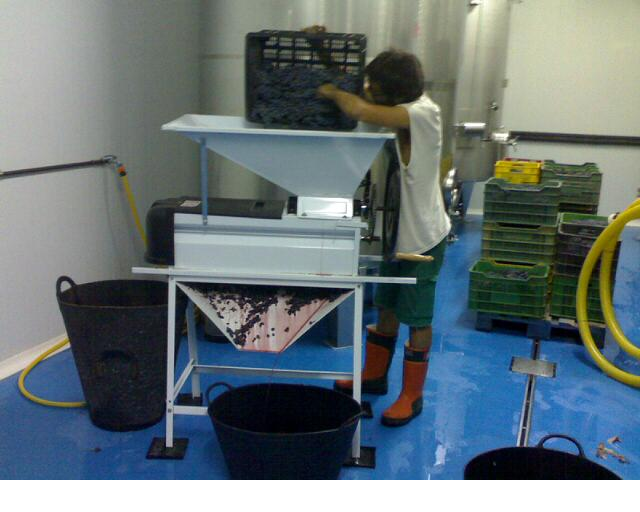
We crushed most of the grapes using this machine (below): a manual crusher-destemmer. You tip a box of grapes into the open top and turn the wheel (left). The grapes fall between 2 rollers that are spaced at less the width of a grape (eg, about 0.5 cm), are crushed and fall down into the waiting 'capazo'. The stems are ejected at the end opposite the wheel.

Crusher-Destemmer

Crusher-destemmer in action. Empty boxes on the left

But we also crushed some underfoot (see pic below). I've heard that people pay good money to go and stomp on grapes! Hmmmm!

Crushing and stomping

Lastly, as they say in Spain (well, at least in Morata de Tajuña) "You can't make wine without beer!"

Cheers! or "Salud y buen vino"

And really lastly, in the end there was about 400 l of must (including skins and pips) which should be more than enough for a 225 l barrel of crianza, including some liters for top-ups. The density of the must was 1097 which should give 13.5% alcohol, more or less.

Friday, 26 August 2011

Pre-Harvest Sampling (Tempranillo)

This morning I was in the vineyard in Carabaña (Madrid, Spain) taking samples of the Tempranillo; and as we suspected we're going to harvest tomorrow, as the probable level of alcohol will be about 13,5º.

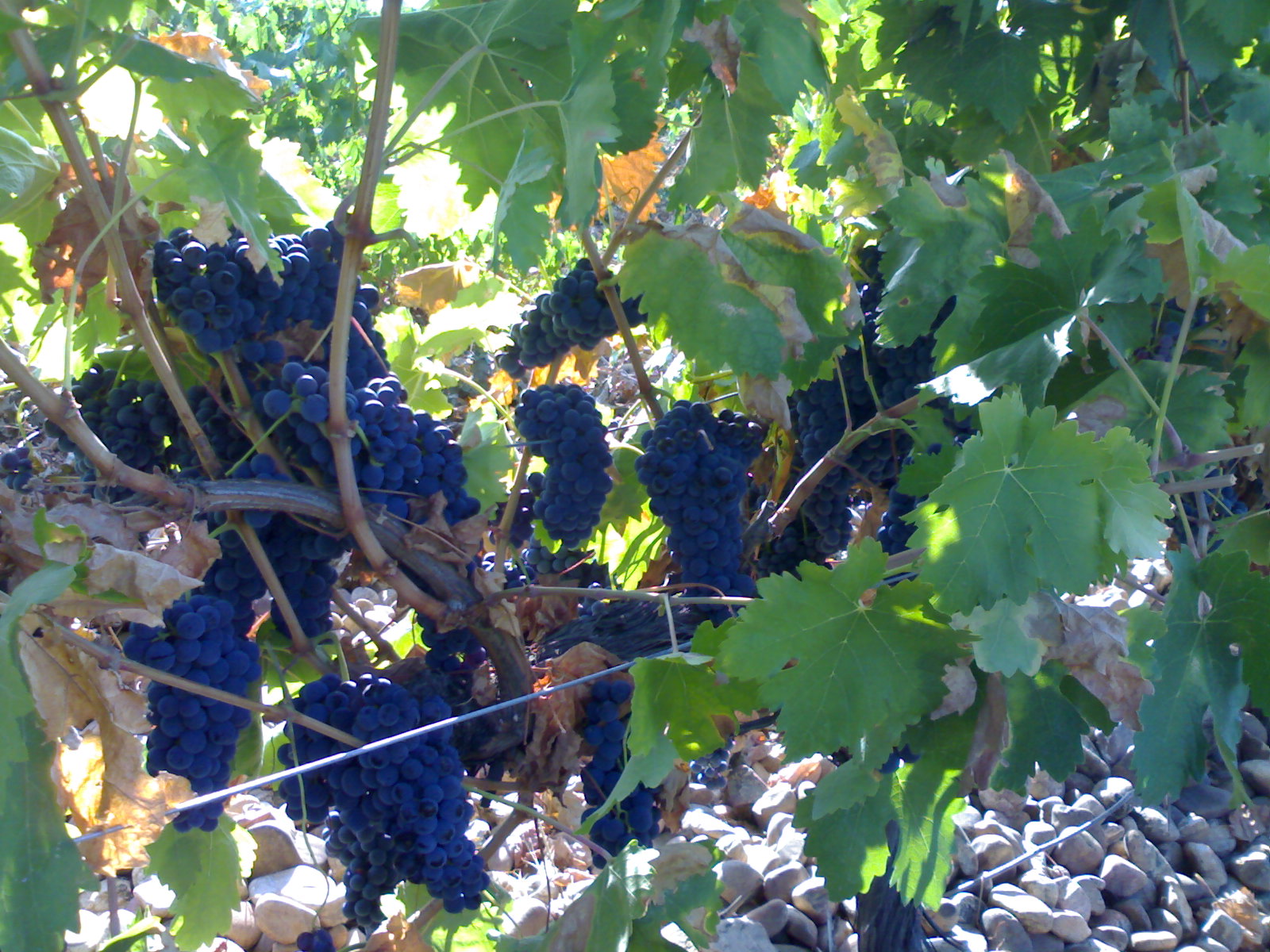
Tempranillo Cluster

I did a systematic sampling as opposed to a quick n dirty one! ie, I walked up and down every row and picked eithe 1, 2, 3 or 4 berries from each vine, (from different sides of the vine, from different parts of the cluster, etc) so as to get an accurate and representative sample. Quick n dirty smaples are OK during the summer to give you a rough idea, but as harvest time approaches, the more accurate, the better.

More Tempranillo Clusters

Ideally, it's best to go early in the morning to take the samples, because that way it's nice n cool and it's a pleasant task to stroll through the vineyard, listening to the birdies and picking berries! Also the temperature of the juice will be lower and so will give an accurate reading, without having to do any calculations to compensate for temperature differences (most instruments are calibrated to 20ºC). Unfortunately, I couldn't get out till about 12 noon, and it was a bit too hot for confort!

It's also a good idea to wear socks and shoes, as opposed to sandals! I usually keep socks and shoes (and other clothes and tools) in the back of the car, but this was my first trip out to the vineyard after my holidays, and so I'd completely forgotten to load up all the usual stuff.

So all in all I didn't enjoy the (90-minute) experience a lot!

Where's the grapes?

This vine (above) is near the edge of the vineyard, and all the clusters have been eaten by some animal - I suspect rabbits! Note the bottom branch - even the leaves have been eaten off it!!!

Berries eaten

Some of the grapes on this vine have been eaten also, but by a different animal. See how the individual berries have been eaten but the stem is still there.

At this point, my mobile reached its limit and wouldn't let me take any more photos :(

I really must get myself a more modern internet-friendly device, so that I can post stuff straight to the internet from the vineyard or bodega, instead of having to come home and downloading into my PC!

More news and photos tomorrow on the Tempranillo harvest.

Wednesday, 13 October 2010

Status of On-going Experiments (Report Nº 1)

Experiment 1. Sparkling wine (Champagne, Cava, Spumante, ... need a name!)

We've made a lot of Airén in the 'normal' way, ie crushed, pressed and left to ferment. It's coming along nicely and there's nothing left to do here, except for one decanting to remove the dead yeast and other larger particles that will have sunk to the bottom of the tank.

We've left some grapes on the vine, to be picked in Nov/Dec, fermented separately and then added at some point in the 'champagne' making process, in collaboration with Alfredo Maestro.

Experiment 2. Airén, (Carbonic Maceration)

We have another lot of Airén that are fermenting. We put the whole clusters, uncrushed into a tank and sealed it about 15 days ago. By now each grape should have started to ferment internally, and should be at 1% or 2% alcohol. Tomorrow or next day we'll open the tank, crush and press the clusters and let it finish fermenting.

Experiment 3. Airén (on skins)

Yet another lot of Airén, we left macerating in their own skins for about 12 days. We pressed them a few days ago, and this lot is also coming along nicely. It has a sort of browny-orange-amber colour and smells more intense than the 'normal' Airén, we also have.

Experiment 4. Barrel fermentation (Graciano)

Last week we rocovered three old oak barrels that we found in the attic of the winery! Actually we tried to salvage 6 but three were so leaky, even after extensive soaking, that we couldn't use them. So we destemmed and crushed a lot of Graciano, and put it into the 3 barrels to begin fermenting. 
Old oak barrel, before being soaked

Non-Experiment 5. Petit Verdot.

This lot was going to go into the other three recovered barrels, but as we couldn't use them, we're using a stainless steel deposit. Not much of an experiment rally, except in the sence that it's the first time we've made Petit Verdot.

Our other wines this year are also in stainless steel, made in the same way we usually do, ie no unnecessary manipulations, or adding of 'substances'. This year we have:
  • Tempranillo (2 lots)
  • Airén (4 lots)
  • Garnacha
  • Shiraz
  • Graciano
  • Petit Verdot

Tuesday, 28 September 2010

Final Harvest and Post-Harvest Report 2010

Well, basically our harvesting is over, though there's still a lot of work to do in the bodega, and some loose ends to tie up (of which more below). It's been an exhausting 3 weeks (and maybe we bit off more than we could chew) but it's also been very productive, creative and great fun, even if a bit stressful at times. But I'm not complaining! This is what I love to do; and it does keep me off the streets, and prevents me from watching TV, getting bored, etc :)

The reason we harvested so many grapes this year is that it's part of our yearly expansion plan. We want to move up from the level we've been at the last few years (ie, glorified home-winemakers running an expensive, time-consuming, family-destroying hobby!) to at least maybe 'garagiste' level this year; and after that to 'small, viable wine business' level ('world domination' can wait a bit longer!).

This year we're in a 'real' bodega; it's a proper building with a roof that doesn't leak and walls that insulate from the heat and cold, a barrel room with AC and humidity control, and equipment that can handle larger quantities of wine. Now, it's not a chateau, so don't get any ideas, and the views are not spectacular either; it is in fact located in the industrial zone of Morata de Tajuña; it's, shall we say, 'functional' :) I'll post photos in another post, though some have appeared already in previous posts.

Apart from our own grapes which we grow ourselves in our vineyard in Carabaña, this year we also bought in and harvested more grapes from some neighbouring grapegrowers who farm organically. This is what we have fermenting in the bodega at the moment: Tempranillo 1, Tempranillo 2, Garnacha, Shiraz and Airén for a total of about 6000 l. One of the loose ends to be tied up is another possible 1000 kg of Shiraz, which should be confirmed or not this week sometime.

With these 5 (or 6) lots of wine, we have to decide what types of wine to make. One day Juan and I will sit down and work it out; the result could be an interesting and complex flow-diagram! We already know that some will be for young wine, best drunk within a year, and some will be barrel aged, assuming our barrel-sponsoring scheme works out).

We already have a few experiments in the pipeline:

EXPERIMENT 1: Sparkling wine, in collaboration with fellow natural winemaker Alfredo Maestro. Some of the Airén will be set aside for this, and in Nov/Dec we'll take it to his bodega, where he has the space, equipment (and knowledge) required. We've left some Airén grapes in the vineyard to be picked in Oct/Nov when they're super-ripe and have a high sugar content; these grapes will be fermented separately and then added to the sparkling wine, as 'liquor de expedición' (what's that called in English?)

EXPERIMENT 2: We're going to ferment some of the Airén grapes by 'carbonic maceration' to see how it turns out. This is done by putting whole uncrushed clusters in a fermentation tank and sealing the lid hermetically. See this previous post. We did it this way last year with Garnacha and the year before with Tempranillo.

EXPERIMENT 3:We're also going to let a lot of Airén grapes macerate in their own skins for a day or two, as if they were red grapes, again just to se how it turns out.

That's enough experiments for one year I think! With the red wines, we'll do three 100% varietals (Tempranillo, Garnacha and Shiraz), and also try all the possible coupage combinations, and based on tastings and advice, decide what to actually bottle.

Marketing

Then there's the question of what do with all this wine! Well, obviously we have to sell it so that people far and wide can drink it and enjoy it, and so we can make more and better wines in the years to come! So in a week or so when things have calmed down in the bodega, I'll be putting our Marketing Plan down on paper. I remember reading a funny comment to a post about a year ago, on the definition of Spanish marketing: "Make wine; wait for phone to ring." Well, it's not really funny of course, more like sad, as I image a lot of winemakers really do do that. But we're not going down that route. Probably the ONLY thing that's been clear to me since I started 7 years ago and still is clear, is that there are, and always will be, three equally important, and inter-connected, parts to our Vinos Ambiz project:

1) Grow (or buy in) quality grapes

2) Make quality wine

3) Sell it!

Pretty simple and obvious really. 1) If you don't have quality grapes, you can't make quality wine; 2) To make quality wine you have to be really careful not to do anything wrong/stupid/hasty/etc in the bodega, and if you have quality grapes to work with and you keep your machinery/equipment/everything scrupulously clean and hygienic, over half the battle is won; 3) and the part that many winemakers forget about but which I believe is equally essential, is that you have to sell it, otherwise you can't carry on making wine: I mean, even Juan and I and all our friends put together can't drink that much wine!!!

Other Items of Interest

- New Vineyard. This year we've taken on another vineyard in addition to the one we've tended in Carabaña for the last 7 years. The new one is just up the road in the next village (Villarejo). It's 1 hectare in area (2.4 acres), white Malvar variety, 30-40 year old vines. The first year we'll be working with the man (now retired) who used to tend it, as we convert it to organic. Should be interesting!

- Grafting/Planting. We've been meaning to do this for the last 7 years, but finally this Spring, it looks like we might actually really do it! In our vineyard in Carabaña, there are about 200 empty spaces where a vine used to live (it died, dried up, got knocked over by a tractor over the years) and another 50 or so vines that have gone 'wild' (ie the varietal grafted on top didn't take, or died, and the rootstock is sprouting directly). So in the spaces, we have to dig a hole and plant a rootstock+varietal and on the wild vines we have to graft on a varietal. We've finally met a neighbouring grapegrower who both knows how to do this and is willing to do it for us (we'll provide the unskilled manual labour, and look and learn).

- Webpage. I really need to get a good webpage up and running. Yes, I've been saying that for about 7 years too, but now it's becoming embarrassing! Dare I say that I'll have one up for before Christmas?

- Another thing I'd like to do is follow up on the 65 cases of Vinos Ambiz Airén 2009 that shipped to the USA a few months ago. I haven't been able to do that so far, what with the Summer holidays, harvesting and crushing etc. I've heard through the grapevine and from a few posts/comments/tweets that it's going down well, which is really encouraging. I heard that it was presented during the JPS Wine Tour at events in S.F., L.A. and N.Y.

That's about it. Thanks for reading. Any comments, thoughts, questions most welcome. In fact it would make me really happy!

Thursday, 9 September 2010

Grape Harvest 2010

Preparation for Harvest

Well, today is Thurs 9 Sept and I've just about recovered from the harvesting we did on Fri 3rd, Sat 4th and crushing on Sun 5th, and from the cleaning and preparation the week before, combined with the moving of all our equipment from our old bodega in Ambite to our new one in Morata de Tajuña!

First, we had to move out all our stuff from Ambite, which we did in a van. The heaviest things were the presses and the bulkiest the 700 l stainless steel tanks, and all the rest were bits and pieces. We also took along several hundred empty wine bottles for later use. The most complicated item was 300 l of wine which we hadn't got round to oaking. So what we did was load an empty 300 l tank onto the van and pump the wine into it. Then at the new bodega we pumped it straight into the oak cask.

This took about 2 or 3 trips per day over 3 days, as after each trip we had to thoroughly clean everything. At the same time as this was happening we were also negotiating with several neighbouring (organic) grape-growers with a view to buying around 3000 kg of grapes from them. This was because our own production is way down this year due to an overnight frost back in May, which killed off the tips of the new shoots. So we were visiting vineyards and negotiating all week too.

1st Harvest (Carabaña)

On Fri 3rd we harvested our own Tempranillo in Carabaña. This was pretty straight-forward and quick: we met at the vineyard at 7:30 in the morning (I took the van, which we'd loaded up with clean crates the night before). By about 14:00 we we done, as there was only about 400 kg. Then to the new bodega, where we unloaded, destemmed and crushed the grapes using a new machine (not by hand as usual). Then, cleaning up and loading the van again for the next day.

Harvesters harvesting Tempranillo in Carabaña

Crate of Tempranillo

Lunchtime

2nd Harvest (Titulcia)

Sat 4th. This was the big one. We had finally agreed to buy about 3000 kg of grapes and we had 1 day to pick them. We figured (on the back of an envelope) that 7 people could do it, ie 500 kg/person over 10 hours (with 1 person driving, not picking) which equals 50 kg/person/hour, which is five 10 kg crates person/hour, which is 1 crate in 12 mins. So much for the theory.

Well, in fact, it worked out more or less OK and we ended up taking 3900 kg (3500 kg Tempranillo and 400 kg Shiraz). We worked out exactly how many grapes we took by using the municipal weighing machine in Morata. On the trip out to Titulcia I weighed the van empty and on the trip back to Morata I weighed it full. The difference is the weight in grapes!

Municipal weighing machine panel (with token thingy)

It was hard, hard work, and it was hot, hot, hot that day. Tempers and nerves were on edge! At one point we ran out of water and had to to into the village to buy more (we had calculated 2 liters each and it wasn't enough).

Long rows of Tempranillo (in Titulcia)

Note the stones between the rows - they retain moisture.

Clusters of Tempranillo

Almost all the vines were like this one, ie very abundant and healthy clusters.

Crates of grapes awaiting loading

Loading up

Video clip:
Loading up crates of grapes


Lunchtime under olive tree

While driving to Morata with the 3rd load of grapes, at about 3 or 4 in the afternoon (ie the hottest time of day) I started getting all mystical and philosophical (light-headed? dehydrated?). There was absolutely no-one to be seen, neither on the road nor the villages I drove through; just the landscape and tarmac shimmering in the heat. Everyone was either having lunch or sleeping off lunch. I was thinking "What am I doing in the middle of nowhere in the Castillian Plain, at 40ºC, driving a van full of grapes? 'Normal' people are are watching TV or sleeping!!!" It must have been some sort of existential angst attack or something. Anyway, I'm alright now :)

So we finished picking and loading just as the sun was setting and drove back to the bodega in Morata. The last task was to move all the grapes out into the patio so they could cool down overnight and be ready for processing the next day.

Processing the Grapes

The next day (Mon 6th Sept) we discovered the wonders of mechanization! The new bodega that we're sharing this year is a 'real' bodega with a capacity of about 30,000 kg and is full of machinery and equipment that's needed to handle that quantity of grapes. For example, before it took us hours and hours to destem and crush the grapes by hand using this machine:

Manual Destemmer-Crusher

It now takes no time at all to do it using this machine (which has an electric motor attached to it).

Motorized Destemmer-Crusher

The grapes are tipped into the top; the stems are ejected into the blue box on the right; the must, skins and pips are pumped through the yellow hosepipe into the 700 l fermentation tank in the corner. I think we've just jumped into the 20th century :)

Fermentation Tank

A 700 l stainless steel fermentation tank tastefully mounted on a stack of three pallets and covered by elegant plasticized tablecloth.

Another novelty is this machine:

Pallet mover

Now we can move approximately 300 kg of grapes around all at once!!! Before it took us hours and gave us a sore back!  Now it takes minutes and makes us grin like maniacs!!!

Here's another 20th century machine:

It's called "Pump"

As the name suggests, this machine pumps liquid from one tank to another, or from the bottom of a tank to the top of same. This latter task is in fact what we've been using it for recently. Whereas before we used to do "punching down" with a stick like this

Stick used for 'punching down'

we now do "pumping over" with the pump like this

Pumping over

The motorized pump (on the floor) sucks out wine/must through the thick hosepipe stuck into an outlet at the bottom of the tank, and pumps it through the thin hosepipe that snakes its way across the floor and up the side of the tank and which is hanging over the lip and over the cap of skins that floats on the wine/must.


Juan (left) and me (right) feeding the crusher

This is actually phase 2 of our quality control system. Phase 1 is in the vineyard where we ensure that we only pick ripe healthy grapes and don't include any leaves, twigs, pebbles, etc. During Phase 2 here, one of us holds the crate and the other drops the clusters into the crusher and removes any stray leaves, twigs, etc that managed to get into the crate.

The final task after cleaning up (at about midnight) was to load up the stems into the van and dump them in the vineyard in Carabaña, where one day we will spread them around and they'll decompose and improve the fertility of the soil. (More existential angst here, ie 'Why am I driving a van full of grape stems in the middle of nowhere at midnight, when I could be sleeping like a normal person!!!' but like I said, I'm alright now.

Grapes stems in vineyard at midnight

Well that's about it. Today was a day of rest, uploading photos to FaceBook, a bit of Tweeting, and writing this post. Hope you enjoyed it. If you have any questions, comments, criticism, etc, don't hesitate :)
 
Creative Commons License
This work is licensed under a Creative Commons Attribution-Share Alike 3.0 Unported License.