name="description" content="Terroir-expressing natural wine minimum intervention">
Showing posts with label organic vineyard. Show all posts

Monday, 26 September 2016

Albillo Harvest 2016, Sierra de Gredos

Well, that was quick! I can’t believe it’s over already! After only four days of intense work I now have about 2500 litres of Albillo fermenting away nicely.

Day 1: in vineyard, harvesting from 7:15 (crack of dawn!) till about 15:00. Six of us took in about 2000 kg. Lunch, then crushing. All done by about midnight.

Day 2: in another smaller vineyard, again at 7:15. This time the six of us took in another 1000 kg and we were done by 13:00. Lunch, and all crushed by midnight.

Day 3: pressing off the first harvest, after 2 days maceration

Day 4: pressing off the second harvest, after 2 days maceration

Scroll down for photos.

This year I decided not to do any experiments with the Albillo like I’ve been doing over the past few years. I’ve tried lots of options and variations, like different skin maceration times, fermenting in stainless steel, open top barrels, amphorae/tinajas, etc. So based on the feedback I get from people and on my own personal taste and preference, I’ve decided to make my Albillo like this:

-          - Crush and macerate for 2 days in stainless steel
-          - Press off, and put juice back into stainless steel
-         -  One racking only into a large tinaja, to remove the really gross lees
-         -  Bottle up in spring, after the cold of winter has passed
-         -  Age in bottle for at least 1 year

This was in fact the way I made my Albillo 2014 (from which I’m constantly receiving good feedback, AND it’s one of my personal favourites). So that’s that!

Climate/weather

Basically, this year in Gredos there was a very mild dry winter and then it rained a lot in May/June, and then a long hot dry summer. I presume that this affected the ripening of the grapes which was a bit odd; they ripened steadily and normally until about the middle of August when the sugar content was indicating a probable level of alcohol of 13%-13.5%, and then it just stuck there. I’m guessing that the vines shut down their sugar production due to the heat. So eventually I decided to harvest at 13.5% (on 27th Aug) as the grapes were otherwise perfectly ripe, ie golden skin, crunchy pips, stems starting to lignify, some leaves turning brown already, etc.

Well, there you have the meteorological info! I know some winelovers like that sort of data, but I personally find it kind of boring and not even all that relevant. I know that it’s important, but on the other hand, I also know that the interventions of the winemaker are much much MUCH more influential on the final wine. So it leaves me kind of nonplussed when I hear a comment like “yes, the 200X was a very wet/dry year” or some such. Or is this a cold-climate thing? Maybe in the Sierra de Gredos, with its dry continental climate, the yearly weather variations, like the one I just described above, it don’t really make that much difference?

More winemaking info

Sulphites. I haven’t added any sulphites (or any other substance, chemical, additive, nutrient, enzyme, etc) to the must. Why not?
1.              Sanitary reasons. Because there is no need to. I ensure that the grapes are perfectly healthy, ripe and clean; I select in the vineyard and reject unripe, rotten or otherwise undesirable grapes, and don’t take in any leaves, dirt, pebbles, etc (see this page for info on what I do and don't do in the vineyard)
2.              Terroir reasons. Because adding sulphites kills the yeasts and thus removes the complexity provided by all the different varieties of yeasts that are present at this time.
During the first few days, saccharomycescervisae is hardly present at all – the active yeasts are other species, including the ones feared so much by enologists and chemical winemaking engineers! (ie brettamonyces, candida, kloeckera and others). During these first few days, these yeasts provide all sorts of interesting flavours and aromas (including so-called “off-tastes”). But, as the alcohol level increases, these yeasts die off and good old saccharomyces begins to take over, because it’s very tolerant to alcohol. And at the end of the fermentation process it’s 100% dominant. This is what I believe is happening during fermentation. But I could be wrong of course!

Racking. I usually do only one racking to take the wine off the really gross lees, but I prefer to leave the fine lees in there. I believe that this a good thing because:

1.              They contribute to the taste and aroma of the wines
2.              They provide protection for the wines against spoilage over time, which is important as I don’t use chemical preservatives or stabilizers to do that

Filtering, clarifying and fining. I don’t! For the same reasons as above, ie for taste, for protection and for terroir expression. This often results in a cloudy wine which many people don’t like. Oh well, you can’t please all the people all the time, can you? And there’s no accounting for tastes! In any case I’ve found that if you leave the bottle standing vertically for a few days it clarifies itself nicely.
It’s interesting to note that all wines must have been cloudy (or clarified naturally by gravity) ever since winemaking began about 8000 years ago. It was only with the advent of bottling technology and the need to store and to distribute to a mass market, that wines started to get filtered, fined and clarified.
It’s not actually necessarily an intrinsically ‘good thing’ to clarify wine, in terms of quality, taste or terroir expression. It’s done due to the need for the wine to be stable and inert so that it can be transported and stored over long distances and over long periods of time.
Clarified wine is also of course ‘prettier’ to look at than a cloudy wine and so is easy to sell to the mass market. A bit like beautiful, perfectly round, shiny tomatoes (which sadly don’t taste of anything).

Photos and anecdotes


Albillo vineyard in El Tiemblo (Sierra de Gredos). River Alberche in the background

Tree in the shade of which we store the cases of grapes 
Close-up of Albillo grapes
  
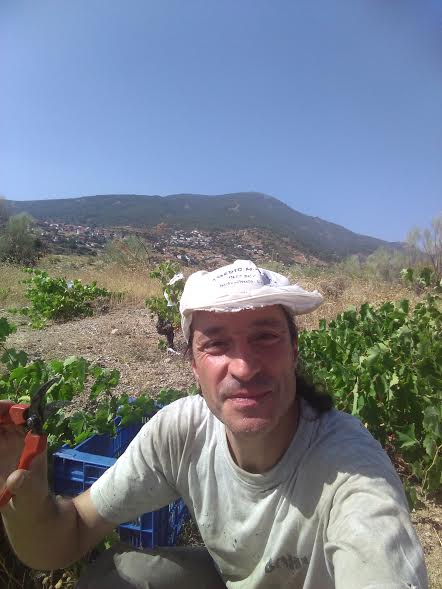
Close-up of me!

Top-down view of Albillo macerating on skins (destemmed)

Albillo juice flowing out of the press

Flamenco moment :)

Albillo juice in full fermentation

Slight overflow of Albillo fermentation foam

All nice and clean again

Rest and relaxation time under pergola structure in the patio of the bodega

Thursday, 4 February 2016

Sheep in the Garnacha Vineyard

Well, for this post I have some interesting anecdotes about sheep in my Garnacha vineyard in El Tiemblo (Sierra de Gredos).
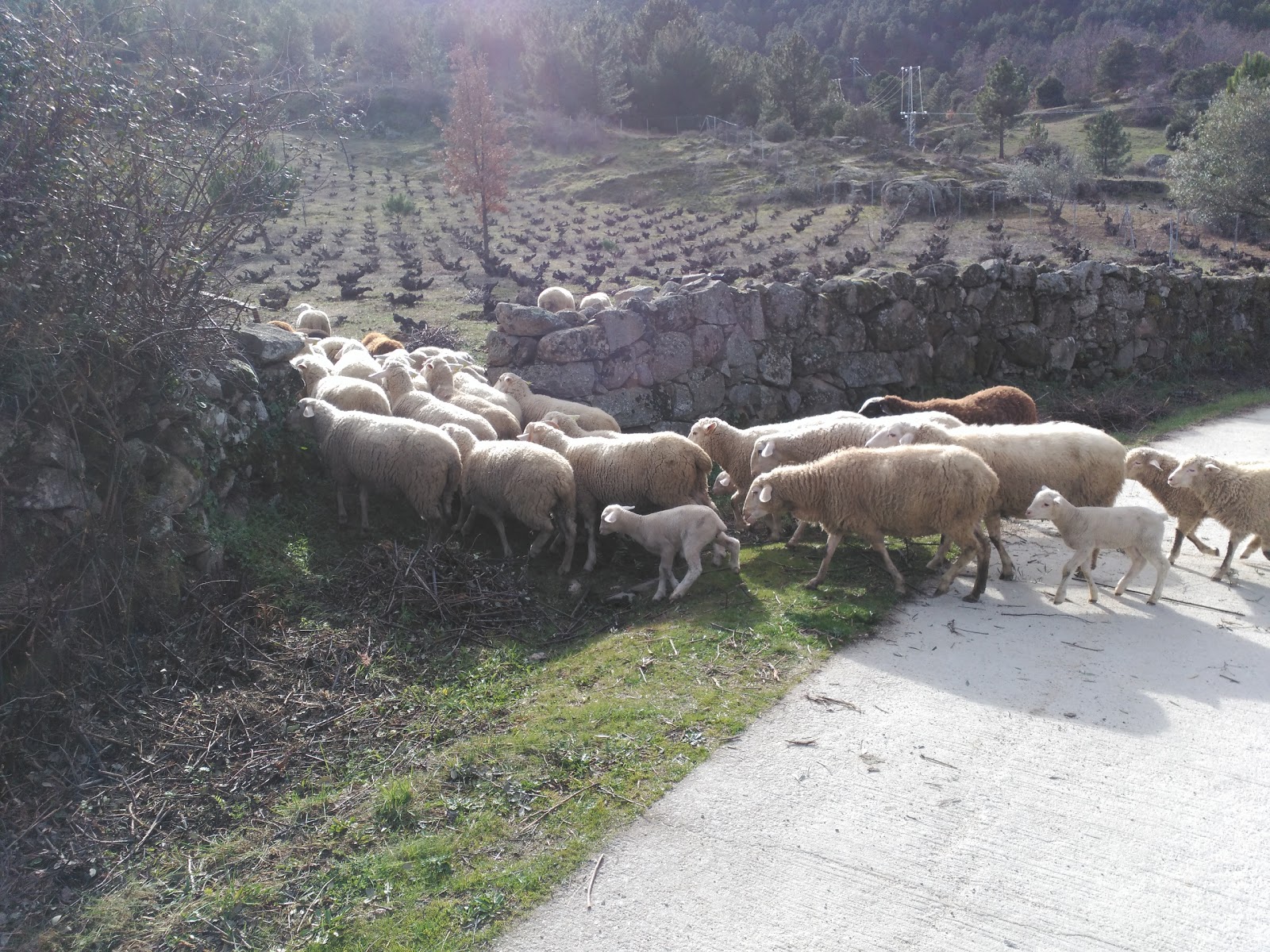
A flock of sheep entering the vineyard
But first...

This is the same vineyard that I wrote about in my previous post (here), when I discovered that ‘someone’ had pruned my ‘Roman’ vines which I had trained up the olive trees, without asking me first. So the other day I had a meeting with the owners of the vineyard and asked them if it was them who had dunnit – and indeed it was! I’m glad that I didn’t speak to them immediately on discovering the unauthorized pruning, because I was upset and angry and would probably have said things that I would have regretted later! But with the passage of time I had calmed down, and now of course it doesn’t seem so important. They were quite amazed when I explained the Roman thing to them, but they were willing to cooperate. Now I just have to wait another year for the vines to grow and try again.
Anyway, I was in this vineyard again the other day, doing more of the same – raking up last year’s dead grass into piles, pruning and hoeing up around the pruned vines. I alternated these three activities so that the same muscles wouldn’t get sore! The method seems to work J
And an ‘interesting thought’ came to me while I was raking up the dead leaves. At first, I had started raking up dead leaves and grass and tidying ‘just for fun’ and to do a bit of gardening and to make the vineyard look beautiful (and alternating tasks so my back muscles wouldn’t suffer so much). But now I’ve discovered a valid agricultural reason for doing this! By raking up the last year’s dead leaves, it makes it easier for the new grass and plants to come up, as there is no physical obstacle stopping their growth, more sunlight hits the earth and little leaves making germination and photosynthesis more efficient, and also the action of the rake on the ground probably helps stir things up and speed them along! I was actually a bit worried that maybe the grass, and plants and flowers would grow too much, to the detriment of the vines, perhaps. But the perfect solution presented itself spontaneously. Sometimes the universe works in your favour, and “they’re not really all out to get you”!
The perfect solution, of course, consisted of a flock of sheep! As I was working, a man called out to me from over the wall of the vineyard. He was a shepherd and he wanted to ask if he could let his sheep graze in my vineyard. I agreed immediately and off he went to get his sheep, which were grazing in a neighbouring vineyard just down the road.
Sheep grazing in the vineyard


Sheep and lambs


Panoramic view

The deal is that I get free manure and short grass and the shepherd gets free grass for his sheep.

Close-up of my free manure

And also, according to my friend and fellow grapegrower Mario Siragusa (who grows grapes in Barolo country near Turin), the sheep also impart positive electro-magnetic energy to the vines from their wool. Interesting theory - I will have to look into it when I have some free time.
This deal only works until about March, when the vines start to sprout. Otherwise the sheep would eat the young leaves.

Sheep leaving the vineyard

Luis the shepherd says that he only drinks wine from the vineyards where his sheep have been grazing! Because his sheep don’t like the grass from chemically farmed vineyards and because the wine tastes crap! Natural wine drinkers are everywhere these days J.
Other vineyard news
There is still a lot of pruning to be done, some of which I will do myself and some of which I will outsource to neighbours. Then there are other assorted tasks to be done too: removing canes, hoeing up around the vines, fixing fences, and general tidying up. I won’t bore you all too much with the details! Yet!
Bodega news
There are lots of tasks I have to be getting on with in the bodega too. Most urgent is the bottling up. I got off to a good start this year but last week I ran out of corks AND bottles! Duh! So now I have to wait for delivery, which takes about 7-10 days. Which is OK really, as I can now concentrate on the vineyards. I also have to fill two barrels with white wine. It took me about a year, but at last I managed to get my hands on two second-hand white wine barrels. They are incredibly difficult to find, for some reason. More about this later. I also have to thoroughly scrub and clean and disinfect two amphorae, which contained wine and which I have already bottled up. Then I have to press off a tank of Garnacha which is still on the skins! And a tinaja of SB and one of Doré. And lastly I have to tidy up the patio and finish building my pergola. Oh, where is all the free labour?
Other news
In about three weeks I’m going to a natural wine fair in Piacenza, Italy: Sorgente del Vino LIVE 2016. It will be my first time at a wine fair in Italy, so am especially looking forward to it. Attenzione importatori italiani J
And in about one month I’ll be going to another natural wine fair in Barcelona: Vins Nus (which means Naked Wines in Catalan). This is one of two natural wine fairs organized in Spain, which is pretty underwhelming really, considering the numbers for France and Italy.
Enough for now. “Salud y buen vino”. (that means ‘Health and good wine’, in Spanish)


Monday, 18 January 2016

In the Vineyard

January is already drawing to a close, and I'm focusing on three different aspects of my mini-wine-business: in the vineyards, pruning, removing the canes, hoeing up around the vines, and other miscellaneous activites like cutting grass, fixings drainage channels, and fences, and generally tidying up; in the bodega, bottling up older vintages from barrels, and filling said barrels with new vintages; and on the home front, writing a HACCP (pronounced "HAZOP"), ie a food safety management plan! Amongst other things. But enough of that! Here's my latest news from the mountains:

In the Vineyard

The other day I was in my other Garnacha vineyard in El Tiemblo (Sierra de Gredos), having completely finished pruning the first (rock rose infested) Granacha vineyard that I wrote about in my previous post. Actually, I still have to finish raking up pine needles and checking and fixing the perimiter fence, but those tasks I have relegated to a lower priority, to be done 'some other time'!

So I spent the whole day here in this vineyard, but in a terribly inefficient manner - I only did 5 rows of about 10 vines. But I did them absolutely beautifully! More like gardening, rather than agricultural labour! I did it this way for a few reasons:
1. The vineyard now looks really beautiful as seen from the gate, so that keeps the owner and neighbours off my back - no more comments on how bad the vineyard look, etc, etc!  I'm used to it by now and I pay no attention, but it's still annoying!
2. A whole day's exclusive pruning is sore on the back muscles, so it's better to do a whole range of different activities that use different muscles
3. It was great fun and immensely satisfying to make such a beautiful 'garden' in the vineyard!

Here's some photos:

Natural State
The photo above (Natural State) shows the vineyard in, errrm, its natural state at this time of year; except for the near foreground, the vines are unpruned and there's lots of dead grass from last year between the rows; and there's new grass growing already, which is quite strange, but not surprising given climate change and generally increasing temperatures. I've even heard news of grapevines budding already - but not in Gredos.


 First Rows
The photo above is of the first few rows of the vineyard as seen from the road. After pruning the vines, I then cut the long grass with a sickle, and then hoed up around around them. I think this is a good idea, as the vines will be able to benefit from 100% of the rain that falls on them, with no competition from the grass and plants. They don't actually need all that water to survive, as their roots are very deep and can find water that the short-rooted plant cannot; and they are hardy drought-resistant varieties anyway. But even so, a little extra competitive advantage won't do them any harm, what?

Then I even raked up all the dead grass between the rows! I don't think there's any good agricultural reason for doing that, but what the hell? I felt like doing it, and the result look quite nice, no? It will be interesting to see if there are any consequences. For example, all the new grass might grow better now that there are no dead leaves and grass in their way. Maybe this spring these first few rows will be overwhelmed by new grass? Has my intervention upset the balance? 

Close-up
Above is a close-up of a pruned vine and its immediate surroundings.


Worm
Above is a lovely worm, evidence of a living healthy and balanced soil. Worms aerate the soil via the tunnels they make, thus helping to protect it from erosion; and they also improve its quality by eating, digesting and exceting it! Go figure!

Healthy balanced soil is very important, because vines can extract from it all the nutrients they need, neither too much not too little, but the perfect amount of each nutrient and micro-nutrient. Industrial-chemically farmed vines produce unbalanced faulty grapes because the soil they live in is biologically dead - it's just a substance that holds the vines upright, and which has an excessive over-abundance of some nutrients and a complete lack of others. There's no way possible to make a complex, interesting, terroir-expressing wine with grapes from that quality of soil. (Enough ranting already - Ed.)

A piece of bad news and really annoying too, is that 'someone' (I'm guessing the owner) took it upon themselves to prune the vines that I had deliberately allowed to climb up the various trees growning in the vineyard. This was so I could make a tiny experimental batch of 'Roman' wine. I haven't spoken to the owner about it yet - I'm letting time pass so I won't be so upset and angry when I do bring the subject up.

The Romans had three systems of grapegrowing: trellised and bush vines which we inherited from them, and also a third method which consisted of letting the vines grow up trees, which we have lost today. Pliny and Columella write about it at length here and here, respectively.

I hope to finish pruning this vineyard soon and make a start on my third, newly acquired, Chelva vineyard here in El Tiemblo.

That just leaves the Carabaña (Airén/Tempranillo) and Villarejo (Malvar) vineyards, but they have interesting issues/complications, ... which is another story!

I've also done some work in the bodega and at my computer, but I'll leave that for another post and another day.

Tuesday, 23 June 2015

Winding down for the summer


Well, its late mid-June-ish, and all is well. More or less. The vineyards are beautiful (touch wood); the bodega is semi-prepared for the coming harvest; (touch wood); and the marketing and sales is going really well too (touch wood!).

Vineyards

I’m really happy with my vineyards. I've let all the grasses, flowers, thistles, etc grow all year, and now all I'm doing is cutting them all back around the vines, so that they will be easier to access during the harvest. The reason I do this, instead of ploughing, is of course to create a living soil and a living ecosystem, full of micro-life (bacteria and other invisible organisms) and visible life itself (insects and other small animals).

Flowery grassy vineyard, Garnacha, El Tiemblo, Sierra de Gredos

If the soil is rich and complex and alive, then the vines can take all the nutrients they from it. No more and no less, but just exactly what they need. The way I create this rich and complex and living soil is just to let everything grow, reproduce, die and decompose; and help the process along a little by cutting the grass and plants back with my sickle. I also keep the canes from the pruning and chop them up into tiny pieces.

At this time of year, dry grass and thistles!
Every few years I add some manure, which I bury near the vines. It's better to bury it because if you leave it on the surface all its nutrients are used by the surface grasses and it doesn't get down to where the vine's roots are.

By letting all the different species of grasses and plants grow, you create diverse and interesting habitats for many different species of insects; whereas if you plough up and keep the vineyard naked, then only one or two species can live there – precisely the ones that eat vine leaves and grapes! Obviously, because there's nothing else left to eat! So now you have to use chemicals to kill them because otherwise they'll destroy your vines and grapes!

This natural system, IMO, produces grapes of a much higher quality than industrially-chemically farmed grapes. The must of naturally farmed grapes is much more complex and interesting and contains a much wider range of components and micro-components; the bunches of industrially-chemically farmed grapes may be bigger and more impressive looking, but the must is diluted, unbalanced and poorer in diversity of flavours and aromas.

more grass
Each to their own. To produce millions of liters of 'affordable' supermarket wine at nice price points, it may well be necessary to pollute the environment and use lots of dodgy chemicals, but to produce small amounts of quality, terroir-expressing, comment-worthy fine wines, it's essential to practice sustainable, environmentally respectful and safe agriculture. IMO.

Next year I'm going to give my vines a fortifying booster, in the form of a horsetail infusion (Latin: Equisetum; Spanish: Cola de Caballo). It's been a few years since I last did this.
The other day I watered the 200 new Tempranillo vines that I planted back in April.

Bodega

The bodega is more or less under control too; it's just that there are lots and lots of minor loose ends to be tied up, but for which I never find the time.

For example:
- The patio outside
- Shopping for ‘stuff’: Hermetic lids, Boxes for harvesting, Crown cap machine, small bits n bobs
- Cleaning everything: steel tanks, tinajas, presses, crushers, floors, etc
- Bottling up some barricas
- Stick insulating panels back on doors
- Line a new tinaja with beeswax

Not much shade here - maybe next year!
I have to do all the above and more, but I have no time to do it all! So I have to prioritize and decide which tasks are more important, and which can be left till ‘later’. The main things are in fact done, ie most of the wines are sold, most of the bodega and equipment is clean and ready for the final pre-harvest thorough cleaning. I will just have to be philosophical and come to terms with the fact that there’s no way I can do everything and have everything ‘just so’ to my entire satisfaction. :)

Marketing and Sales (the unglamourous part)

No real complaints in this department either. One of my goals last year was to diversify my exports, instead of selling exclusively to JPS in the USA, and I’ve managed to achieve that. I now also export to Denmark, Belgium, France and the UK (see this page for details).

a nice big pallet of wine, almost ready to go
I also decided to try to sell in Spain too, but that is proving more difficult. I do sell regularly to three places in Madrid (Enoteca Barolo, SoloDeUva and Montia) and also sporadically to another few places. But I see two problems here: firstly there is a lot less demand for natural wines in Spain, it’s still very much a novelty, like it was back in the 80’s or 90’s in other parts of the world. And I have no desire to ‘evangelize’ or try to persuade to drink natural wines. My approach is “if anyone wants to buy my wines they are more than welcome to do so, but I’m not going to argue or justify.” That’s a completely different thing from providing information or answering questions, of course! Which I do, a lot!

The other difficulty with selling wines in Spain is that I don’t have the time, resources or skills required to be a distributor! I can only just manage those three places I mentioned above, and even then it takes me weeks to respond to orders! What I really need, I suspect, are some proper distributors! J

Winding Down

So, time to wind down and try to relax. The first thing I have to look forward to this summer is the H2O Natural Wine Festival, held in the village of Pinel de Brai (Tarragona).

Next up will be the Albillo harvest, at the beginning of August. (Albillo Real is a very early ripening variety!) Then there will be a respite of a few weeks, until the regular varieties become ready for harvesting all through September and October.

Before, during and after those two events I hope to hang out in Barga (Tuscany) my family’s home town, and apart from doing the usual odd-jobs about the house and garden, I hope to expand my knowledge of Italian wines at the local enoteca – Colordivino, set right in the centre of the old part of town :)

Sunday, 9 February 2014

Tasting and Pruning With Gabriel

I spent the other day (Sun 2nd Feb) pruning with Gabriel, my first ever "intern" who spontaneously volunteered to work for free in return for whatever I could teach him! Wow! I was honoured that anyone would want to do that. Lots of people have helped me in the vineyards for free over the years of course, but they were always people I already knew - family, friends, regular consumers of my wine, etc.

Gabriel tries his hand at pruning


On this occasion it was different, as I'd only met Gabriel (Sánchez Blocona) about 2 weeks ago at a tasting that we were at. As it happened, it was a tasting of the wines of Basilio Izquierdo, which would merit a whole post to itself, as there were some really incredible wines there. Including some really old ones (for me!) like a CVNE 1948 which is the oldest everest wine I've ever tasted in my life. But I won't go on about that - I've been getting paranoid lately about turning into a wine-bore! I think that's what happens when you read the Hosemaster of Wine!


Anyway, that was in the morning. After lunch (here) (which, btw, was the most expensive lunch I've ever paid for in my life, and where I witnessed for the first time a bottle of wine being opened with a pair of heated tongs!) we (Gabriel and I) decided to gate-crash another tasting in the evening.


This one was one of these wine-tasting clubs of friends who get together regularly to taste and comment on interesting wines. I knew a few of these friends (including Alfredo Maestro) so I figured that they wouldn't mind. As luck would have it they were doing a blind tasting, which I love, even though I never identify any of the wines.


The only clue we had was that all 6 bottles were non-Spanish. Incredibly, I was the only one who identified the country of provenance of 4 of them (Georgia)!  I think this was because no-one else there had tasted Georgian wines before, while I had - once, two years ago in London at RAW fair. Amazing! Then of course I had to explain that I'm not an expert or even experienced taster and that it was just luck that I remembered those wines. This is true, I'm a very inexperienced wine-taster, as the only tasting I ever do is of my own wines, and even then just checking for faults/off-tastes/strangeness/etc. I'm practicing though, and I try to get to whatever tastings I get invited to, time and tasks permitting!


Gabriel on the other hand is a wine-geek, an experienced taster, and collector of old rare wines. But he doesn't know much about grape-growing, vineyard work, pruning, etc. So, there was a win-win situation if ever there was one.

Now pruning is quite a skilled task, it's not just manual labour; so it's a bit of risk to just let anyone loose in your vineyard with a pair of pruning sheers! :)  A bit of a risk only in the sense that he/she might snip off a bit too much, or the wrong canes, and hence reduce the production of a few 'mutilated' vines!  I mean to say, it's not a catastrophy or a disaster. Vines can survive a lot worse than a crazy pruner :)  But in any case, why do it wrong, when it's so easy to do it right?

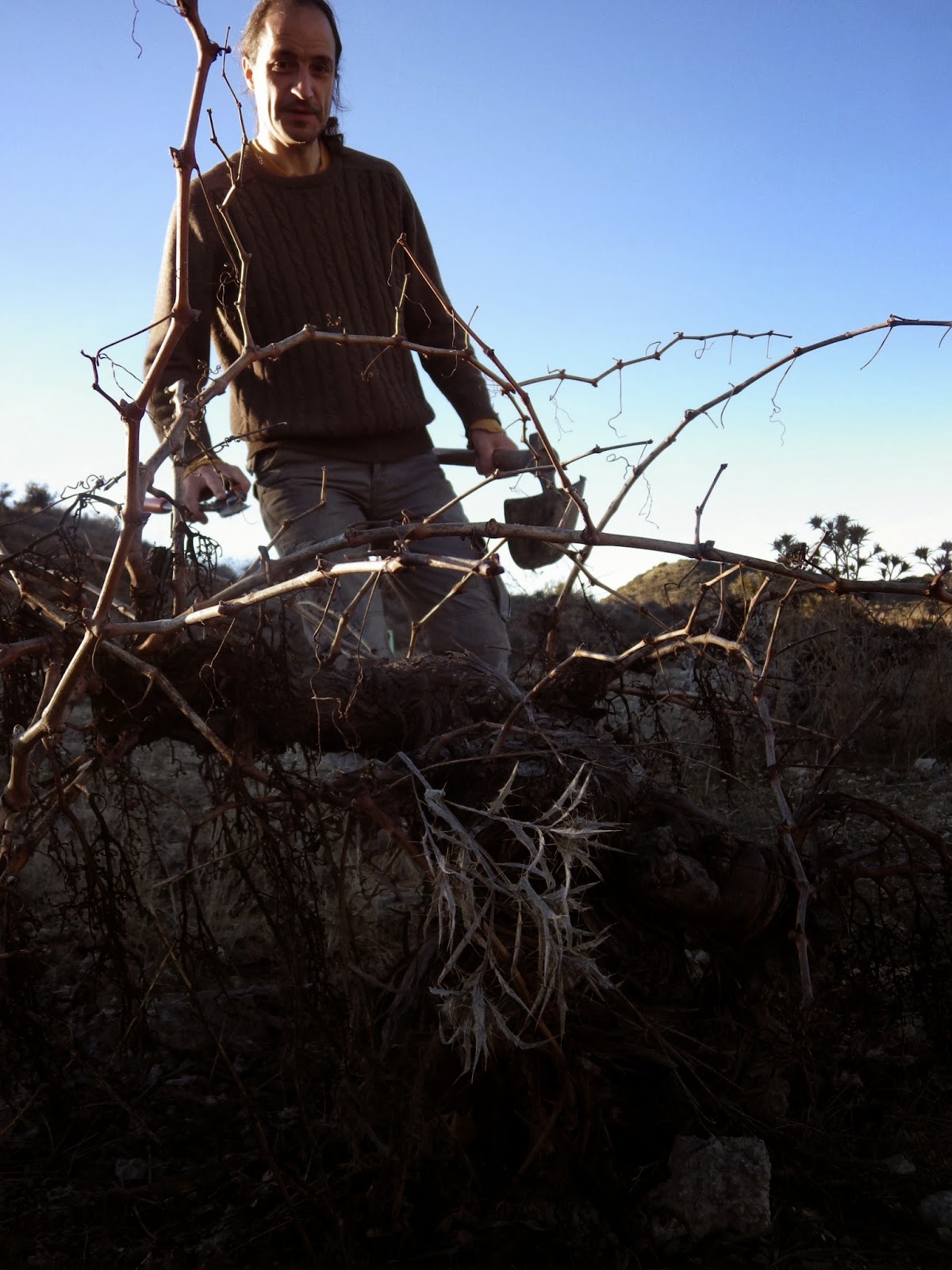
Here's me pruning a vine

So this is what we did: First he just followed me and watched, while I pruned and explained. But that gets boring after a while and the 'student' doesn't really learn anything new, after so much theory. So I sent him a vine ahead of me to do some pre-pruning. This entails snipping off all the obviously unwanted little canes, the canes growing from obviously wrong places and those growing in obviously wrong directions (all of which I explained beforehand).

Nice ladybird. Super-predator. Eats up all those nasty aphids

Contemplating ladybirds :)
 
I also got him to snip back all the remaining major canes but leaving 5 or 6 buttons. Then I myself would either prune these canes right back to the wood, or prune it to 1 or 2 buttons, as appropriate.

Those tasks that I set Gabriel to are very useful for getting to know those obviously useless canes, which can then just be snipped off without a second thought, and also for learning to handle the pruning shears, getting to know their weight and balance, how far they open, possible angles of entry, etc.

Nice earthworm. Sign of healthy living soil

His final task was to pick up all the snipped canes from where they fell and to put them in little piles in the middle of the lanes. Now that really is pure manual labour, but it saved me a lot of time :)  Come on, I had to do SOME brutal exploitation!  :)

Vine and thistle

The next time he comes out to help me, I'll teach him how to actually choose which canes to prune and keep, and which ones to prune right back to the wood. That is of course the most important piece of knowledge in pruning. How well you do that impacts not only the quantity of grapes that the vine will give you that year, but also long-term it will affect the health, vigour and longevity of that vine.

Ready, steady, prune!
Gabriel is also an awesome photographer, and he took all the photos in this post (except for the one of himself, obviously!).

His camara has also got this function that makes speedy videos. (For UK reader: think Benny Hill!) Check it out:


I'd be happy to teach anyone who wants to learn what I know. It's just a question of arranging to meet. Which is actually more difficult than it sounds because I usually don't know when I'm going to prune until a few days before! Anyway, feel free to contact me if you're interested.

Another really useful thing to do when short of time and you have thousands of vines to prune, is simply to temporarily duplicate yourself:


Me and my double ready to go
 After a hard day's work, our just reward:

In a bar, back in Madrid


Very pretty, but is it art?  ha ha!

Monday, 2 April 2012

Some Vineyard Photos and Comments


Yet more pruning today in the 'new' vineyard in Villarejo. New in the sense that that this is only the second year that we've been caring for it. The vines are actually about 20 years old (Malvar variety).

It's really slow going, as just about every vine has wild shoots growing out of the trunk from under ground level. I remembered to take some photos this time!

Wild shoots from below ground level
 This means that I have to dig down and expose the point where the shoots grow out the trunk and then cut them off. They're usually about 20 to 30 cm deep under ground level. It takes about 10 - 15 mins per vine.

More wild shoots

I only managed to prune about 40 vines today.

This is what the end result looks like, after excavating, cutting of the shoots, and filling in the hole:


Pruned and ready to go

I think the vines are running a bit late this year. The buds are only just starting to show the first signs of swelling, and absolutely none have opened.

And to finish off, our friends and super-predators - the ladybirds:

Ladybird on the landing pad

This photo is quite amazing. I caught it right at the moment of take-off! If only I had a higher quality mobile!

Ladybird taking off

Monday, 26 March 2012

Almost Finished Pruning


I finished pruning the vineyard in Carabaña over the weekend. This vineyard is planted to Airén and Tempranillo, all mixed up at random!

Vineyard in Carabaña all pruned

It's rather strange that the vines haven't started 'crying' yet. Usually around this time, the vines come out of their winter dormancy and the sap, stored in the roots and trunk, starts flowing. You can tell because it drips out of the cuts left by the pruning for a few days until the vines heals itself.

pending: photo vine crying from last year

I have a few theories:

1.As we're in the middle of a drought here in central Spain, maybe some self-defence / survival mechanism has kicked in and the vines are holding back the sap, or not sending it to the extremities?

2.Maybe they're just late this year. The buds haven't even started to swell yet

3.It's happened already, but I haven't noticed? Unlikely! surely I would have noticed!


Semi-wild roadside vines on the embankment

Another semi-wild vine
These vines are semi-wild! They're growing on the embankment beside the local road from Carabaña to Villarejo, which runs right next to the vineyard. Usually we pick these grapes only if we have time, and have the energy to scramble up the embankment through the undergrowth. So I thought this year I'd clear away the grass, etc, to make access easier. I also pruned the ones down low, but I just left the top ones to run wild(er) and see what happens.


Vineyard in Villarejo, last year

Anyways, now onto our other vineyard in Villarejo. We actually started, last week, but we only did about 100 vines. Another 400 or 500 to go. This vineyard is planted to Malvar.

We have an added complication in this vineyard. For some reason, almost all the vines have shoots coming out of the trunk from below ground level. (Sorry, I have no photos - will remember next time). So the quick-n-dirty solution would be just to quickly snip them off at ground level. But they would probably sprout again over the spring/summer, taming energy and nutrients away from the productive shoots up top, and making access difficult, and creating humidity by blocking the wind and sun! What we really should do (and what we've in fact done so far for the first 100 vines) is to dig down, expose the roots, and snip them right at the base where they grow from. That way they shouldn't grow back.

This takes about 10 minutes per vine, more or less, two people (one digging, one snipping). Which means 6 vines/hour, which means 50-60 vines/day, which means 8/10 days. Hmmm, maybe doable, maybe not. We'll just have to wait and see how it goes.

Wednesday, 18 January 2012

Pruning, Pesticides ... and Natural Wine Dogmas

Vineyards

We've gotten off to a good start with the pruning this year. We started right after New Year and have finished the small upper plot of the Carabaña vineyard - about 250 vines (all white Airén variety). It took so long to do because apart from the actual pruning, we also hoed up the earth around each vine to remove the grass and plants and to aerate the soil a bit.

Panoramic view of the small top plot in Carabaña
We don't plough up the vineyard between the rows like all our neighbours do - instead we let all the grasses, plants, flowers and thistles grow, and we just cut them back once or twice a year when they get too high. We also leave the canes from the pruning and chop them up into little pieces; and all this organic matter returns to the soil, improving its structure and fertility.

Close-up of vine before pruning it
This way of doing things has its advantages and disadvantages. The main disadvantage, I think, is the competition for water and nutrients from the grasses and plants. But, on the other hand, grass and plants have relatively small short roots, while vines have very long deep ones, as well as surface roots, and they seem to manage fine; also the vines we have, Airén and Tempranillo, are well suited to the climate and don't need a lot of water.

Close-up of vine after pruning it
The main reason for leaving all the grasses and plants is to provide a habitat for insects that all predate on each other, so no one species ever becomes a problem and attacks the vines or grapes. We've never used any pesticides in all the years (9) that we've been cultivating the vineyard.

Fabio hoeing up the soil around the vines
Yet another reason for not ploughing is that there will never be any residues of pesticides on the grapes or in the wine. I understand, from reading reports and articles, that all conventional wines made from non-organic grapes have traces of pesticides in them. Some people say that these residues are insignificant and harmless, but I have my doubts. I think that, like in many other issues, once you have the actual real facts and hard data available to you, it still boils down to a question of belief!

Fog in the vineyard in the morning
In this case, the facts are:
- There are traces of pesticides in wine
- Experts tell us that the quantities are insignificant and safe for human consumption

BUT, here are a number of doubts (or 'beliefs' if you prefer) that are important enough for me not to use pesticides:

Lovely earthworm - sign of a healthy living soil :)
1. It's happened often enough in the past that a chemical or substance has been banned at a certain point in time, because it was discovered that it wasn't safe after all! I believe that the same could happen this year or next with any product that is currently permitted. I also believe that this is because the authorities pay more attention to corporate lobbies than they do to consumer/safety lobbies.

2. These products may well be safe for human consumption, but what about the runoffs that go into the soil, underground aquifers and rivers? I don't think they're safe for micro-organisms, flora and fauna, or for the environment in general. It's also a fact that the world's pollution problem is caused by industry and agriculture.

3. Even though each individual pesticide may be considered harmless and safe for human consumption, what about the 'cocktail effect' of many pesticides combined. There are no studies showing that they're safe in combination with each other.

Tools of the day - hoe (or is it an adze?), gloves and pruning shears
Anyway, 250 vines down, 1000 to go - in Carabaña. Then we have about 3000 vines in Villarejo (Malvar variety) to prune too. The deadline is around March when the vines wake up from their winter dormancy and the sap starts flowing. It's not a good idea to prune after that happens, because you'd be removing valuable nutrients from the vine. The same applies if you start pruning too early, ie before the vines go into dormancy around November/December.


Rabbit droppings - at least they left something nice behind
 after eating 20% of our grapes!

Bodega

Not much happening in the bodega these days. Just checking and tasting the wines to see that they're coming along OK. Basically, they just sitting there and the cold of winter which helps them to settle down. The most pressing task at the moment is to do some bottling. We have several wines in oak barrels that need to be bottled, otherwise the oak will dominate too much.

Crates of recycled de-labelled wine-bottles, ready for washing
The other day I soaked and delabelled about 100 bottles. Sinse the harvest back in September, we've managed to delabel about 1000 bottles; now we need to wash them and fill them.

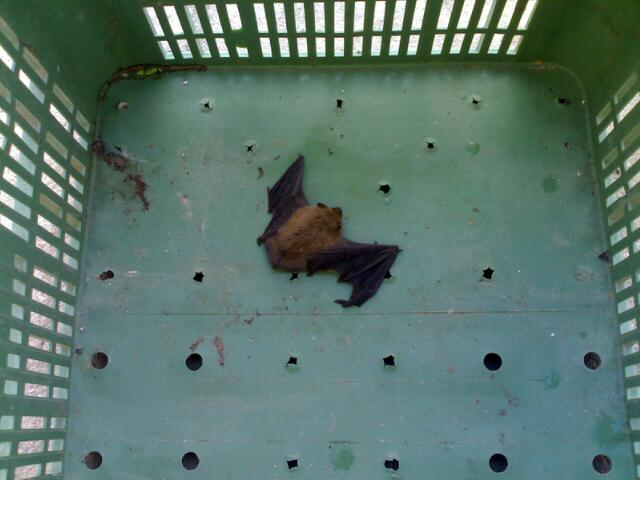
Poor bat
I found this poor bat lying at the bottom of an empty crate. No idea what could have happened. They usually fly around at night in the patio of the bodega, and inside the bodega itself too, snapping up insects. This is especially useful during fermentation when myriads of tiny fruit-flies appear.


Promotion/Social

Not much happening on this front either in general, though there have been two very interesting events recently. The first was our annual Vinos Ambiz tasting where we presented our new 2011 wines and a couple of older ones too (see this post). This year it was on 16th December and held at CSO Casablanca, an 'occupied' (ie squatted) social centre in Madrid. Unfortunately, I forgot to take photos until the very end, and no-one who was there has sent me any that I can use :(  That'll teach me!

The second event was a lunch last Sunday with some wine-people at Los Asturianos restaurant in Madrid. It started off being just a tasting of my new wines between me and my US importer, José Pastor, but as time went by (and Spain being Spain!), things escalated and complicated themselves and in the end there were 7 of us with over 40 wines to taste!!! We were: José Pastor (US natural wine importer), Victor de la Serna (Spanish journalist and winemaker), Alice Feiring (US natural wine writer), Alfredo Maestro (Spanish natural winemaker), Richard van Oorschot (Dutch wine aficcionado), Nacho Bueno (Spanish wine aficionado). And these were the wines:

- Niepoort-Navazos 2009 Palomino Fino (Non-DO)
- Equipo Navazos La Bota de Manzanilla Num.32 (DO Jérez y Manzanilla)
- Ximénez-Spínola Exceptional Harvest 2010 (Non-DO)

- Vinos Ambiz 2011 Airén (Non-DO)
- Lovamor 2011 Alfredo Maestro (VT Castilla)
- Vinos Ambiz Malvar 2011 Carbonic Maceration

- Albariño de Fefiñanes III Año 2007 (DO Rías Baixas)
- Reto 2010 Ponce (DO Manchuela)
- Níspero 2009 Eufrosina Pérez Rodríguez
- Picarana 2010 Marañones (DO Vinos de Madrid)

- Picos de Cabariezo 2010 (VT Liébana)
- Ganko 2009 Olivier Rivièr (DOC Rioja)
- Finca Sandoval Signo Garnacha 2009 (DO Manchuela)
- El Puño 2007 El Escocés Volante (DO Calatayud)
- Vinos Ambiz Garnacha 2010
- Vinos Ambiz Coupage 2010 (Tempranillo Graciano Sirah)

- Ultreia 2008 Raúl Pérez (DO Bierzo)
- Tilenus Pieros 2002 Bodegas estefanía (DO Bierzo)
- Finca Sandoval Signo Bobal 2008 (DO Manchuela)
- Ponce PF 2009 (DO Manchuela)
- Alfynal 2009 Bruno Prats (DO Alicante)

- Casa Castillo Pie Franco 2006 (DO Jumilla)
- Tres Patas 2007, Bodegas Canopy (DO Méntrida)
- Malpaso, Bodegas Canopy (DO Méntrida)
- Guimaro
- Jarrarte Maceración Carbónica (DOC Rioja)

Apart from the above wines (as if they weren't enough!) Alfredo brought these:

Lovamor 2011
Amanda 2011
Viña Almate 2011
Garnacha 2011
Garnacha 2010
Viña Almate 2010.
Viña Almate LA OLMERA 2009
Viña Almate LA GUINDALERA 2009
Tinto Castrillo de Duero 2009
Gran Fausto 2003

and José brought these:

<pending>

I have to say that it was too much for me. I loved all of them, but I didn't have enough time to savour them and talk about them. I was surrounded by experts who could do 2 wines in about 5 minutes (we tasted them in pairs). So I'm not going to post any tasing notes here, firstly because I didn't take any (!), secondly because I'm sure the other 'comensales' will post some comments, and they're all more experienced tasters than me. The only ones I managed to savour were a few unfinished bottles that I stuffed into my rucksack as we left the restaurant, which I thoroughly enjoyed over lunch and dinner at home on Monday and Tuesday :)

I was also looking forward to a nice chat about natural wines, but that didn't happen either :(   Too many people, too many wines, too many conversations going on at the same time. But hey, I'm not complaining - I really appreciated the chance to taste so many quality Spanish wines, at the same time, and surrounded by such knowledgeable people. Quite a lot of corners of Spain were represented at our table that day!

Sorry, I forgot to take photos!
 
Creative Commons License
This work is licensed under a Creative Commons Attribution-Share Alike 3.0 Unported License.